JPO finds “CLUB MOET KYOTO” and “Moët & Chandon” likely to cause confusion

The Opposition Board of the Japan Patent Office (JPO) sided with MHCS, the producer, inter alia, of the famous Moët & Chandon champagne, and decided to cancel trademark registration no. 6030384 for word mark “CLUB MOET KYOTO” due to a likelihood of confusion with “Moët & Chandon”.

CLUB MOET KYOTO

Opposed mark, a word mark “CLUB MOET KYOTO” written in standard character, was filed on November 14, 2017 by designating restaurant service of class 43 in the name of a Japanese business entity having its principal place of business at Kyoto. It appears the applicant owns hostess bar and opposed mark is actually used as a name of the bar. See here.

Immediately after filing the application, applicant requested the JPO to accelerate examination of opposed mark. In accordance with the request, the JPO rushed to a decision and admitted registration on March 23, 2018.

MHCS – OPPOSITION

MHCS, as a holder of the Japanese trademark “MOET”, sought to retroactively cancel the registration of opposed mark, on the grounds that the mark was likely to cause confusion with “Moët & Chandon” when used on restaurant service in class 43 under Article 4(1)(xv) of the Japan Trademark Law.

Likelihood of confusion is a key criteria when assessing the similarity of trademarks. To establish whether there is likelihood of confusion, the visual, phonetic and conceptual similarity will be assessed as well as the goods and/or services involved. This assessment is based on the overall impression given by those marks, account being taken, in particular, of their distinctive and dominant components. A low degree of similarity between the goods or services may be offset by a high degree of similarity between the marks, and vice versa.

MHCS argued that a term “MOET” of opposed mark shall playa a dominant role as a source indicator since both “CLUB” and “KYOTO” are devoid of distinctive character in relation to restaurant service. If so, relevant consumers may misconceive “Moët & Chandon” from opposed mark when used on the service in question by taking its prestigious reputation of “Moët” as an abbreviation of world-famous champagne into consideration.

OPPOSITION DECISION

The JPO Opposition Board decided in favor of MHCS, finding that both “Moët & Chandon” and its abbreviation “Moët” have acquired substantial reputation as a top ranking champagne brand distributed by MHCS. It is unlikely that relevant consumers would conceive “Moët” as a surname of foreigners. If so, the term is anything but a dictionary word, rather a coined word. Besides, both marks are confusingly similar, due to visual, phonetic and conceptual similarities, since the literal elements “CLUB” and “KYOTO” of opposed mark are devoid of distinctive character in relation to the service in question, as well as close association between champagne and restaurant service for which protection was sought based on the fact that MHCS once opened restaurant in the year 2014.

Based on the above considerations, the Opposition Board cancelled trademark registration of opposed mark in its entirety, finding there to be likelihood of confusion between “Moët & Chandon” and the trademark applied for.
[Opposition case no. 2018-900152, Gazette issued date: October 25, 2019]
HUGO BOSS fails in attempt to block trademark registration

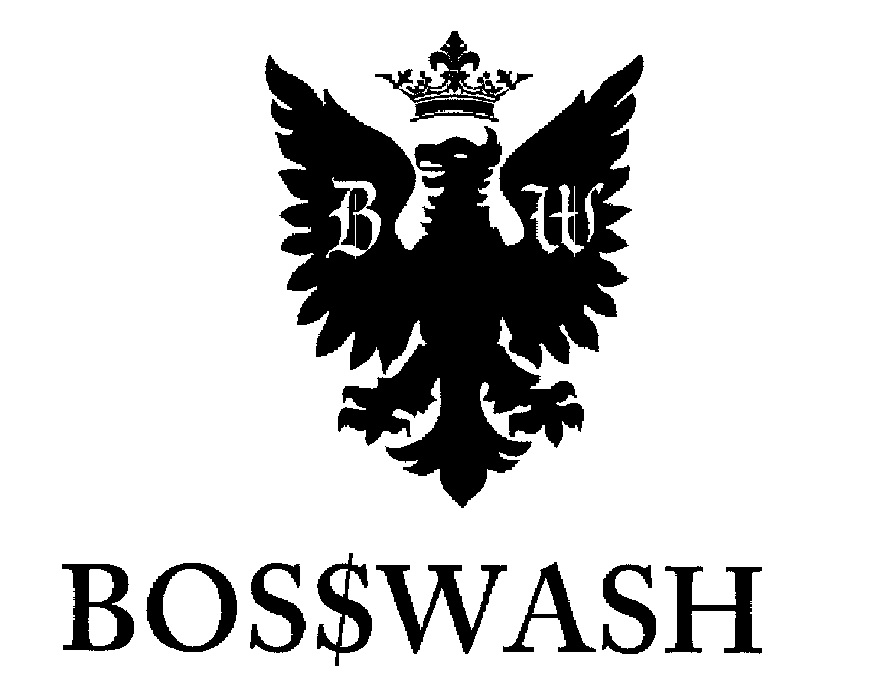
German luxury fashion house Hugo Boss has failed in their attempt to stop the registration of a composite mark consisting of “BOSSWASH” and a spread-eagle device at the Japan Patent Office (JPO).
[Opposition case no. 2017-900382, Gazette issue date: October 25, 2019]
Opposed mark

Opposed mark, filed in April 2017, consists of the literal element “BOSSWASH” and a spread-eagle in black with crown over its head, a letter “B” on its right wing and “W” on left wing (see below).

The application was for bags and pouches in class 18 and published for registration (TM Registration no. 5985092) by the JPO on October 24, 2017.

Opposition by Hugo Boss

To oppose against registration within a statutory period of two months counting from the publication date, HUGO BOSS Trademark Management GmbH & Co KG filed an opposition on December 20, 2017.

Hugo Boss’s opposition to stop the registration was based on claims that the “BOSSWASH” mark could be similar to or confused with sixteen of their earlier trademarks (#2190696, #3236870, IR746972, IR754225, IR773035, IR782587, IR827260, IR827261, IR831750, IR952458, IR964946, IR1023719, IR1055000, IR1058629, IR1072604, IR1263822), which prominently contain the term “BOSS”.

Board Decision

In the decision, the JPO found that, given the literal portion of opposed mark “BOSSWSH” shall be inseparable and perceived in its entirety, opposed mark and Hugo Boss’s trademarks were sufficiently distinguishable in visual, phonetic and conceptual points of view.

To my surprise, the Opposition Board of JPO admitted a high degree of popularity and reputation of “HUGH BOSS” as a trade name of opponent, however, it denied popularity of Hugo Boss’s trademarks, stating that produced materials are insufficient and non-objective to demonstrate substantial use and famousness of the cited marks.

Based on the foregoing, the JPO concluded it is unlikely that consumers confuse or misconceive a source of the opposed mark with Hugo Boss and dismissed the opposition totally.

Adidas scores win against adidog in trademark dispute

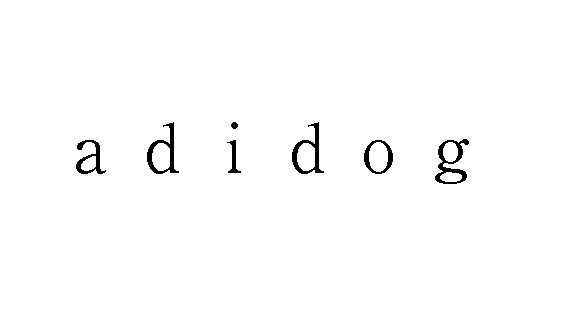
The Opposition Board of Japan Patent Office (JPO) decided in favor of Adidas AG to retroactively cancel trademark registration no. 5990777 for word mark “adidog” (Opposed mark) due to a likelihood of confusion with “adidas”.
[Opposition case no. 2018-900019, Gazette issued on August 30, 2019]

Opposed mark

Opposed mark “adidog”, a word mark in standard character, was filed on October 17, 2016 by an individual, designating clothing for pets in class 18 and published for registration on November 21, 2017 without confronting with office action from the JPO examiner.

TRADEMARK OPPOSITION – Article 4(1)(xv)

On January 16, 2018, before the lapse of a two-months opposition period, Adidas AG filed an opposition to opposed mark. In the opposition, Adidas AG contended opposed mark shall be cancelled based on Article 4(1)(xv) of the Japan Trademark Law.

Article 4(1)(xv) prohibits to register a trademark which is likely to cause confusion with a business of other entity.

Adidas AG argued opposed mark is likely to cause confusion with Adidas’ renowned trade name “adidas”, which enjoyed a high degree of reputation as a source indicator of Adidas sportswear and sports shoes both in Japan and abroad, because of visual resemblance between and opposed mark “adidog”, and close relatedness/proximity of goods in question.

Opposition Board decision

The Board found that:

  1. It is unquestionable that trade name “Adidas” has acquired a remarkable degree of reputation well before the filing date of opposed mark as a result of continuous use on sportswear and marketing activities in Japan since 1971.
  2. “Adidas”, coined after the name of opponent’s founder ‘Adi Dassler’, is an invented word with no dictionary and other known meaning. Besides, the Board could not find any words starting with ‘adid’ in language dictionaries of English, French, German and Italian as well as registered trademarks with the prefix ‘adid’ in Japan other than opponent mark.
  3. Opposed mark, consisting of six alphabets, starts with ‘adid’. In the meantime, stylized 5th letter ‘a’ of opponent mark looks like a device combining a short vertical bar with ‘o’. The final letter ‘s’ gives rise to a similar impression with ‘g’ since both letters have the same way of writing and configuration with a digit – ‘8’. Thus, opposed mark shall be deemed similar to “adidas” from appearance and sound.
  4. Clothing for pets is one of fashion items consumed by general public. Sportswear is also consumed by general public not only for exercise use but also fashion items. It becomes apparent that distributors of sports gears, apparels, bags, and shoes also deal with clothing for pets nowadays. If so, both goods shall be closely related.

Based on the above findings, the Board concluded that consumers who are accustomed to the circumstance, are likely to confuse clothing for pets using opposed mark with Adidas’ famous trade name “adidas” or misconceive a source from any entity systematically or economically connected with Adidas AG. Thus, opposed mark shall be cancelled in violation of Article 4(1)(xv) of the Trademark Law.

Trademark Dispute Over Cigarette Sub-Brand “SIGNATURE”

In a decision dated September 12, 2019, the Japan IP High Court affirmed the Japan Patent Office’s (JPO) determination to refuse registration for the STATE EXPRESS 555 “SIGNATURE” cigarette package design due to a conflict with senior Trademark Registration No. 4658792 for word mark “SIGNATURE”.
[Court case no. Heisei31(Gyo-ke)10020]

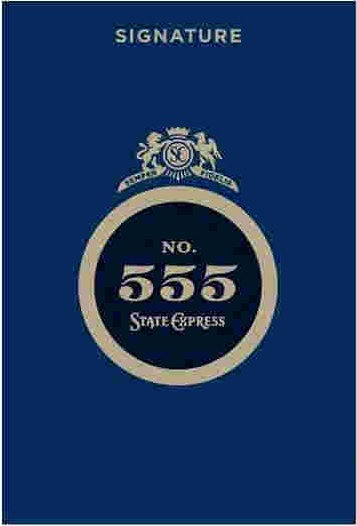
STATE EXPRESS 555 “SIGNATURE” cigarette package design

CTBAT International Company Limited, a joint investment of subsidiaries of China National Tobacco Corporation and British American Tobacco and incorporated in Hong Kong, filed a trademark application for device mark representing cigarette package design (see below) by designating cigarette, tobacco, electronic cigarette and others in class 34 on November 28, 2016 (TM application No. 2016-134074).

It the center, “No. 555 STATE EXPRESS” is written in three lines inside a circle. “SIGNATURE” is written independently on the upper side of the design.

Senior trademark “SIGNATURE”

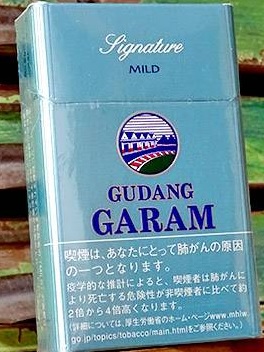
The JPO examiner refused registration by citing a senior Trademark Registration No. 4658792 for word mark “SIGNATURE” in standard character overt the goods of cigarette in class 34 owned by PT Gudang Garam TBK, one of Indonesia’s leading cigarette manufacturers, best known for its kretek clove cigarettes, headquartered in Kediri, Indonesia, which was acquired by Philip Morris in 2005.

PT Gudang Garam TBK has used the registered mark as a cigarette sub-brand of Gudang Garam.

CTBAT filed an appeal against the JPO examiner’s refusal and argued dissimilarity between the marks, but in vain. [Appeal case no. 2018-002007]
Subsequently, CTBAT appealed to the IP High Court and demanded cancellation of the administrative decision to refuse registration for plaintiff’s mark.

Qualitative description

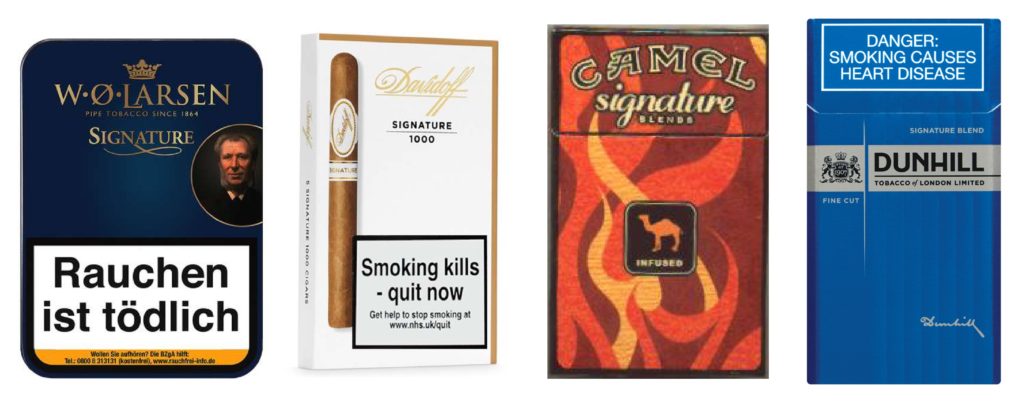
CTBAT argued the term ‘SIGNATURE’ lacks distinctiveness in relation to cigarette because several cigarette manufacturers, e.g. Dunhill, Camel, Davidoff, W.O.Larsen, have been using it as a qualitative term to indicate the cigarette has a specific feature of symbolic brand.

Besides, plaintiff’s mark contains distinctive terms, “No. 555 STATE EXPRESS”, which has acquired a certain degree of popularity of the cigarette brand through substantial use for more than 100 years. If so, it is unlikely that relevant consumers and traders would recognize the term “SIGNATURE” on the upper side as a source indicator in itself.

IP High Court Ruling

The court dismissed the allegation entirely, by stating that:

  1. From overall appearance of plaintiff’s mark, the term “SIGNATURE” shall not be perceived to combine with other figurative and literal elements.
  2. From the produced evidences, it is unclear if “No. 555 STATE EXPRESS” and “555” has acquired a certain degree of popularity because the cigarette brand has never been distributed in Japan so far.
  3. It is questionable that relevant Japanese consumers fully understand the term “SIGNATURE” and associated words, “Signature model”, “Signature Blends” have a qualitative or descriptive meaning in connection with cigarette.
  4. It has been often seen that a sub-brand is used on cigarette package separable from its main brand.
  5. The court finds the cited mark is used as a source indicator (sub-brand) on its cigarette package as well.
  6. Given the term “SIGNATURE” does not inseparably combine with other elements of plaintiff’s mark, it shall be permissible to cut out the portion and assess similarity of both marks based on the portion as long as it does meet with trade practice.

Based on the foregoing, the IP High Court sided with the JPO and upheld the refusal decision.

PUMA’s Fight Against Logo Parody

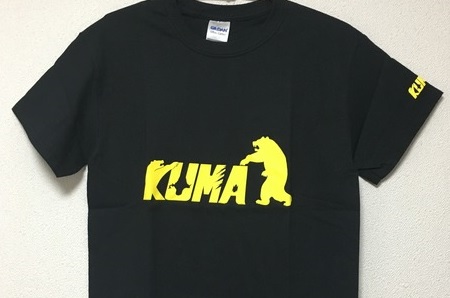
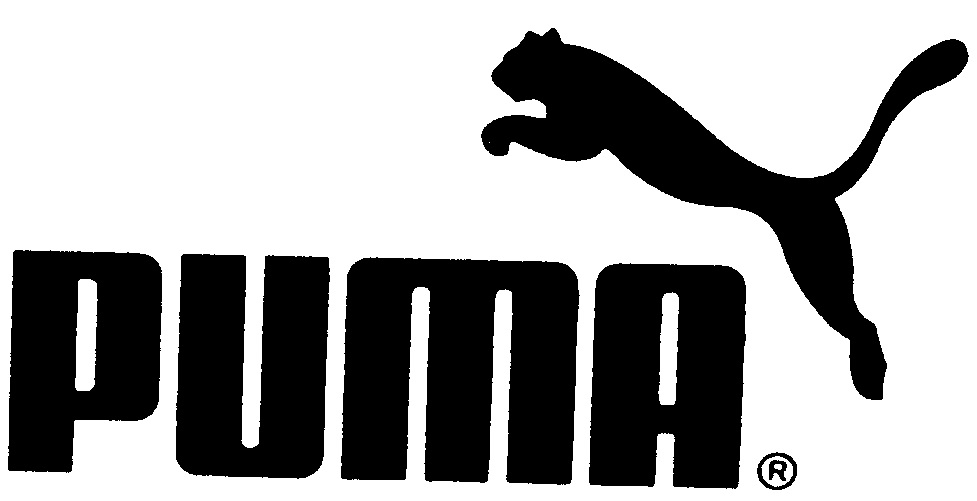
On August 1, 2019, the Japan Patent Office (JPO) decided to invalidate trademark registration no. 5861923 for composite mark consisting of a word “KUMA”, which means ‘bear’ in Japanese, and the bear device by finding a likelihood of confusion with a world-renowned sports brand, PUMA and detrimental effect to public policy or morality.
[Invalidation case no. 2019-890001]

KUMA device mark

Disputed mark (see below) was filed on January 7, 2016 by a Japanese business entity in Hokkaido, Japan’s most northerly main island, an otherworldly volcanic land with eastern Asia’s highest concentration of brown bears, over various goods in class 25 including sportswear and shoes.

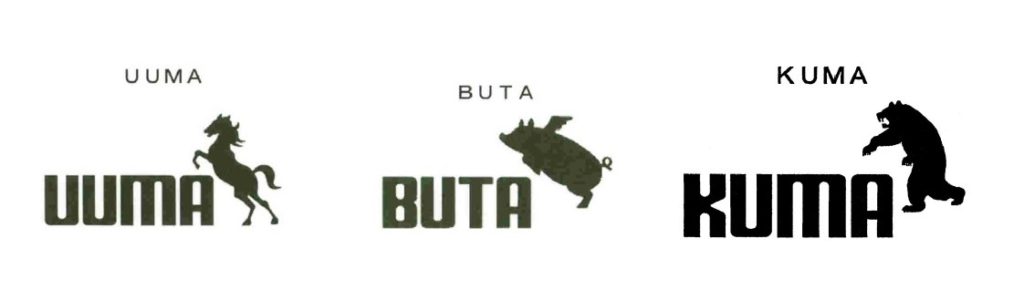
Precedently, applicant applied for registration of following trademarks, consist of four alphabets in bold font and an animal silhouette facing left depicted in the upper right of the alphabets, on goods in classes 9, 14, 16, 24, 25 and 28, but in vain.

“UUMA” means ‘horse’, “BUTA” means ‘pig’, “KUMA” means ‘bear’ in Japanese. It is obvious that both literal element and figurative element of respective mark give rise to a same meaning, which is the same for PUMA.

It is likely the applicant intended to use these marks on souvenirs from Hokkaido since we get accustomed to see scenes at a famous tourist spot that T-shirts and other small items displayed at gift shops parody famous brands by featuring local specialty to attract tourists for fun.

PUMA’s Opposition / Invalidation Trial

On September 26, 2016, PUMA SE filed an opposition against the KUMA mark based on Article 4(1)(vii) and 4(1)(xv) of the Trademark Law. PUMA argued relevant consumers or traders are likely to confuse or misconceive a source of disputed mark with PUMA when used on designated goods in class 25 because of a high reputation and close resemblance between PUMA logo and the KUMA mark.

The Opposition Board admitted a high degree of popularity and reputation of PUMA logo, however, the Board dismissed the opposition entirely due to unlikelihood of confusion as a result of low degree of similarity between the marks (Opposition case no. 2016-900308).

Subsequently, PUMA SE entrusted the case to MARKS IP LAW FIRM. On New Year’s Eve of 2018, MARKS IP LAW FIRM on behalf of PUMA SE requested for an invalidation trial and sought to annul the KUMA mark on the same grounds.

Invalidation Decision

The Invalidation Board reversed the opposition decision and decided in favor of PUMA by finding that:

  1. PUMA logo has been continuously famous as a source indicator of PUMA in connection with sports shoes, sportswear and others among relevant consumers and traders in Japan.
  2. Configuration of PUMA logo looks unique, creative, and impressive in itself.
  3. Regardless of visual difference in detail between the marks, overall impression of both marks is quite similar.
  4. Given close association between designated goods in class 25 and PUMA business, relevant consumers of the goods with an ordinary care are likely to confuse its source with PUMA
  5. Besides, it is presumed the current registrant of disputed mark was knowingly assigned a similar KUMA mark that applicant had a fraudulent intent to free-ride and dilute PUMA’s goodwill.
  6. If so, current registrant must have filed disputed mark with a fraudulent intention to dilute or do harm to PUMA’s goodwill given a close resemblance of between disputed mark and a rejected KUMA mark (see above right).

Based on the foregoing, the JPO decided to invalidate disputed marks based on Article 4(1)(xv) as well as 4(1)(vii) of the Japan Trademark Law.

SISLEY lose trademark opposition over SOIR DE LUNE

In a recent trademark opposition, the Opposition Board of the Japan Patent Office (JPO) held a junior trademark registration no. 6041076 for word mark “LunaSoir” is dissimilar to a senior IR registration no. 845029 for word mark “SOIR DE LUNE”, one of fragrance brands by SISLEY, a French producer of cosmetics and fragrances, even when used on fragrance in class 3
[Opposition case no. 2018-900194, Gazette issue date: July 26, 2019]

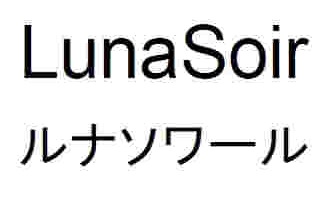
LunaSoir

Opposed mark (see below) was applied for registration on July 31, 2017 by designating soaps, perfumery, cosmetics and others in class, and published for registration on June 5, 2018 without any office action from the JPO examiner.

SISLEY – SOIR DE LUNE

Opponent, SISLEY, a French producer of cosmetics and fragrances, claimed that the opposed mark “LunaSoir” shall be cancelled under Article 4(1)(xi) of the Japan Trademark Law by citing a senior trademark registration for word mark “SOIR DE LUNE”covering soaps, perfumery, essential oils, cosmetics, hair lotions, dentifrices in class 3.

Article 4(1)(xi) is a provision to prohibit from registering a junior mark which is deemed identical with, or similar to, any senior registered mark.

SISLEY argued both marks give rise to a same meaning of “moon night” given “Luna” and “LUNE mean “moon” in Latin and French respectively, “SOIR” means “night” in French, and “DE” corresponds to “of” in English. If so, both marks are likely to cause confusion from a conceptual point of view.

Board Decision

In the decision, the Board decided that “LunaSoir” and “SOIR DE LUNA” are both dissimilar in appearance, pronunciation as well as concept.

The Board assessed, by taking into consideration a relatively low level of knowledge to Latin and French language among relevant consumers with an ordinary care, opposed mark consisting of “Luna” and “Soir” would not give rise to any specific meaning at all.
Based on the fact finding, the Board concluded that opposed mark “LunaSoir” is obviously dissimilar to SISLEY’s fragrance brand “SOIR DE LUNE” from concept, needless to say appearance and pronunciation.

It is noteworthy to a brand owner from non-English speaking nations that conceptual similarity would not play a defensive role to prevent free-riding and enjoy a broader scope of protection against use by others where the brand contains a non-English term unfamiliar to Japanese.

Patagonia Victorious in Trademark Battle

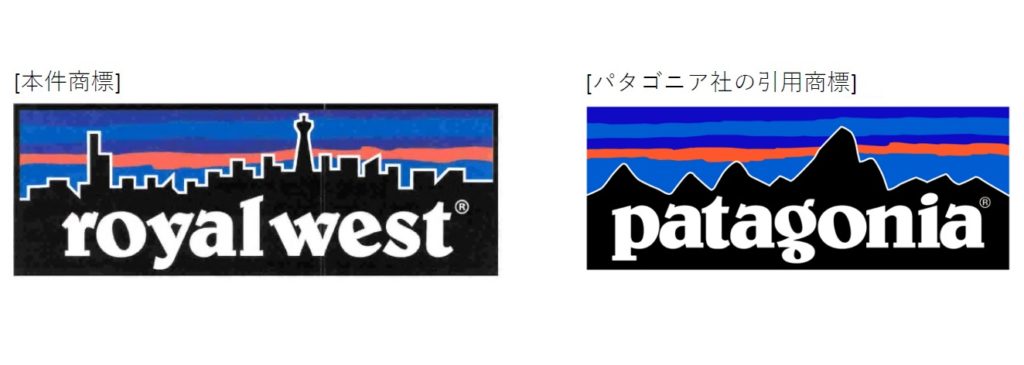
The Trial Board of Japan Patent Office (JPO) recently upheld an invalidation petition by US outdoor apparel company, Patagonia Inc. against TM Reg. no. 6028801 for the “royalwest” mark in combination with figurative elements due to a likelihood of confusion with Patagonia logo.
[Invalidation case no. 2018-890048, Gazette issue date: June 28, 2019]

TM Registration no.6028801

Disputed mark, consisting of a word “royalwest” and figurative elements (see below left), was applied for registration on April 13, 2017 in respect of apparels and other goods in class 25.

Without confronting with a refusal during substantive examination, disputed mark was registered on March 23, 2018.

Petition for invalidation

Japan Trademark Law provides a provision to retroactively invalidate trademark registration for certain restricted reasons specified under Article 46 (1).

US outdoor apparel company Patagonia Incorporated filed a petition for invalidation against disputed mark on June 29, 2018. Patagonia argued it shall be invalidated due to similarity to an owned senior trademark registration no. 5891980 for the Patagonia mark with figurative elements depicting mountain landscape and sky in blue, purple and orange color (see above right), and a likelihood of confusion with its famous brand when used on designated goods in class 25 based on Article 4(1)(xi) and (xv) of the Trademark Law.

Board decision

At the outset, the Board admitted the Patagonia logo has acquired a high degree of popularity and reputation as a source indicator of Patagonia Inc. among relevant consumers in connection with outdoor goods.

In assessing similarity of both marks, the Board found that a literal element of respective mark is unquestionably dissimilar. However, even if both marks give rise to a different pronunciation and concept, by taking account of similar factors: (1) coloring of the sky, (2) font design and size, (3) rectangular outline, (4) black silhouette with a white border line, (5) configuration and proportion of respective elements, and balancing them comprehensively, relevant consumers with an ordinary care at the sight of both marks would conceive a same impression from appearance and associate disputed mark with Patagonia. If so, it is obvious that visual similarity plays a key role in the assessment. A phonetical and conceptual difference arising from literal element is insufficient to negate similarity between the marks in its entirety.

Based on the foregoing, the Board concluded that, from totality of circumstances and evidences, relevant traders or consumers are likely to confuse or misconceive a source of disputed mark with Patagonia or any entity systematically or economically connected with the opponent when used on apparels and any other designated goods in class 25 and declared invalidation based on Article 4(1)(xi) and (xv).

Boeing Wins 777 Trademark Victory

The Trial Board of Japan Patent Office (JPO) recently upheld The Boeing Company’s invalidation petition against TM Reg. no. 5990529 for the “PACHINKO&SLOT AIRPORT 777” mark in respect of amusement services in class 41 due to a likelihood of confusion with Boeing’s famous jet airliner “777”.
[Invalidation case no. 2018-890054, Gazette issue date: May 31, 2019]

AIRPORT 777

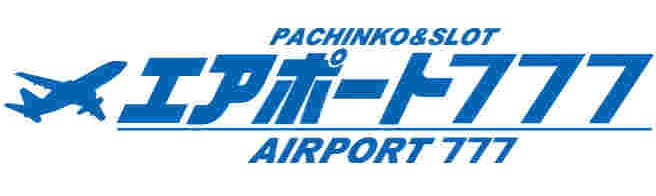
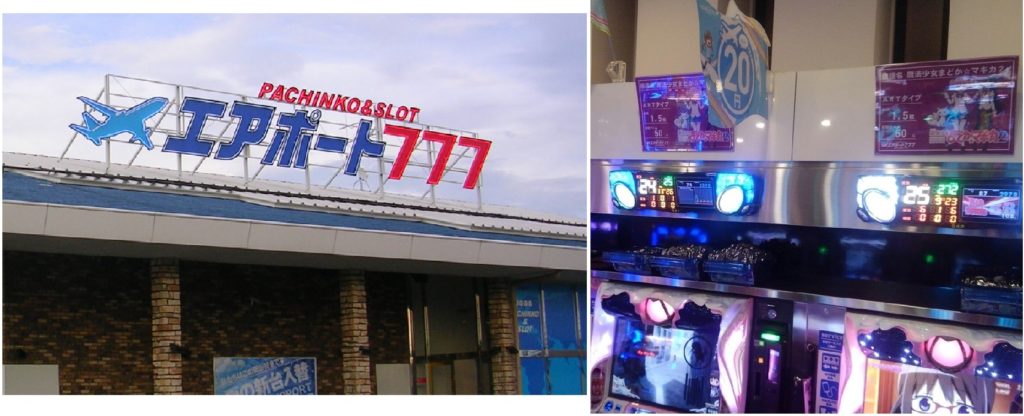
Mark in dispute, consisting of three terms, “PACHINKO&SLOT” and “AIRPORT777” in English and Japanese in three lines, and a device of jet airliner (see below), was applied for registration by SEA Co., Ltd., a Japanese business entity, on February 17, 2017 in respect of providing Pachinko and slot machine parlors, game services provided online from a computer network or mobile phone; providing amusement facilities and other services in class 41.

Opposed mark “AIRPORT 777”

SEA CO., Ltd. has been operating pachinko and slot machine parlors in the name of AIRPORT 777.

Pachinko& Slot Airport 777

Without confronting with a refusal during substantive examination, the AIRPORT 777 mark was registered on October 20, 2017.

Petition for Invalidation

Japan Trademark Law provides a provision to retroactively invalidate trademark registration for certain restricted reasons specified under Article 46 (1).

The Boeing Company, the world’s largest American aerospace company and leading manufacturer of commercial jetliners, defense, space and security systems, and service provider of aftermarket support, filed a petition for invalidation against opposed mark on July 17, 2018. Boeing argued the AIRPORT 777 mark shall be invalidated due to a likelihood of confusion with “777” The Boeing 777 when used on above designated services in class 41 based on Article 4(1)(xv) of the Trademark Law.

The Boeing 777 is the world’s largest twin-engine jet airliner, first flown in June of 1994. Commonly referred to as the ‘Triple Seven,’ the 777 is Boeing’s first fly-by-wire airliner (an electronic system that replaces the conventional manual flight controls of an aircraft) and the first commercial aircraft entirely computer-designed.

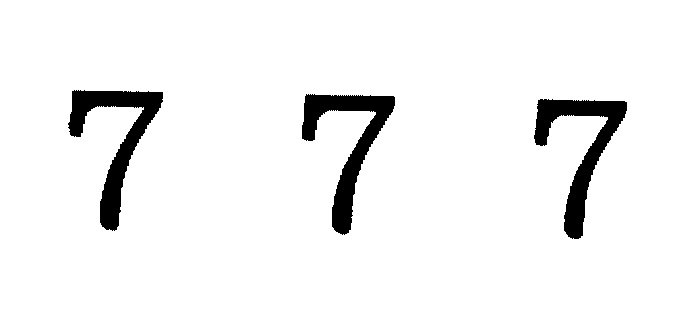
In Japan, Boeing has successfully registered three digits “777” in respect of jet airliners in class 12 since 2001. Trademark Registration no. 4456004 (see below).

Japan TM Registration no. 4456004

Board decision

The Board admitted that the “777” mark has acquired a high degree of popularity and reputation as a source indicator of Boeing jetliners among relevant consumers.

In assessment of the similarity between two marks, at the outset the Board found that three digits 777 implies a meaning of wining jackpot in association with pachinko and slot machines. However, by taking account of a term “AIRPORT” and a silhouette of jet airliner, the Board considered it is likely that relevant consumers with an ordinary care shall connect or associate the services using opposed mark with The Boeing 777. If so, it is unquestionable that opposed mark is highly similar to a famous mark “777”. Besides, since recent game and amusement industry have a trend to introduce flight and airplane games with new technology or to use images, video and sounds of jet airliner, it is not unreasonable to find above services in class 41 are closely related to jet airliners. In view of Boeing’s business portfolio, it is highly predictable that The Boeing Company expands the business and launches amusement business.

Based on the foregoing, the Board concluded that, from totality of circumstances and evidences, relevant traders or consumers are likely to confuse or misconceive a source of opposed mark with Boeing or any entity systematically or economically connected with the opponent and declared invalidation based on Article 4(1)(xv).

Is Marie-Antoinette a name of French Queen consort or a trademark?

The Japan Patent Office (JPO) ordered to dismiss an invalidation trial against IR no. 1238820 for word mark “Marie-Antoinette” by finding the mark shall be irrevocable under Article 4(1)(vii) of the Trademark Law. [case no. 2017-68002]

Tempting Brands Netherlands B.V. (NL), filed an international registration for the mark over goods of “Bleaching preparations [deodorants] for cosmetic purposes; perfumery, essential oils, cosmetics, hair lotions; dentifrices; cosmetic soaps, soaps for personal use; douching preparations for personal sanitary or deodorant purposes [toiletries]” in class 3 and others in class 9, 18 and 25 on Dec. 5, 2014 claiming priority based on Benelux TM application dated Aug. 22, 2014, and designating Japan which granted registration of the mark on Feb. 10, 2017.

To challenge, an invalidation trail was filed against the mark. Claimant, a Japanese business entity asserted the mark shall be invalidated in violation of Article 4(1)(vii) of the Trademark Law on the grounds that the mark “Marie-Antoinette” written in a plain letter represents the late ill-fated queen consort of King Louis XVI of France who has been highly well-known as a symbolic queen of beauty among relevant public not only in France but also Japan and other countries. If so, it is extremely harmful to prestige of “Marie Antoinette” and social affections on the historical figure to admit an exclusive right on the name to any unrelated entity. It may inevitably offend public order and morals

Article 4(1)(vii) of the Trademark Law prohibits any mark likely to cause damage to public order or morality from registration. Trademark Examination Guidelines provides  “Name of a well-known or famous historical personage likely to free-ride on public measures derivative from the personage and damage the public interests in face” as an example to apply the article.

The Invalidation Trial Board decided the mark shall not be subject to the article due to the following reason.

It is unquestionable that “Marie-Antoinette” represents a name of queen consort of King Louis XVI of France and becomes famous in France as well as Japan. In the meantime, the Board could not see a fact that the name has been made use of for revitalization of local communities or tourism industry. If so, it is quite unlikely to happen that the mark could offend public order and morals when used on goods of class 3. Besides, the Board has no reason to believe registration of the mark would cause disrespect for France and French people as well as international fidelity.  Besides, there finds no circumstances to conclude the mark is proscribed to use by other legislation and applicant apparently filed the mark with a malice or fraudulent intent to be blamed.  Based on the foregoing, the international registration shall be deemed valid since the Board was unable to find out any relevant facts to apply the article on the case.

It is not freely allowed to use and register a name of historical personage as trademark. JPO rejected “Darwin” and “Monet” based on Article 4(1)(vii), but allowed registration of “Elvis”.