Never trademark “BON GOÛT” in food-service business

The Appeal Board of the Japan Patent Office (JPO) decided to register a term of “bon goût” in relation to various foods of class 30 and restaurant service of class 43 by finding that the term is deemed a coined word to relevant public in Japan.
[Appeal case no. 2017-7985]

“BON GOÛT”

Disputed mark (see below), written in a common font design, was filed in December 14 by designating various foods of class 30, e.g. buns and breads, confectioneries, hamburgers, pizza, hot dogs, spices, noodles, pasta, coffee, tea, and restaurant service, rental of cooking apparatus and microwave ovens and others of class 43 in the ultimate.

Lack of distinctiveness

JPO examiner entirely refused the mark due to lack of distinctiveness based on Article 3(1)(iii) of the Trademark Law. In refusal decision, examiner asserted the term of “bon goût” is a French term to mean “good taste” in English.

If so, relevant consumers and traders are likely to conceive the term in association with quality of goods and services.

Besides, given the mark is written in a common font design, it shall be objectionable under Article 3(1)(iii) since the mark is solely composed of elements just to indicate, in a common manner, the place of origin, place of sale, quality, raw materials, efficacy, intended purpose, quantity, shape (including shape of packages), price, the method or time of production or use.


Appeal Board decision

In the meantime, the Appeal Board overruled examiner’s rejection and granted registration of “bon goût”.

The Board admitted the terms of “bon” and “goût” are French words meaning good and taste respectively by referring to French dictionary, but, in contrast, considered a combined word of “bon goût” is unfamiliar to Japanese public with an ordinary care.
If so, disputed mark shall be deemed a coined word in its entirety and relevant consumers are unlikely to conceive any specific meaning from the mark.

Besides, the Board held, as a result of ex officio examination, there found no circumstance to convince “bon goût” is ordinarily used as a mere descriptive indication in food-service business.

Consequently, it is groundless to reject the trademark “bon goût” based on Article 3(1)(iii) since it does not give rise to any descriptive meaning in relation to the goods and services in question.


This case gives us a lesson.
Descriptive term in foreign language has a potential risk to be registered in Japan if we are unfamiliar to the term.

JPO admits “TE’ CON MIEL” is distinctive in relation to tea

In a recent trademark opposition, the Opposition Board of the Japan Patent Office (JPO) decided to overrule the opposition against TM Registration no. 5951823 for word mark “TÉ CON MIEL” designating tea in class 30 due to distinctiveness of the mark among relevant Japanese consumers.
[Opposition case no. 2017-900259, Gazette issued date: January 26,2018]

Opposed mark

Opposed mark consists of a term “TE’ CON MIEL” and its transliteration written in Japanese character (Katakana) as shown below.

Opposition

Opponent argued the mark shall be objectionable based on Article 3(1)(iii) and 4(1)(xiv) of the Trademark Law because of descriptive meaning in relation to tea.

Each Spanish word of the mark means ‘tea’ for “TE”, ‘with’ for “CON”, ‘honey’ for “MIEL” respectively. It is obvious that opposed mark gives rise to a meaning of ‘TEA WITH HONEY’ in English as a whole.

Article 3(1)(iii)

Article 3(1)(iii) of the Trademark Law prohibits any mark from registering if the mark solely consists of elements just to indicate, in a common manner, the place of origin, place of sale, quality, raw materials, efficacy, intended purpose, quantity, shape (including shape of packages), price, the method or time of production or use.

Opponent relied on the article on the assumption that opposed mark just indicates quality or ingredient of designated goods and lacks distinctiveness in relation to ‘tea with honey’ which is undoubtedly included in the designation of tea.

Article 4(1)(xiv)

Article 4(1)(xiv) is a provision to prohibit any mark from registering if the mark is likely to mislead as to the quality of goods or service.

Opponent relied on the article presuming that relevant consumers misconceive the quality of a tea when opposed mark is used on tea other than honey tea.

In order to bolster the argument, opponent produced evidential materials showing tea bags imported from Spain.

Board decision

However, the Opposition Board, by taking into consideration the produced evidences and relevant facts, held as follows.

  1. Each term of “TE”, “CON” and “MIEL” is not familiar among relevant Japanese consumers with an ordinary care. Besides, there exists no circumstance to find a whole term of “TE’ CON MIEL” gets to be known for its descriptive meaning. If so, relevant consumers consider opposed mark as a distinctive source indicator.
  2. A fact that “TE’ CON MIEL” is used on honey tea as a generic term in Spain and other Spanish native countries does not immediately negate a distinctive perception toward opposed mark among relevant Japanese consumers
  3. Obviously, produced evidences are insufficient to demonstrate a certain degree of perception as a generic indication of ‘honey tea’ in Japan.

Based on the foregoing, the Board concluded opposed mark shall not be objectionable under Article 3(1)(iii) and 4(1)(xiv) and dismissed the opposition.


It should be noted that a descriptive term in foreign language can be deemed distinctive and registered in Japan 

How can a combination of descriptive words become a source indicator?

In a recent decision, the Appeal Board of Japan Patent Office (JPO) granted to protect a word mark “TOUGH CARRY” in relation to carts and trolleys of class 12.
[Appeal case no. 2017-7976]

“TOUGH CARRY”

As a result of substantive examination, the JPO examiner refused trademark application no. 2016-28871 for a mark “TOUGH CARRY” composed of descriptive words combination in relation to carts, trolleys, sleighs and sleds[vehicles], rickshaws, horse drawn carriages, bicycle trailers [Riyakah], and casting carriages of class 12 on the ground that the mark lacks distinctiveness under Article 3(1)(iii) of the Trademark Law. Examiner raised her objection based on the facts that a word of “TOUGH” means “strong and durable; not easily broken or cut”. “CARRY” means “to take or support from one place to another; convey; transport”. Besides, it is obvious that relevant consumers are familiar with both words. If so, consumers with an ordinary care will surely conceive the meaning of “being able to transport items with strong and durable capability” at the sight of trademark “TOUGH CARRY” when used on designated goods.

Appeal Board decision

In the meantime, the Appeal Board cancelled the examiner’s rejection and admitted registration of “TOUGH CARRY”.

The Board decided that, even if respective word, highly known among consumers, inherently lacks distinctiveness in relation to goods of class 12 and the entire mark gives rise to the meaning as examiner asserted, it does not mean the mark as a whole is just a direct and clear qualitative indication of specific goods.

On the case, the Board found, as a result of ex officio examination, no evidence to demonstrate the descriptive words combination of “TOUGH CARRY” is ordinarily used in transaction of carts and trolleys. Besides, there exists no circumstance to use the combination as a qualitative indication in relation to any other goods.

Consequently, it is groundless to reject the trademark “TOUGH CARRY” based on Article 3(1)(iii) since it does not give rise to any descriptive meaning in relation to the goods in question.


Occasionally, a trademark composed of descriptive words combination becomes controversial. Such disputes mostly focus on distinctiveness of the entire mark. In case the JPO found that combination of respective word is unique and remains suggestive in relation to disputed goods/service by taking account of transactional circumstance, the mark is eligible for registration regardless of descriptive meaning of each word.
In other words, it depends on competitor’s behavior and perception of relevant consumers whether a combination of descriptive words can be protected as a source indicator.

Masaki MIKAMI, Attorney at IP law – Founder of MARKS IP LAW FIRM

JPO decided to invalidate the word mark “Bord’or” in relation to wines

In a decision to the invalidation trial jointly claimed by INSTITUT NATIONAL DE L’ORIGINE ET DE LA QUALITE and CONSEIL INTERPROFESSIONNEL DU VIN DE BORDEAUX, the Invalidation Board of Japan Patent Office (JPO) ordered to invalidate TM registration no. 5737079 for a word mark “Bord’or” in script fonts (see below) in violation of Article 4(1)(vii) of the Trademark Law.
[Invalidation case no. 2016-890075]

TM Registration no. 5737079

Mark in dispute (see above), owned by a Japanese legal entity, was filed on October 9, 2014 by designating various types of alcoholic beverages including wines in class 33. After an initial application, applicant requested the JPO to expedite substantive examination. In accordance with the request, JPO examiner put a priority on the mark and admitted to grant registration in three months subsequent to substantive examination.

Accelerated Examination

JPO applies the accelerated examination system to trademark application on the condition that the application meets the following condition.

  1. Applicant/licensee uses or will use applied mark on one of designated goods/services at least, and there exists an urgency to registration, e.g. unauthorized use by third parties, basic application to international registration,
  2. All designated goods/services are actually or shortly used by applicant/licensee, or
  3. Applicant/licensee uses or will use applied mark on one of designated goods/services at least, and all the goods/services are designated in accordance with a standard description based on Examination Guidelines for Similar Goods and Services.

Accelerated examination system enables applicant to obtain examination results in less than two months on average, which is four months shorter than regular examination.

Claimants’ allegation

Claimants argued disputed mark gives rise to the same pronunciation with BORDEAUX, “ bɔːˈdəʊ”. If so, relevant consumers shall conceive BORDEAUX, a world-famous geographical name known for an origin of French wine. Besides, according to the document produced by applicant to demonstrate actual use of disputed mark on designated goods in requesting accelerated examination, it evidently reveals intention to free-ride or dilute fame of prestigious wine.
Thus, if disputed mark is used on wines originated from areas other than BORDEAUX, it severely does harm to fame and aura of prestigious wine constituted under the strict control of domicile of origin. Then, inevitably it causes disorder to a world of global commerce in a manner inconsistent with international fidelity.

To bolster the allegation, claimants cited precedent trademark decisions involving famous French wine, e.g. ROMANEE-CONTI, BEAUJOLAIS NOUVEAU, CHABLIS. Inter alia, IP High Court ruled a word mark “CHAMPAGNE TOWER” invalid in relation to “CHAMPAGNE” based on Article 4(1)(vii).

Article 4(1)(vii) of the Japan Trademark Law

Article 4(1)(vii) prohibits any mark likely to offend public order and morals from registering.

Trademark Examination Guidelines sets forth criteria for the article and samples.

  1. Trademarks that are “likely to cause damage to public order or morality” are, for example, the trademarks that fall under the cases prescribed in (1) to (5) below.

(1) Trademarks which are, in composition per se, characters or figures, signs, three-dimensional shapes or colors or any combination thereof, or sounds that are unethical, obscene, discriminative, outrageous, or unpleasant to people. It is judged whether characters, figures, signs, three-dimensional shapes or colors or any combination thereof, or sounds are unethical, discriminative or unpleasant to people, with consideration given to their historical backgrounds, social impacts, etc. from a comprehensive viewpoint.

(2) Trademarks which do not have the composition per se as prescribed in (1) above but are liable to conflict with the public interests of the society or contravene the generally-accepted sense of morality if used for the designated goods or designated services.

(3) Trademarks with their use prohibited by other laws.

(4) Trademarks liable to dishonor a specific country or its people or trademarks generally considered contrary to the international faith.

(5) Trademarks whose registration is contrary to the order predetermined under the Trademark Act and is utterly unacceptable for lack of social reasonableness in the background to the filing of an application for trademark registration.


  1. Examples that fall under this item

(i) Trademarks that contain characters such as “university” and are likely to be mistaken for the name of universities, etc. under the School Education Act.

(ii) Trademarks that contain characters such as “士(shi)” which are likely to mislead that they represent national qualifications.

(iii) Trademarks of the name of a well-known or famous historical personage which are determined to have the risk of taking a free ride on public measures related to that personage and damage the public interests by inhibiting the performance of such measures.

(iv) Trademarks with figures indicated in a manner that may impair the dignity and honor of national flags (including foreign national flags)

(v) A sound mark related to the services of “medical treatment” which causes people to recognize siren sounds generated by ambulances that are well known in Japan.

(vi) A sound mark which causes people to recognize national anthems of Japan and other countries.

Board decision

Board found in favor of claimants that “BORDEAUX” has acquired a high degree of popularity and reputation among Japanese consumers as a source indicator of wines originated from the Bordeaux district. As long as disputed mark gives rise to the same pronunciation with BORDEAUX, it is undeniable that consumers are likely to connect the disputed mark with BORDEAUX wine or its district. If so, disputed mark free-rides or dilutes lure and image of BORDEAUX wine, and adversely affects domicile of origin strictly controlled by French government.
Consequently, Board decided to invalidate Bord’or in violation to Article 4(1)(vii).


Protection of geographical indication

The Japan Trademark Law contains provisions to protect geographical indication.
In principle, a mark merely consisting of geographical name or location is deemed descriptive and falls under Article 3(1)(iii). Even if a mark is combined geographical indication with other distinctive elements, it is subject to Article 4(1)(xvi) since the mark may mislead the quality when used on goods from other areas.
Regarding a mark indicating a place of origin off wine, Article 4(1)(xvii) plays a significant role.

Article 4(1)(xvii)

No trademark shall be registered if the trademark is comprised of a mark indicating a place of origin of wines or spirits of Japan which has been designated by the Commissioner of the Patent Office, or a mark indicating a place of origin of wines or spirits of a member of the World Trade Organization which is prohibited by the said member from being used on wines or spirits not originating from the region of the said member, if such a trademark is used in connection with wines or spirits not originating from the region in Japan or of the said member.

Geographical indications to be protected under the article can be reviewed by accessing http://www.jpo.go.jp/tetuzuki_e/t_tokkyo_e/pdf/appendix2.pdf

In this regard, it should be noted that Article 4(1)(xvii) is applicable to any mark containing a term to represent protected GI in itself. In other words, Article 4(1)(xvii) can’t block “Bord’or” since disputed mark does not contain “BORDEAUX” or its transliteration.


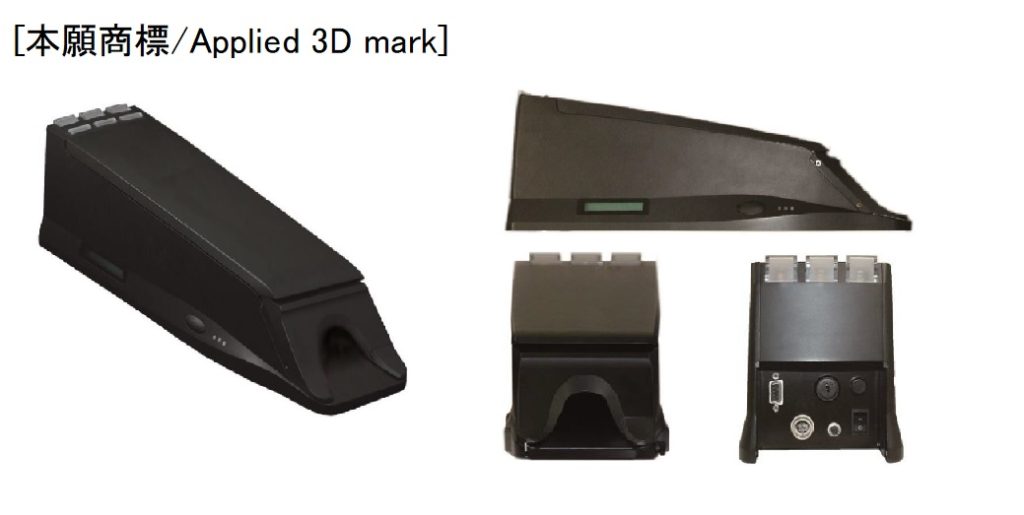
It is just a 3D shape of electronic baccarat shoe, or trademark?

In a lawsuit disputing adequacy of decision by the JPO Appeal Board (Appeal case no. 2015-907) to refuse the applied 3D mark (TM2014-5943, class 28), consisting of a three-dimensional shape of electronic baccarat shoe with the program enabling to reduce the chance of foreign cards and eliminate dealer mistakes, due to lack of  distinctiveness and secondary meaning, the IP High Court sustained the decision being appealed.
[Case no. Heisei28(Gyo-ke)10266,  Decision date: September 27, 2017]

Inherent distinctiveness of the 3D shape

Plaintiff, a Japanese manufacturer and distributor of the ANGEL EYE electronic baccarat shoe, asserted that the 3D shape of ANGEL EYE, being the first products in the industry, is not an essential shape to make it free for public use since no competitors have dealt with same type of product other than plaintiff so far. Besides, a fact that the 3D shape has been registered in the legal gambling countries, e.g. US, EU, AU, RU, Malaysia and NZ, will rather bolster necessity to allow exclusive right on the shape.

However, the Court opposed to plaintiff. “It is inadequate to allow plaintiff to use the 3D shape exclusively. Applied 3D mark can be perceived objectively as a general shape of electronic baccarat shoe aimed to fulfill its original function and produce aesthetic image. If so, it may disorder a fair marketplace to allow exclusive use to plaintiff just because of a first-to-file. A mere fact of trademark registrations in countries where the ANGEL EYE has been distributed is insufficient to admit trademark registration in our nation since the goods is yet to be distributed in Japan.” Accordingly, the Court refused Applied 3D mark based on Article 3(1)(iii).


Secondary meaning of Applied 3D mark

Plaintiff argued Applied 3D mark has already served to function as a source indicator by means of substantial use of the mark sine 2005. Plaintiff exported 11,481 units (sale proceeds: 2.7 billion yen) over the lase decade and has achieved 90 % market share in Macau, the world’s largest casino gambling hub.

In this respect, the Court ruled in favor of the JPO. As plaintiff admits, the shoe has not been manufactured for domestic use. Any evidence suggesting a high degree of recognition to Applied 3D mark in foreign countries is neither relevant nor persuasive. Unless plaintiff demonstrates that domestic consumers have become aware of such recognition, it is groundless to find Applied 3D mark would satisfy requisite of secondary meaning based on Article 3(2) of the Japan Trademark Law.


The case raises a question: What is a role of the Trademark Law where applied mark, being registered in foreign nations,  confronts with an insuperable refusal attributable to legal restrictions on domestic use of the mark?
Unsuccessful domestic registration prevents domestic company from utilizing the Madrid Protocol and protecting his/her vital brands on the global market in an effective and economical manner.