Porsche wins trademark protection for “911”

Porsche, a German sports car maker, has recently won trademark protection for its widely known three-digit code “911” in Japan.
[Appeal case no. 2018-650044]

911 – a mark composed exclusively of numerals

Dr. Ing. h.c. F. Porsche Aktiengesellschaft filed a trademark application for three-digit mark “911” in standard character to the Japan Patent Office (JPO) via the Madrid Protocol with a priority date of March 15, 2014, which is the international registration date for IR no. 1199656.

Evidently, the mark represents the famous Porsche 911, one of the greatest sportscar.  

It starts in 1963. 911 was Designed as a Rear Engined Luxury Sports Coupe from the get-go. Germans wanted to call it the 901. and that had been it’s factory code ever since it was in production. But Porsche was forced to rename the model the ‘911’ after French Automaker Peugeot claimed the name 901, having the {Number – Zero – Number}, was in violation of French copyright and trademark protection laws.

On April 5, 2018, the JPO examiner refused the 911 mark on the ground that it is descriptive for the designated goods ‘sports cars’ in class 12 based on Article 3(1)(v) of the Trademark Law.

The article prohibits any mark from registering if it consists solely of a very simple and common mark. Trademark Examination Guidelines (TEG) stipulates that a mark consisting of numerals is not eligible for registration under the article. Click here.

A mark composed exclusively of numerals is deemed uncapable of identifying the source of the goods since relevant public immediately perceives, without further thought, a description of one of the essential characteristics of the goods in question, such as their quantity or value.

The examiner had considered that since the sign 911 can be used to indicate a value, code, type, model or standard, it could be immediately perceived by the relevant public as descriptive of a characteristic of the goods in question and not of their provenance from a specific undertaking.

Numerals falling under the article are only capable for registration based on Article 3(2) if they have “acquired distinctiveness”, which means the term has taken on a meaning in the public view so that people see the term as a trademark identifying the goods rather than simply describing the goods.

In the appeal, Porsche argued the 911 mark in itself has already played a role of source indicator as a result of substantive use since 1964.

APPEAL BOARD Decision – Acquired Distinctiveness

JPO Appeal Board granted protection of the 911 mark, stating that the mark has acquired distinctiveness due to substantive and continuous use with goods in question based on following fact-findings.

  1. Appellant has used the 911 mark as a sports car brand of its high-end product since 1964 in Japan and been continuously distributing the sports car.
  2. Recent domestic sales show 1,420 cars in 2016, 1,543 cars in 2017.
  3. Press release, news articles, catalogs and advertisements on magazines and newspapers featuring Porsche count to approximately 300 per year from 2010 to 2014.
  4. From the produced evidences, it could be seen that the 911 mark has been used in a separable manner with Porsche.

Thus, the Board found the applied mark in itself has been widely known for a source indicator of the famous Porsche 911 among relevant consumers of goods in respect of which an application for registration has been filed. If so, the 911 mark is exceptionally eligible for registration in connection with sports cars of class 12 based on Article 3(2) of the Trademark Law.

Is “VEGAS” an abbreviation for Las Vegas, or a source indicator?

In a trademark opposition disputing over abbreviation for ‘Las Vegas’, the Japan Patent Office (JPO) decided the term “VEGAS” shall be distinctive in connection with a service of providing amusement facilities (casino facilities, Pachinko parlors) of class 41.
[Opposition case no. 2018-900349, Gazette issue date: August 30, 2019]

VEGAS

Opposed mark is a word mark “VEGAS” in a plain gothic type.

The mark was filed in December 26, 2017 by a Japanese entertainment company, VEGASVEGAS Co., Ltd., headquartered in Tokyo, for various services in class 41 including providing casino (gambling) facilities, Pachinko parlors.

JPO, going through substantive examination, admitted registration (TM Registration no. 6080858) and published for opposition on October 9, 2018.

TRADEMARK OPPOSITION – Article 3(1)(iii)

On November 26, 2018, before the lapse of a two-months opposition period, DAIHACHI Co., Ltd. (d/b/a VEGAS GROUP), an amusement company, operating Pachinko & slot machine parlors in the name of VEGAS, filed an opposition, arguing that the word ‘VEGAS’ has been known among relevant consumers for an abbreviation for Las Vegas, the gamblers’ paradise, a trendy tourist destination, the entertainment capital of the world.

If so, it shall be forbidden to allow exclusive use of famous geographical indication by trademark right. Besides, consumers at the sight of opposed mark would establish a link between the geographical indication Las Vegas and “amusement facilities, casino (gambling) facilities and Pachinko parlors” and just conceive the facilities using opposed mark are connected with or equivalent to services available in Las Vegas Nevada (US).

Therefore, it is evident that opposed mark lacks distinctiveness in connection with the designated service of providing amusement facilities (casino facilities, Pachinko parlors) of class 41 and shall be revocable under Article 3(1)(iii) of the Trademark Law.

Article 3(1) of the Trademark Law is a provision to prohibit descriptive marks from registering.

Section (iii) of the article aims to remove any mark merely or directly suggesting quality of goods and services.

“Article 3(1) Any trademark to be used in connection with goods or services pertaining to the business of an applicant may be registered, unless the trademark:

(iii) consists solely of a mark indicating, in a common manner, in the case of goods, the place of origin, place of sale, quality, raw materials, efficacy, intended purpose, quantity, shape (including shape of packages), price, the method or time of production or use, or, in the case of services, the location of provision, quality, articles to be used in such provision, efficacy, intended purpose, quantity, modes, price or method or time of provision;”

OPPOSITION DECISION

JPO Opposition Board totally dismissed the opposition by stating that:

  1. From the produced evidences, it is unclear whether ‘VEGAS’ becomes ordinary indication for Las Vegas in Nevada, US.
  2. The Board could not find circumstances and business practices related to the service in dispute that ‘VEGAS’ has been used to indicate a specific quality of the service or an association with Las Vegas at all.
  3. A mere fact that ‘VEGAS’ reminds consumers of Las Vegas is insufficient to negate distinctiveness of opposed mark in connection with the service in dispute.

Based on the foregoing, the JPO decided opposed mark shall play a part of source indicator over the service in class 41 and irrevocable under Article 3(1)(iii) of the Trademark Law.

The Japan IP High Court Finds “EQ” Entitled to Trademark Registration Belonging to Mercedes Benz

On July 3, 2019, the Japan IP High Court reversed a decision of the Japan Patent Office (JPO) finding that the company Daimler AG was entitled to registration of “EQ” for Motor vehicles in class 12, even though the term “EQ” by itself is descriptive for the goods.
[Case no. Heisei31(Gyo-ke)10004, Daimler AG vs the JPO Commissioner]

The EQ Application

The JPO has refused registration to an application for EQ in standard characters (word only, see below) on the basis that the mark was descriptive for the goods “Motor vehicles” in class 12 based on Article 3(1)(v) of the Trademark Law.

The article prohibits an applied mark from registering if it consists solely of a very simple and common mark. Trademark Examination Guidelines (TEG) stipulates that a mark consisting of one or two alphabetical letters is not eligible for registration under the article. Click here.

A mark consisting of two alphabetical letters is not capable of identifying the source of the goods due to a lack of distinctiveness because a combination of two alphabetical letters is limited on quantity and currently used to represent a model name of vehicle, e.g. BMW XS, TOYOTA Carina ED, Ferrari FX, Nissan GT-R.

Descriptive terms falling under the article are only capable for registration based on Article 3(2) if they have “acquired distinctiveness”, which means the term has taken on a meaning in the public view so that people see the term as a trademark identifying the goods rather than simply describing the goods.

In this regard, Daimler AG argued the EQ mark, a coined term originating from “Electric Intelligence” to appeal design, extraordinary driving pleasure, high levels of everyday suitability and maximum safety of electric car by Mercedes-Benz, has acquired distinctiveness since launching the brand at the Paris Motor Show in September 2016.

JPO Decision

However, the JPO dismissed the argument on the grounds that:

  1. Daimler has neither used the EQ mark by itself as a name of electric car nor produced evidences of its plan to sell electric car named “EQ”.
  2. Daimler uses the EQ mark in a stylized design in press releases. If so, it is questionable whether relevant consumers conceive the EQ mark in standard characters as a source indicator of Mercedes-Benz.
  3. According to the produced evidences, Daimler uses the EQ mark in combination with other literal elements, e.g. “Generation EQ Concept”, “Concept EQA”, “EQC”, “smart vision EQ for two”, “EQ POWER”, “EQ POWER+”.
  4. There are no actual domestic sales of the electric car using the applied mark during the past two years from the date Daimler launched the brand in fact.
  5. A combination of two alphabetical letters, “E” and “Q”, has been generally used as a mode name in association with vehicles, e.g. TOYOTA electric car “eQ”, HYUNDAI luxury sedan “EQ900”, Zhengzhou Nissan truck “EQ1060”, Laufenn tyre “S FIT EQ”, ALPINE car navigation “EX11Z-EQ”, SPECIALLIZED bicycle “ALIBI SPORT EQ”. If so, the EQ term shall not be eligible for monopoly by a specific entity any longer.

The Appeal Board of JPO also upheld the refusal.
[Appeal case no. 2018-650016]

To contest the administrative decision, Daimler AG filed an appeal to the IP High Court on January 15, 2019.

IP High Court Ruling

The court first found the EQ mark in standard characters is not eligible for registration under Article 3(1)(v) of the Trademark Law.

In the meantime, the court found Daimler has newly released, promoted, and used the EQ mark with a combination of “POWER” as a new brand concept of electric car by Mercedes-Benz. Given a space for single letter between “EQ” and “POWER”, relevant consumers at the sight of promotional materials, advertisements and car magazines pertinent to Mercedes-Benz’s new electric car brand would perceive “EQ” as a specific source indicator. Taking account of enormous number of circulation of magazines (approx. 230,000) and advertisements for users (170,000 per year), the court held the EQ mark has been well known for a source indicator of Daimler electric car among relevant consumers and traders even if the duration of actual use and sales amount are not sufficient by themselves.

Notably, the court also negated fact-finding by JPO regarding ordinary use of the term EQ in association with vehicles by stating that since competitors use the term in a tight combination with other literal elements, they can be simply perceived as a mode name. If so, such use shall not be construed to negate acquired distinctiveness of the EQ mark by Daimler.

Based on the foregoing, the court ruled the EQ mark is entitled to trademark registration based on Article 3(2) of the Trademark Law and reversed a decision by the JPO on that account.

Trademark trolls target New Japan era name “REIWA”

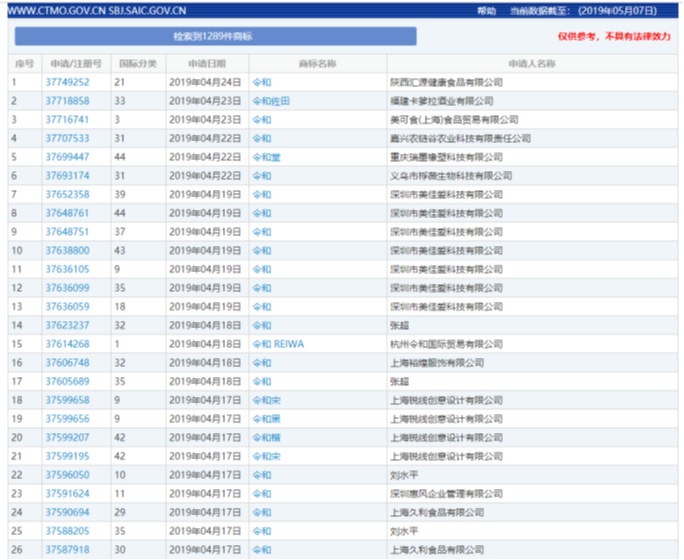
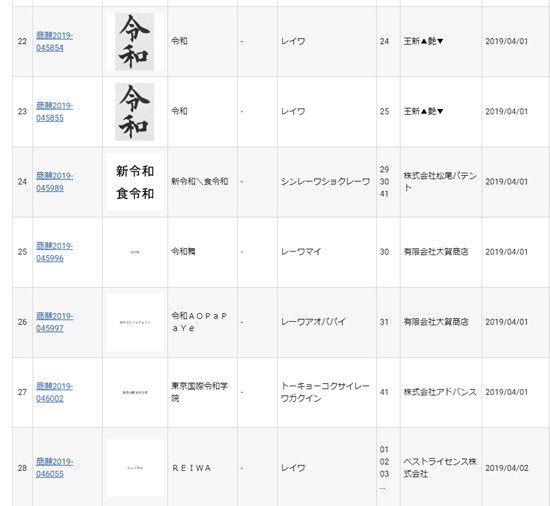
Over 1,200 applications filed for Reiwa-related trademarks in China within a month after announcement of the new Imperial era name “REIWA” by the Japanese government on April 1, 2019.

According to a search site of China’s trademark office, prior to the April 1 announcement of the era name, there was only one trademark application for the name, filed in 2017. However, 238 applications related to REIWA were filed on April 1 alone, when the new era name was announced. The number of such applications further swelled to 1,276 as of April 30.

The applicants seem to be trying to take advantage of the new era name. Those requests are for registration of names such as “Reiwado,” “Reiwaya” and “Reiwa tenka.” The applications were in a variety of fields ranging from cosmetics to food, with examples including “Reiwa beef” and “Reiwa hall.”

It is unclear whether their applications will be approved. Chinese authorities are unlikely to grant any new permission for trademark names related to REIWA.


Other neighbor nations (Taiwan, Korea)

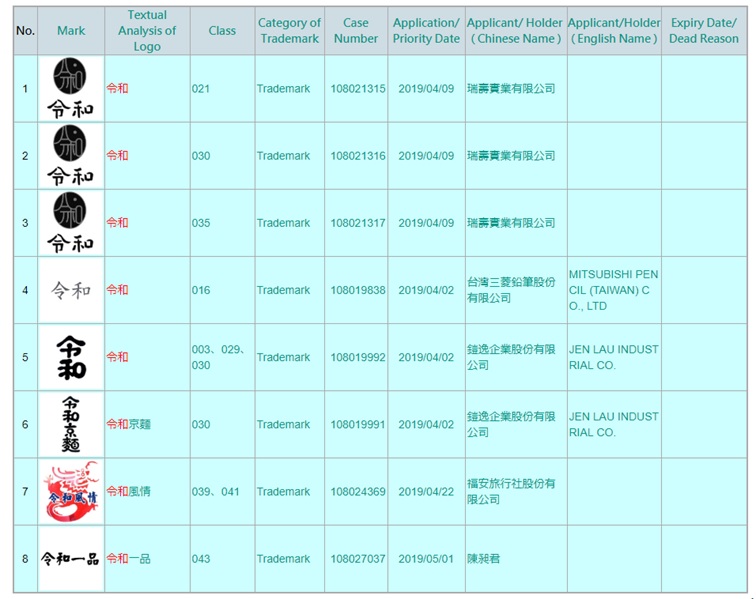
According to a search site of Taiwan’s IP office, 8 applications related to REIWA were filed after announcement as of May 1.

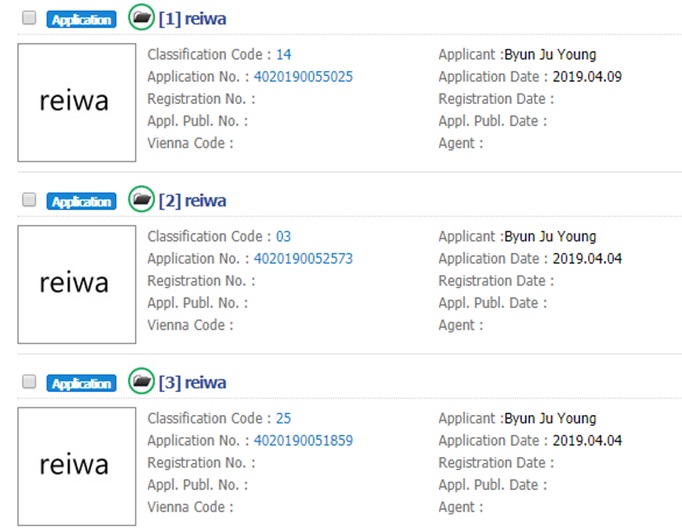
In Korea, a search site revealed only 3 applications related to REIWA were filed in April.

Japan

48 applications related to REIWA were filed to the Japan Patent Office in three days after announcement of the new era name.

As mentioned in the previous blog article, the revised trademark guidelines to ensure trademarks do not feature any era name now clearly state that all era names, in principle, cannot be used for trademarks.
It is expected most of the applications are rejected for registration under the latest guidelines.


Trademark registration for Tasaki’s Akoya pearls ring

In March 17, 2017, Japanese jewelry house TASAKI & Co., Ltd., the Japanese leading producer of Akoya pearls, filed an application for trademark registration at the Japan Patent Office (JPO) for the following three-dimensional mark for rings in class 14.

Signature ring featuring a row of five seemingly identical Akoya pearls

Applied mark represents a signature ring featuring a row of five seemingly identical Akoya pearls, one of Tasaki’s bestsellers.


Tasaki commenced sales of the ring in the name of “balancing signature ring” in April, 2010 and has been continuously promoting the sales since then.


JPO Examination/Acquired distinctiveness

The JPO examiner totally refused the mark due to a lack of inherent distinctiveness in relation to rings [jewelery].

Tasaki filed an appeal against the decision and argued acquired distinctiveness of the 3D configuration of the ring arising from uniqueness of its shape and substantial advertisement.

According to the filed evidences to the JPO, Tasaki installed a large signboard for advertisement at busy places, Ginza (Tokyo), Kobe, Osaka and made various promotional activities via internet, direct mails and events. The ring was appeared and published in magazines more than 130 times for the last eight years.

In March 1, 2019, the Appeal Board of JPO granted trademark registration based on Article 3(2) of the Trademark Law by finding acquired distinctiveness of the 3D configuration of the ring as a source indicator of Tasaki regardless of a fact that only 2,242 rings were purchased by consumers in fact .
[Appeal case no. 2018-9531, TM Registration No. 6125506]

Article 3(2) is a provision to allow registration of applied mark if, as a result of substantial use of the mark in fact, consumers are able to connect the mark with a source indicator of designated goods or services.

HISAMITSU unsuccessful in registering a shape of “Salonpas”

The Appeal Board of Japan Patent Office (JPO) disallowed registration of a shape of famous Japanese pain relief patches in the name of “Salonpas” manufactured by Hisamitsu Pharmaceutical Co., Inc. due to lack of inherent distinctiveness in relation to poultices, class 5. [Appeal case no. 2017-12694]


Salonpas

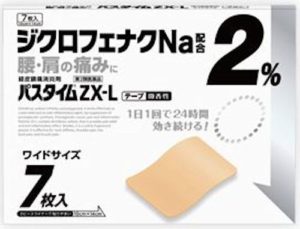
Hisamitsu Pharmaceutical Co., Inc. filed a trademark application for a shape of Over-The-Counter Topical Pain Patch known for “Salonpas” (see below) by designating pharmaceutical preparations, gauze for dressings, bandages for dressings, adhesive plasters and other goods in class 5 [TM application no. 2015-7479].

Salonpas is a product of Hisamitsu Pharmaceutical, a company whose history dates back to the mid-1800s. Salonpas was introduced in 1934 and was first distributed in Asia. The FDA approved the Salonpas Pain Relief Patch for the US market in 2008. Approximately 20 billion Salonpas transdermal patches have been sold in the last 20 years. Salonpas has been acknowledged as World’s No.1 OTC Topical Analgesics in patch format.


JPO Examination

The JPO examiner totally refused the application based on Article 3(1)(iii) of the Japan Trademark Law stating that the applied mark can be easily seen as a shape of poultices and the shape does solely consist of a common configuration to achieve the basic function of poultices. If so, the applied mark lacks distinctiveness as a source indicator.

Article 3(1)(iii) is a provision to prohibit any mark from registering where the mark solely consists of elements just to indicate, in a common manner, the place of origin, place of sale, quality, raw materials, efficacy, intended purpose, quantity, shape (including shape of packages), price, the method or time of production or use.


To dispute the refusal, Hisamitsu filed an appeal on August 28, 2017.


Appeal Board’s decision

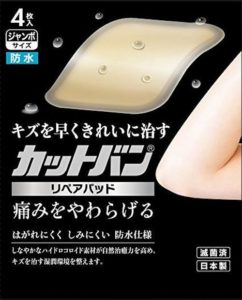
The Appeal Board, however, upheld the examiner’s decision on the ground and dismissed Hisamitsu’s allegation by stating that relevant consumers and traders shall conceive of a mere qualitative representation to indicate the shape of poultices and plasters at the sight of applied mark given similar indications are depicted on the packages of other supplier’s goods on the market (see below).


Based on the foregoing, the Board consequently refused to register the mark based on Article 3(1)(iii) of the Trademark Law.


AI SCAN ROBO

In a recent administrative decision, the Appeal Board of Japan Patent Office (JPO) allowed registration for a word mark of “AI SCAN ROBO”, finding that the mark could function as a source indicator.
[Appeal case no. 2018-5433, Gazette issue date: November 30, 2018]


AI SCAN ROBO

Disputed mark, consisting of “AI SCAN ROBO” in a standard character, was applied for registration on April 13, 2017 in connection with computer programs of class 9 and data processing in computer files for others of class 42.

The JPO examiner totally refused the mark due to lack of distinctiveness by stating that:

“AI” is known for an abbreviation of Artificial Intelligence. “SCAN” is a verb to use a machine to make a copy of a document or picture and put it into a computer. “ROBO” is equivalent to “robot”. Besides, the term of “SCAN ROBO” becomes generic in connection with Robotic Process Automation (RPA) robot to capture data and manipulate applications automatically. If so, disputed mark shall fall under Article 3(1)(vi) of the Japan Trademark Law since relevant consumers are likely to conceive disputed mark as a mere description of RPA robot to capture data automatically by making use of Artificial Intelligence.


Article 3(1)(vi) is a comprehensive provision to prohibit any mark lacking inherent distinctiveness from being registered.

Any trademark to be used in connection with goods or services pertaining to the business of an applicant may be registered, unless the trademark:
(vi)
 is in addition to those listed in each of the preceding items, a trademark by which consumers are not able to recognize the goods or services as those pertaining to a business of a particular person.


Applicant filed an appeal against the refusal and argued inherent distinctiveness of applied mark “AI SCAN ROBO” in its entirety.


Appeal Board decision

The Board set aside the refusal, finding that disputed mark shall not fall under Article 3(1)(vi) on following grounds.

  1. “AI” is known for an abbreviation of Artificial Intelligence.
  2. In the meantime, the Board opines the term “SCAN ROBO” per se does not represent a specific meaning. Rather it shall be considered as a coined word.
  3. If so, “AI SCAN ROBO” does not give rise to any descriptive meaning as a whole.
  4. Besides, there found no circumstances in commerce to support the term “AI SCAN ROBO” has been commonly used in connection with designated goods and service.
  5. Based on the foregoing, it shall be concluded that disputed mark is distinctive and relevant consumers and traders recognize it as a source indicator.

Is Polaroid Photo Frame trademarked?

In a recent decision, the Appeal Board of Japan Patent Office (JPO) admitted trademark registration for the Polaroid Photo Frame design mark (see below) in relation to services of photo printing, digital on-demand printing, processing of photographic films, photographic retouching (class 40).
[Appeal case no. 2017-9599, Gazette issue date: June 28, 2018]


Polaroid Photo Frame

Disputed mark (see below), apparently looking like Polaroid Photo Frame, was filed in the name of PLR IP Holdings, LLC, the ex-owner of the Polaroid brand and related intellectual property, by covering services of photo printing, digital on-demand printing, processing of photographic films, photographic retouching under class 40 on June 24, 2015.

As a result of substantive examination by the JPO examiner, disputed mark was refused due to a lack of inherent distinctiveness based on Article 3(1)(vi) of the Trademark Law.

Article 3(1)(vi) is a comprehensive provision to prohibit any mark lacking inherent distinctiveness from being registered.

Any trademark to be used in connection with goods or services pertaining to the business of an applicant may be registered, unless the trademark:
(vi)
 is in addition to those listed in each of the preceding items, a trademark by which consumers are not able to recognize the goods or services as those pertaining to a business of a particular person.


Appeal Board decision

The Appeal Board sided with applicant and overruled examiner’s refusal decision by stating that the Board could not detect actual use of the applied design as a representation of shape or quality in connection with the designated services.

Besides, it is questionable to conclude that disputed mark, a combination of White Square and black rectangle, solely consists of a very simple and common sign. If so, the Board considers disputed mark is capable of serving as a source indicator so that consumers may distinguish the source with the clue of disputed mark.

Based on the foregoing, the Board admitted trademark registration of the Polaroid Photo Frame device mark in class 40.

JPO refused 3M Company to register “3M” in relation to vehicles regardless of renowned 3M logo

In a recent decision, the Appeal Board of Japan Patent Office (JPO) did not allow registration of a word mark “3M” written in standard character due to a lack of distinctiveness in relation to vehicles (class 12). [Appeal case no. 2017-3200]

Disputed mark – “3M” in standard character

Disputed mark, a word consisting of “3M” written in standard character, was filed by designating various types of vehicles (class 12) in the name of 3M Company, an American multinational technology company that engages in the manufacture of industrial, safety and consumer goods, and equipment on October 28, 2014 (TM application no. 2014-90835).

Article 3(1)(v)

On December 6, 2016, The JPO examiner totally refused disputed mark based on Article 3(1)(v) of the Trademark Law, stating that sign consisting of a digit and an alphabet is commonly used in transaction to represent article number, model number or standards. If so, disputed mark lacks inherently distinctiveness as a source indicator.

The article prohibits applied mark from registering if the mark consists solely of a very simple and common mark. Trademark Examination Guidelines (TEG) provides that a trademark composed of a numeral followed by one or two Roman characters, e.g. 2A, is subject to the article.

3M Company filed an appeal against the refusal and asserted that “3M” has become famous among public in general as a trade name and source indicator of applicant or its Japanese subsidiary.

Appeal Board decision

The Board, however, dismissed the assertions by finding that:

  1. Evidences just reveal longtime use of “3M” as a trade name of applicant or its subsidiary. But most of them show disputed “3M” mark is used to represent a commercial name in the context of newspapers and web articles. If so, there shall not be seen as a source indicator.
  2. Renowned 3M logo is different from disputed 3M mark in appearance.
  3. Even if “3M” keyword extraction from the web pages demonstrates substantial numbers of articles pertinent to applicant’s business and less possibility to use “3M” by unrelated business entities as article number, model number or standards, these facts are insufficient not to apply Article 3(1)(v).
  4. Precedent administrative decisions and judicial rulings are cases relating to renowned 3M logo. If so, as long as disputed mark consists of “3M” written in standard character, the Board can’t find any reason to bind the case in dispute.

Trademark registration for Kikkoman’s Soy sauce 3D Bottle

In October 11, 2016, Kikkoman Corporation, the world’s leading producer of soy sauce, filed an application for trademark registration at the Japan Patent Office (JPO) for the following three-dimensional colored mark for soy sauce in class 30.

Red-capped Kikkoman soy sauce dispenser

Iconic red-capped Kikkoman soy sauce dispenser was introduced in 1961 and has been in continuous production ever since. It was developed by Kenji Ekuan, a Japanese Navy sailor former naval academy student who dedicated his life to design when he left the service. Its unique shape took three years and over a hundred prototypes to perfect, but the teardrop design and dripless spout have become a staple of restaurant condiments all around the world. The bottle’s design hasn’t changed over the past 50 years.

JPO Examination/Acquired distinctiveness

The JPO examiner initially notified her refusal due to a lack of inherent distinctiveness in relation to say sauce.

In a response to the office action, Kikkoman argued acquired distinctiveness of the 3D bottle arising from uniqueness of its shape and substantial use for over five decades.

According to news release from Kikkoman, over 500 million of the bottles have been sold since the design was first introduced and distributed in approximately a hundred countries worldwide. Red-capped Kikkoman soy sauce dispenser has already been registered as 3D mark in US, EU, Ukraine, Norway, Russia, Australia.

In March 30, 2018, the JPO granted trademark registration based on Article 3(2) of the Trademark Law by finding acquired distinctiveness of the 3D color mark as a source indicator of Kikkoman.
[TM Registration No. 6031041]