Ariana Grande Loses Trademark Opposition at Japan Patent Office

The Japan Patent Office (JPO) dismissed an opposition filed by GrandAri Inc., the owner of a trademark “ARIANA GRANDE”, against TM Reg no. 6202585 for wordmark “Arianna” to be used on cosmetics by finding dissimilarity between “Arianna” and “ARIANA GRANDE.”
[Opposition case no. 2020-900051, Gazette issued date: January 29, 2021.]

Opposed mark

Arianna Co., Ltd. applied for a wordmark “Arianna” registration for use on cosmetics, soaps, and detergents of Class 3 and medical apparatus of Class 10 with the JPO on January 7, 2019 (TM Application no. 2019-000339).

The JPO admitted the registration of the opposed mark on November 29, 2019, and published for opposition on Christmas Eve of the year.

Opposition by GrandAri Inc.

On February 21, 2020, GrandAri Inc. filed an opposition before the JPO and claimed that the opposed mark shall be revocable in contravention of Article 4(1)(xi) and (xv) of the Japan Trademark Law by citing International Registration no. 1260129 for wordmark “ARIANA GRANDE” and others over the goods of ‘Perfume; eau de parfum; fragranced body care preparations, namely, body lotions, body scrubs’ in Class 3.

Article 4(1)(xi) is a provision to prohibit registering a junior mark that is deemed identical with, or similar to, any senior registered mark.

GrandAri argued that relevant consumers would easily think of American pop superstar from the cited mark “ARIANA GRANDE”. Besides, because of her celebrity and popularity, she is affectionately called by her first name “ARIANA”. In view of the space between “ARIANA” and “GRANDE”, it is highly likely that the consumers would consider the term “ARIANA” as a dominant source indicator at the sight of the cited mark. It is no doubt that the opposed mark “Arianna” is confusingly similar to “ARIANA” since the mere difference of the letter ‘n’ is negligible in appearance and both terms give rise to the same pronunciation.

Article 4(1)(xv) provides that any mark shall not be registered where it is likely to cause confusion with other business entity’s well-known goods or services, to the benefit of brand owners and users’ benefits.

GrandAri argued the cited mark is used on fragrances developed by Ariana herself, which are also called “ARIANA” in the advertisement.

Given a close resemblance between the opposed mark and the “ARIANA” mark, and a certain degree of popularity of the fragrances, firstly sold in November 2015 in Japan, it is likely to cause confusion with the cited mark when the opposed mark is used on the goods in question.

JPO Decision

The JPO admitted a high level of reputation and popularity of American pop singer, “ARIANA GRANDE” in Japan. In the meantime, the JPO questioned, from the produced evidence, whether the term “ARIANA” per se plays a role of the source indicator of Ariana Grande fragrances since it is constantly adjacent to the cited mark “ARIANA GRANDE.”
Consequently, the JPO negated the famousness of the term “ARIANA” as a source indicator of the opponent’s goods.

As for the similarity of the marks, the JPO assessed that relevant consumers would see the cited mark “ARIANA GRANDE” in its entirety because she is known and called by her full name. If so, both marks are distinctively dissimilar since the opposed mark does neither give rise to a pronunciation of “ARIANA GRANDE” nor a concept of American pop superstar.

The JPO dared to assess the similarity between the opposed mark “Arianna” and “ARIANA” and held that “Arianna” is not confusingly similar to “ARIANA” from a phonetical point of view. Due to a low level of similarity of the marks, the JPO does not have any reason to believe that the opposed mark would cause confusion with the cited mark “ARIANA GRANDE” as well as “ARIANA” when used on cosmetics, soaps, and detergents of Class 3.

Based on the foregoing, the JPO dismissed the entire allegations of GrandAri and allowed “Arianna” to survive.

El Clasico Scores a Goal in Trademark Race

The Japan Patent Office (JPO) overturned the examiner’s refusal and decided to register the “El Clasico” mark in connection with sporting activities, production of sports events, sports information services, and other services of class 41 by finding the term shall not be recognized as football matches between FC Barcelona and Real Madrid C.F.
[Appeal case no. 2019-650060, Gazette issued date: October 30, 2020]

El Clasico

“El Clasico” is a magical phrase to make football fans passionate, emotional, and excited. The meaning of El Clasico is the Spanish name that is given to any football match between fierce Spanish rivals Real Madrid and Barcelona FC. The literal translation of El Clasico is ‘The Classic’. According to the Cambridge Dictionary, “El Clasico” is defined as ‘any of the games played between the football teams Real Madrid and Barcelona’. Being that this rivalry can be dated back to the 1930s and ever since then, it is one of the most viewed annual sporting events.

Liga Nacional de Fútbol Profesional, the administrator of the Spanish football league, aka LaLiga, applied for registration of the “El Clasico” mark (see below) in relation to sporting activities, production of sports events, sports information services, and other services of class 41 via the Madrid Protocol (IR No. 1379292).

On August 15, 2019, the JPO examiner refused the applied mark due to a lack of distinctiveness in contravention of Article 3(1)(iii) of the Trademark Law. Examiner asserted that the term “El Clasico” gets to be known as football matches between FC Barcelona and Real Madrid C.F. If so, relevant consumers would conceive that services bearing the applied mark just relate to football matches between two teams. In this respect, the applied mark shall not be registrable based on Article 4(1)(xvi) as well since the consumers would mistake its nature when used on service unrelated to football matches between two teams.

LaLiga filed an appeal against the refusal on November 15, 2019.

JPO Appeal Board’s decision

The Appeal Board overturned the examiner’s decision by stating that relevant consumers and traders at the sight of the applied mark are unlikely to see the mark to represent football matches between indicate FC Barcelona and Real Madrid C.F. immediately when used on services in question.

Taking into account less familiarity with the Spanish language among relevant consumers in Japan and the literal meaning of ‘The Classic’, the Board found the term “El Clasico” would be conceived as a coined word in its entirety. Furthermore, the Board could not identify any fact that the term is commonly used to represent a specific nature or quality in connection with the services in question.

Based on the foregoing, the Board concluded the refusal shall be disaffirmed since the examiner erroneously found the applied mark “El Clasico”.

Fast Track Trademark Examination – Japan Patent Office

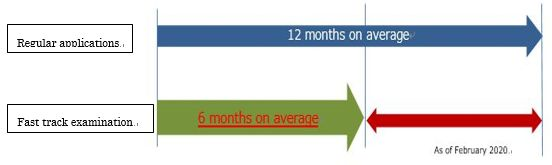
At present, applicant will wait at least 12 months from when trademark is filed until it becomes registered by the Japan Patent Office (JPO).

Accelerated Trademark Examination

To meet a need of earlier registration, JPO has introduced “Accelerated Trademark Examination” which enables trademark application to be registered in two or three months.
However, since it requires applicant to demonstrate actual use of applied mark on at least one of designated goods and services, if applicant has yet to use the mark, such applications have no way but to be in a long queue for JPO examination.

Fast Track Trademark Examination

Newly introduced “Fast Track Trademark Examination” provides an option to achieve earlier registration for non-use trademark owners. According to announcement from JPO, the Fast Track Examination shortens trademark examination period to 6 (six) months on average.

Excerpt from the JPO website

If trademark application meets with following conditions, your trademark will be freely on the fast track without request.

  1. Good and services initially designated under the application are all listed on the “Examination Guidelines for Similar Goods and Services”, “Regulation for Enforcement of the Trademark Act”, or “International Classification of Goods and Services (Nice Classification)”; and
  2. No amendment has been made with respect to goods and services by the time JPO commences examination; and
  3. Applied mark does not belong to non-traditional trademark, international applications under the Madrid system, or partial 3D (three dimensional) mark.

JPO adopts the Fast Track Examination to trademark application filed on or after February 1, 2020.

Further information is available from here.

Empire Steak House loses to trademark its restaurant name in Japan IP High Court battle

On December 26, 2019, the Japan IP High Court ruled to uphold a rejection by the Japan Patent Office (JPO) to International Registration no. 1351134 for the mark “EMPIRE STEAK HOUSE” in class 43 due to a conflict with senior trademark registration no. 5848647 for word mark “EMPIRE”. [Judicial case no. Reiwa1(Gyo-ke)10104]

EMPIRE STEAK HOUSE

The case was brought into the IP High Court after the JPO decided to dismiss an appeal (case no. 2018-650052) filed by RJJ Restaurant LLC (Plaintiff), an owner of IR no.1351134 for mark consisting of stylized-words “EMPIRE STEAK HOUSE” in two lines and a golden cow design (see below) on restaurant services; carry-out restaurant services; catering services in class 43.

EMPIRE STEAK HOUSE, one of the top steakhouses in New York City since 2010, has opened their first restaurant aboard on the first floor of the new Candeo Hotel in Roppongi, Tokyo (JPN) on October 17, 2017. To secure the restaurant name in Japan, RJJ Restaurant LLC applied for registration of disputed mark via the Madrid Protocol with a priority date of March 2, 2017 in advance of the opening.

Senior registered mark “EMPIRE”

The JPO rejected disputed mark by citing senior trademark registration no. 5848647 for word mark “EMPIRE” in standard character on grilled meat and sea foods restaurant services in class 43 based on Article 4(1)(xi) of the Trademark Law.

Article 4(1)(xi) is a provision to prohibit from registering a junior mark which is deemed identical with, or similar to, any senior registered mark.

Senior registered mark was applied for registration on December 8, 2015 and registered on May 13 ,2016. Apparently, senior mark is actually used as a name of restaurant, “Dining Bar Empire”, located in the city of Ueda, Nagano Prefecture (JPN).

To contend against the decision, plaintiff filed an appeal to the IP High Court on July 19, 2019.

IP High Court Decision

Plaintiff argued the literal elements of disputed mark “EMPIRE STEAK HOUSE” shall be assessed in its entirety by citing web articles relating to applicant’s restaurant which referred to the restaurant as Empire Steak House in full. Like ‘Empire State Building’ and ‘Empire Hotel’, the term “EMPIRE” gives rise to unique meaning and plays a role of source indicator as a whole when used in combination with other descriptive word. Besides, disputed mark contains an eye-catching golden cow which attracts attention to relevant consumers. If so, it is evident that the JPO erred in assessing similarity of mark between “EMPIRE STEAK HOUSE” and “EMPIRE”.

The IP High Court, at the outset, mentioned the Supreme Court decision rendered in 2008 which established general rule to grasp a composite mark in its entirety in the assessment of similarity of mark.

“Where a mark in dispute is recognized as a composite mark consisting of two elements or more, it is not permissible to decide similarity of mark as a whole simply by picking out an element of the composite mark and then comparing such element with other mark, unless consumers or traders are likely to perceive the element as a dominant portion appealing its source of origin of goods/service, or remaining elements truly lack inherent ability to serve as a source indicator in view of sound and concept.”

Next, the court analyzed the configuration of disputed mark and found it is allowed to grasp a literal element “EMPIRE” of disputed mark as dominant portion in light of the criteria applied by the Supreme Court by stating that:

  1. A term “STEAK HOUSE” is commonly used to indicate steak restaurant even in Japan.
  2. Where the term is included in restaurant name, it sometimes happens that relevant consumers over leap the term to shorten the name.
  3. In restaurants, it becomes common practice to display cucina and foodstuffs to be served on signboard or advertisement. Likewise, there are many steak and grilled meat restaurants displaying cow design. If so, relevant consumers at the sight of disputed mark would perceive the cow design as a mere indication to represent foodstuffs at the restaurant.
  4. From appearance, given the configuration of disputed mark, respective element can be considered separable.

Finally, based on the above findings, the court dismissed plaintiff’s arguments and concluded the JPO was correctly assessing similarity of mark. Given dominant portion of disputed mark is identical with the cited mark “EMPIRE” and both marks designate the same or similar services in class 43, disputed mark shall be unregistrable under Article 4(1)(xi) of the Trademark Law.

Porsche wins trademark protection for “911”

Porsche, a German sports car maker, has recently won trademark protection for its widely known three-digit code “911” in Japan.
[Appeal case no. 2018-650044]

911 – a mark composed exclusively of numerals

Dr. Ing. h.c. F. Porsche Aktiengesellschaft filed a trademark application for three-digit mark “911” in standard character to the Japan Patent Office (JPO) via the Madrid Protocol with a priority date of March 15, 2014, which is the international registration date for IR no. 1199656.

Evidently, the mark represents the famous Porsche 911, one of the greatest sportscar.  

It starts in 1963. 911 was Designed as a Rear Engined Luxury Sports Coupe from the get-go. Germans wanted to call it the 901. and that had been it’s factory code ever since it was in production. But Porsche was forced to rename the model the ‘911’ after French Automaker Peugeot claimed the name 901, having the {Number – Zero – Number}, was in violation of French copyright and trademark protection laws.

On April 5, 2018, the JPO examiner refused the 911 mark on the ground that it is descriptive for the designated goods ‘sports cars’ in class 12 based on Article 3(1)(v) of the Trademark Law.

The article prohibits any mark from registering if it consists solely of a very simple and common mark. Trademark Examination Guidelines (TEG) stipulates that a mark consisting of numerals is not eligible for registration under the article. Click here.

A mark composed exclusively of numerals is deemed uncapable of identifying the source of the goods since relevant public immediately perceives, without further thought, a description of one of the essential characteristics of the goods in question, such as their quantity or value.

The examiner had considered that since the sign 911 can be used to indicate a value, code, type, model or standard, it could be immediately perceived by the relevant public as descriptive of a characteristic of the goods in question and not of their provenance from a specific undertaking.

Numerals falling under the article are only capable for registration based on Article 3(2) if they have “acquired distinctiveness”, which means the term has taken on a meaning in the public view so that people see the term as a trademark identifying the goods rather than simply describing the goods.

In the appeal, Porsche argued the 911 mark in itself has already played a role of source indicator as a result of substantive use since 1964.

APPEAL BOARD Decision – Acquired Distinctiveness

JPO Appeal Board granted protection of the 911 mark, stating that the mark has acquired distinctiveness due to substantive and continuous use with goods in question based on following fact-findings.

  1. Appellant has used the 911 mark as a sports car brand of its high-end product since 1964 in Japan and been continuously distributing the sports car.
  2. Recent domestic sales show 1,420 cars in 2016, 1,543 cars in 2017.
  3. Press release, news articles, catalogs and advertisements on magazines and newspapers featuring Porsche count to approximately 300 per year from 2010 to 2014.
  4. From the produced evidences, it could be seen that the 911 mark has been used in a separable manner with Porsche.

Thus, the Board found the applied mark in itself has been widely known for a source indicator of the famous Porsche 911 among relevant consumers of goods in respect of which an application for registration has been filed. If so, the 911 mark is exceptionally eligible for registration in connection with sports cars of class 12 based on Article 3(2) of the Trademark Law.

Serapian Loses Trademark Opposition against S device mark

The Italian-based fashion house Stefano Serapian S.r.l., known for its briefcases, handbags and purses opposed the registration in Japan of the trademark S logo owned by the Japanese company, Kabushiki Kaisha Overseas.


Opposed mark

Overseas filed an application to register S logo (see below) designating, among others, bags, purses, pouches and leather goods in class 18 on April 27, 2017. Going through substantive examination at the Japan Patent Office (JPO), it was registered on October 20 of that year (TM Reg no. 5990450).

Serapian Opposition

A trademark opposition proceeding filed on January 15, 2018, Serapian contended that opposed mark is confusingly similar to its registered famous “S” device mark (see below) by citing its owned IR no. 1117130 and thus shall be cancelled in violation of Article 4(1)(xi) and (xv) of the Japan Trademark Law.


Article 4(1)(xi) is a provision to refrain from registering a junior mark which is deemed identical with, or similar to, any senior registered mark.

Article 4(1)(xv) provides that a mark shall not be registered where it is likely to cause confusion with other business entity’s well-known goods or services, to the benefit of brand owner and consumers.

Theoretically, Article 4(1)(xv) is applicable to the case where a mark in question is deemed dissimilar to well-known brand, but still likely to cause confusion because of a high degree of popularity and reputation of the brand.


The Ruling

The Opposition Board of JPO negated a certain degree of popularity and reputation of Serapian’s “S” device mark, stating that produced materials are insufficient and non-objective to demonstrate famousness of the cited mark.

Besides, the Board found that both marks are sufficiently distinguishable from appearance in view of overall configuration. From phonetic and conceptual points of view, it is apparent that respective mark would not be perceived as an alphabetical letter ‘S’, but a geometric figure device without any specific concept and pronunciation. If so, both marks would not give rise to similar appearance, sound and meaning at all.

Even if taking account of originality of “S” device mark, as long as it remains unclear whether Serapian “S” device mark has become popular among relevant consumers in Japan, the Board had no reason to admit a likelihood of confusion.

As a conclusion, the Board decided opposed mark is not subject to Article 4(1)(xi) and (xv) of the Trademark Law and dismissed the opposition accordingly.

[Opposition case no. 2018-900017, Gazette issue date December 28, 2018]

ROLEX Unsuccessful in Trademark Battle Over Crown Logo

In a recent trademark decision, the Opposition Board of Japan Patent Office (JPO) dismissed an opposition against IR no. 1263679  filed by Rolex SA, Swiss manufacturer of luxurious watches, based on the iconic Rolex crown.

[Opposition case no. 2017-685031, Gazette issue date: August 31, 2018]


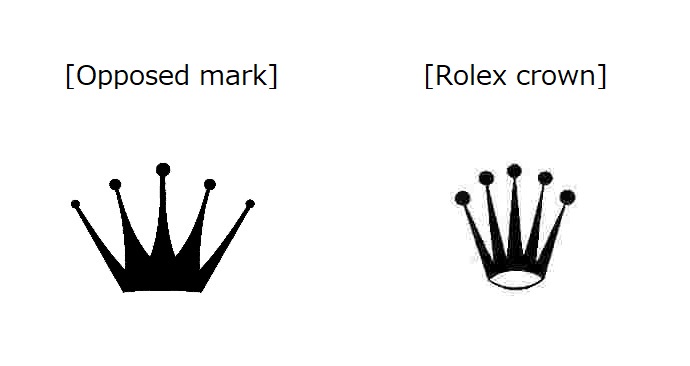
Opposed mark – Crown device

Opposed mark, consisting of a crown device (see below), was filed in the name of PWT A/S, a Danish retailer of clothing, furnishings, and accessories for men, women, and children.
The mark was filed to JPO through the Madrid Protocol (IR no. 1263679) with priority date of June 25, 2014 and admitted national registration on July 28, 2017 over the goods of “Toilet soaps, perfumery, essential oils, cosmetics, perfumed toilet preparations, preparations for cleaning, care and beauty cosmetics of the skin, scalp and hair, deodorizing preparations for personal use” in class 3, “Leather, boxes of leather or leather board, bags of leather for packaging” in class 18, and “Clothing, headgear” in class 25.
During substantive examination, JPO examiner initially issued a refusal due to a conflict with senior registrations for the Rolex crown. However, the JPO withdrew the refusal as a result of PWT’s response to partially delete goods and argue dissimilarity of mark.

Opposition by Rolex

During a two-months opposition period after registration, Rolex SA filed an opposition, stating that relevant consumers are likely to confuse or misconceive opposed mark with Rolex or any business entity systematically or economically connected with Rolex because of high similarity to the iconic Rolex crown (see above) and close association between “watches” and the designated goods in class 3 and 25.

Article 4(1)(xv)

Rolex SA sought to retroactively cancel opposed mark in relation to cosmetics and other goods designated under class 3 and clothing, headgear in class 25 based on Article 4(1)(xv) of the Japan Trademark Law.
Article 4(1)(xv) provides that a mark shall not be registered where it is likely to cause confusion with other business entity’s well-known goods or services, to the benefit of brand owner and users’ benefits.

Board decision

The Opposition Board did not question a remarkable degree of popularity and reputation of the ROLEX crown as a source indicator of opponent business.
In the meantime, the Board considered both marks give rise to a different impression in the minds of relevant consumers from overall appearance and found that the degree of similarity of marks is relatively low irrespective of a common crown design with five points and its circle-shaped ends. Besides, the Board negated close association between watches and cosmetics, apparel to the extent that watches, a sort of precision instrument, are not ordinarily manufactured or distributed by same business entity with cosmetics and apparel.

Based on the foregoing, the Board concluded that relevant consumers of goods in question are unlikely to confuse opposed mark with Rolex or any business entity systematically or economically connected with opponent.
Thus, opposed mark is not subject to Article 4(1)(x), and valid as a status quo.

Trademark battle over slogan : Think different vs Tick different

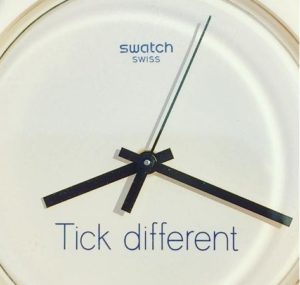
Swiss watch giant Swatch has failed to stop US tech giant Apple from registering “Think Different” as a trademark, which Swatch argued segues too closely to its own “Tick Different” trademark.

THINK DIFFERENT

Apple’s “THINK DIFFERENT” mark was used in its successful Emmy-award winning advertising campaign which ran for five years from 1997. The mark was also used on the box packaging for its iMac computers next to another trademark “Macintosh”.

Its applications to register “THINK DIFFERENT” were filed in Japan on February 24, 2016 for use in relation to various goods and services belonging to 8 classes like watches, clocks (cl.12) as well as online social networking services (cl.45), among other items. JPO admitted registration on September 12, 2017. Subsequently, the mark was published in the Official Gazette for opposition.

Tick different

By citing its own mark, Swatch filed an opposition against Apple’s “THINK DIFFERENT” mark based on Article 4(1)(xi) of the Japan Trademark Law and asserted a likelihood of confusion with Swatch “Tick different” mark when used in connection with all goods designated in class 14.

Swatch’s “Tick Different” mark was filed to JPO through the Madrid Protocol (IR no. 1279757) with priority date of July 16, 2015 and admitted national registration on July 15, 2016 by designating timepieces and chronometric instruments, namely chronometers, chronographs, clocks, watches, wristwatches, wall clocks, alarm clocks, among other items in class 14.

Swatch, having a worldwide presence and its corporate group owns a stable of Swiss watch brands, including Omega, Tissot and Swatch, has allegedly used the mark on mobile payment smart watches since 2015.


Opposition decision

Swatch argued that the two marks were highly similar due to the same syllabic structure and number of words. With the same ending and almost the same beginning, they are visually and aurally similar.

However, in decision grounds issued on June 6 2018, the Opposition Board of Japan Patent Office (JPO) found that when compared as wholes, the marks were more dissimilar than similar.

The Board, after considering all the pleadings, evidence and submissions, concluded because of the conceptual, visual and aural dissimilarities of the marks, the Board was persuaded that the average consumer would conceive they are, overall, more dissimilar than similar.

Consequently, JPO ruled that as Swatch’s opposition failed on all grounds, the “THINK DIFFERENT” mark registration from Apple will remain with the status quo.
[Opposition case no. 2017-900376]

Trademark Battle: SPEC vs. SPECK

In a trademark opposition filed by Samsonite IP Holdings S.à.r.l., an owner of IR no. 1024440 for the mark “SPECK”, against Japanese TM Reg. no. 5980195 for the mark “SPEC”, the Opposition Board of Japan Patent Office (JPO) dismissed the opposition.
[Opposition case no. 2017-900373, Gazette issue date: July 27, 2018]

“SPEC”

Opposed mark “SPEC” was filed by SPEC CORPORATION, a Japanese business entity on September 3, 2015 by designating the goods of audio speakers; audio amplifiers; audio players; CD players; audio equipment to be connected with internet” in class 9.
The JPO admitted registration on September 15, 2017 and published for registration on October 10, 2017.


“SPECK”

Samsonite IP Holdings S.à.r.l., operating as a wholly-owned subsidiary of Samsonite International S.A., a travel luggage company, owns international TM registration no. 1024440 for the mark “SPECK” over the goods of “Protective carrying cases for portable electronic listening devices and music players, namely, MP3 players, and for global positioning systems (GPS devices), mobile and cellular telephones, and portable media players” in class 9 and it has become effective in Japan since 2012.

As a result of acquisition of Speck Products, a leading U.S. designer and distributor of slim protective cases for personal electronic devices, Samsonite extends its brand portfolio beyond its traditional strength in travel luggage products.


Opposition – SPEC vs. SPECK

On December 11, 2017, Samsonite IP Holdings S.à.r.l. filed an opposition and cited senior registered mark “SPECK”.
In the opposition brief, Samsonite asserted opposed mark shall be cancelled in violation of Article 4(1)(xi) of the Japan Trademark Law.
Article 4(1)(xi) is a provision to refrain from registering a junior mark which is deemed identical with, or similar to, any senior registered mark.


Board decision

The Opposition Board negated similarity of mark between SPEC and SPECK, stating that:

“From appearance, both marks are distinguishable by means of a fact that opposed mark does not contain “K” in the suffix position since such difference shall not be negligible in the configuration consisting of small number of letters, four or five. Conceptually, opposed mark can be perceived as a word to mean specification. Meanwhile, opponent mark does not give rise to any specific meaning. Hence, both marks are dissimilar in concept.
It is doubtless that both marks give rise to the same sound, however, distinctive gap in appearance and concept may cause consumers to recognize them as a different source indicator. If so, both marks are unlikely to cause confusion and thus deemed dissimilar.”

Based on the foregoing, the Board decided opposed mark is not subject to Article 4(1)(xi), and admitted registration as a status quo.

It is just a 3D shape of electronic baccarat shoe, or trademark?

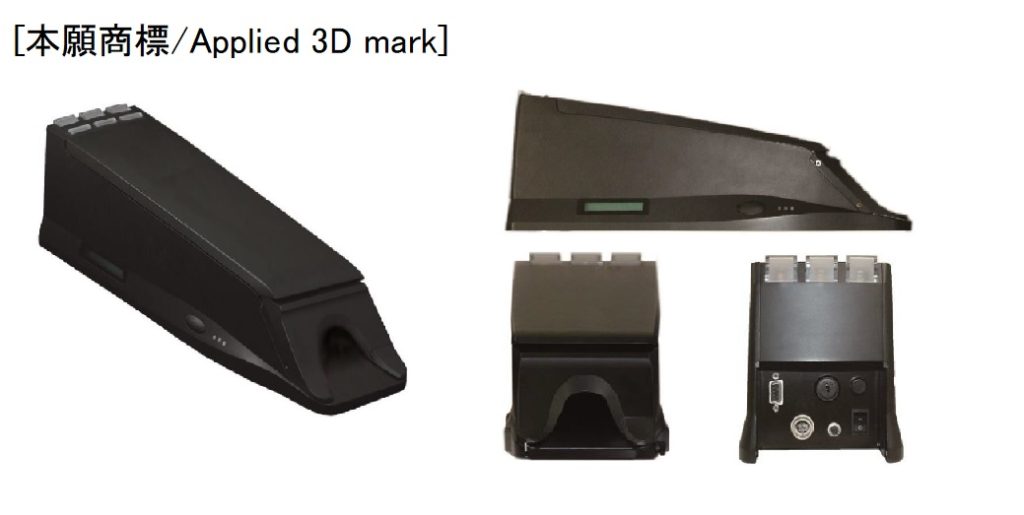
In a lawsuit disputing adequacy of decision by the JPO Appeal Board (Appeal case no. 2015-907) to refuse the applied 3D mark (TM2014-5943, class 28), consisting of a three-dimensional shape of electronic baccarat shoe with the program enabling to reduce the chance of foreign cards and eliminate dealer mistakes, due to lack of  distinctiveness and secondary meaning, the IP High Court sustained the decision being appealed.
[Case no. Heisei28(Gyo-ke)10266,  Decision date: September 27, 2017]

Inherent distinctiveness of the 3D shape

Plaintiff, a Japanese manufacturer and distributor of the ANGEL EYE electronic baccarat shoe, asserted that the 3D shape of ANGEL EYE, being the first products in the industry, is not an essential shape to make it free for public use since no competitors have dealt with same type of product other than plaintiff so far. Besides, a fact that the 3D shape has been registered in the legal gambling countries, e.g. US, EU, AU, RU, Malaysia and NZ, will rather bolster necessity to allow exclusive right on the shape.

However, the Court opposed to plaintiff. “It is inadequate to allow plaintiff to use the 3D shape exclusively. Applied 3D mark can be perceived objectively as a general shape of electronic baccarat shoe aimed to fulfill its original function and produce aesthetic image. If so, it may disorder a fair marketplace to allow exclusive use to plaintiff just because of a first-to-file. A mere fact of trademark registrations in countries where the ANGEL EYE has been distributed is insufficient to admit trademark registration in our nation since the goods is yet to be distributed in Japan.” Accordingly, the Court refused Applied 3D mark based on Article 3(1)(iii).


Secondary meaning of Applied 3D mark

Plaintiff argued Applied 3D mark has already served to function as a source indicator by means of substantial use of the mark sine 2005. Plaintiff exported 11,481 units (sale proceeds: 2.7 billion yen) over the lase decade and has achieved 90 % market share in Macau, the world’s largest casino gambling hub.

In this respect, the Court ruled in favor of the JPO. As plaintiff admits, the shoe has not been manufactured for domestic use. Any evidence suggesting a high degree of recognition to Applied 3D mark in foreign countries is neither relevant nor persuasive. Unless plaintiff demonstrates that domestic consumers have become aware of such recognition, it is groundless to find Applied 3D mark would satisfy requisite of secondary meaning based on Article 3(2) of the Japan Trademark Law.


The case raises a question: What is a role of the Trademark Law where applied mark, being registered in foreign nations,  confronts with an insuperable refusal attributable to legal restrictions on domestic use of the mark?
Unsuccessful domestic registration prevents domestic company from utilizing the Madrid Protocol and protecting his/her vital brands on the global market in an effective and economical manner.