“Teddy Bear” versus “Rose Teddy Bear”

The Appeal Board of Japan Patent Office (JPO) ruled that senior trademark registrations for the mark “Teddy Bear” in standard character over goods of trees, flowers, dried flowers, plants, seedlings, saplings in class 21 is unlikely to cause confusion with a junior mark “Rose Teddy Bear” in plain letters even if the mark is used on rose and rose bushes in class 21. [Appeal case no. 2017-18006, Gazette issue date: October 26, 2018]


Senior registrations for the “Teddy Bear” mark

“TEDDY BEAR”, a children’s toy, made from soft or furry material, which looks like a friendly bear, has its origin after Teddy, nickname for Theodore Roosevelt who was well known as a hunter of bears.

In Japan, name of the toy bear has been registered in the name of Nisshin OilliO Group. Ltd. on various goods in class 29, 30, 31 and 32 since 1986.


Junior application for “Rose Teddy Bear”

Junior mark for “Rose Teddy Bear” was applied for registration by a French company on August 10, 2016 over goods of rose, rose trees and other items relating to rose in class 31.

JPO examiner rejected junior mark due to a conflict with the “Teddy Bear” mark based on Article 4(1)(xi) of the Trademark Law on September 5. 2017.

Article 4(1)(xi) is a provision to refrain from registering a junior mark which is deemed identical with, or similar to, any senior registered mark.

To seek for registration, applicant filed an appeal against the refusal on December 5, 2017.


Appeal Board decision

The Appeal Board set aside a refusal on the grounds that:

(1) From appearance and pronunciation, the term of “Rose Teddy Bear” shall be recognized as one mark in its entirety.
(2) Relevant consumers and traders are likely to conceive the term as a coined word since it does not give rise to any specific meaning as a whole.
(3) Therefore, the refusal based on the assumption that literal portions of “Teddy Bear” in junior mark plays a dominant role made a factual mistake and shall be cancelled consequently.

It seems that the Board decision is not consistent with the Trademark Examination Guidelines (TEG) criteria.

[Chapter III, Part 10 of TEG] A composite trademark having characters representing an adjective (characters indicating the quality, raw materials, etc. of goods or characters indicating the quality of services, the location of its provision, quality, etc.) is judged as similar to a trademark without the adjective as a general rule.

In this respect, as long as the junior mark designates rose in class 21 and the term “Rose” in the mark further impresses the concept of rose in mind of consumers, the portion of “Rose” should be considered descriptive in relation to designated goods. Otherwise, any combined mark composed of registered mark and a generic term pertinent to the designated goods is deemed dissimilar to the registered mark.

I suppose the Board signaled a narrower scope of right where trademark has evidently its origin from other entity or meaning unrelated to senior registrant.

Trademark dispute for XXXX

In a recent trademark appeal trial to seek dismissal of examiner’s refusal, the Appeal Board of Japan Patent Office (JPO) set aside the refusal and allowed registration of TM Application no. 2017-21396 for the XXXX mark because of dissimilarity to a senior registration for “XXXX” mark.
[Appeal case no. 2018-5881, Gazette issue date: October 26, 2018]


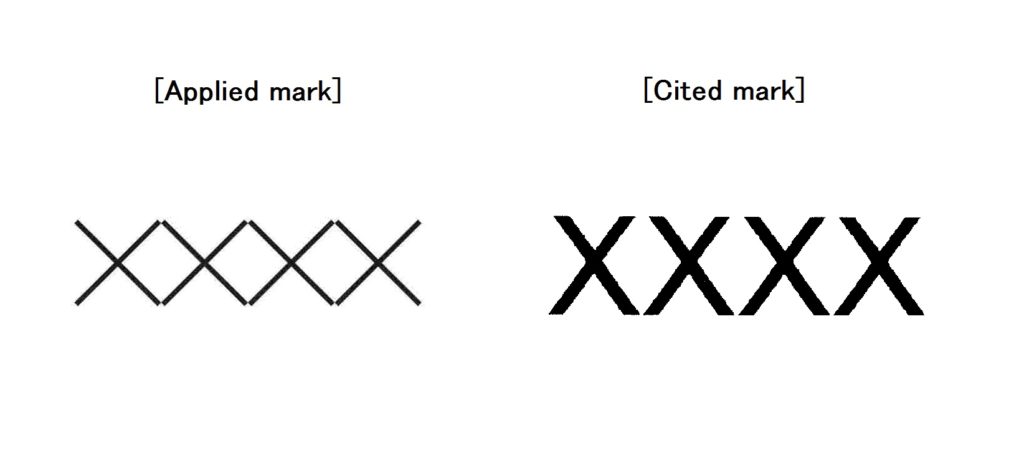
Applied mark

The mark in dispute (see below left) was applied for registration in the name of Mitsukoshi Isetan, Japan’s largest department store group, on February 22, 2017 by designating goods of clothing; belts in class 25 and retail or wholesale services for clothing, bags and pouches, handkerchief and hair ornaments in class 35.


Cited TM registration for “XXXX”

The JPO examiner refused the applied mark due to a conflict with senior TM registration no. 4147840 for the mark “XXXX” (see above right) based on Article 4(1)(xi) of the Trademark Law.

Article 4(1)(xi) is a provision to refrain from registering a junior mark which is deemed identical with, or similar to, any senior registered mark.

Cited mark has been registered since 1998 over goods of clothing, garters, sock suspenders, suspenders [braces], waistbands, belts for clothing, footwear, clothes for sports, special footwear for sports in class 25.

Applicant filed an appeal against the decision on April 27, 2018 and disputed dissimilarity of the marks.


Appeal Board decision

The Appeal Board sided with the applicant and negated similarity of both marks by stating that:

Applied mark shall be seen to represent a certain geometric figure. It appears that cited mark represents four alphabetical letters of “X” in line. It means there finds distinguishable gap between geometric figure and alphabetical letters from appearance.
Applied mark does not give rise to any specific pronunciation. In the meantime, cited mark shall have pronunciations of “eks eks eks eks” and “four eks”. Likewise, both marks are sufficiently distinguishable in pronunciation.
Besides, as long as both marks do not give rise to any specific meaning, it is not feasible to compare them in concept.
In view of above aspects, it unlikely happens confusion between the marks and thus deemed dissimilar.


Based on the foregoing, the Board decided applied mark is not subject to Article 4(1)(xi), and admitted registration.

Is Polaroid Photo Frame trademarked?

In a recent decision, the Appeal Board of Japan Patent Office (JPO) admitted trademark registration for the Polaroid Photo Frame design mark (see below) in relation to services of photo printing, digital on-demand printing, processing of photographic films, photographic retouching (class 40).
[Appeal case no. 2017-9599, Gazette issue date: June 28, 2018]


Polaroid Photo Frame

Disputed mark (see below), apparently looking like Polaroid Photo Frame, was filed in the name of PLR IP Holdings, LLC, the ex-owner of the Polaroid brand and related intellectual property, by covering services of photo printing, digital on-demand printing, processing of photographic films, photographic retouching under class 40 on June 24, 2015.

As a result of substantive examination by the JPO examiner, disputed mark was refused due to a lack of inherent distinctiveness based on Article 3(1)(vi) of the Trademark Law.

Article 3(1)(vi) is a comprehensive provision to prohibit any mark lacking inherent distinctiveness from being registered.

Any trademark to be used in connection with goods or services pertaining to the business of an applicant may be registered, unless the trademark:
(vi)
 is in addition to those listed in each of the preceding items, a trademark by which consumers are not able to recognize the goods or services as those pertaining to a business of a particular person.


Appeal Board decision

The Appeal Board sided with applicant and overruled examiner’s refusal decision by stating that the Board could not detect actual use of the applied design as a representation of shape or quality in connection with the designated services.

Besides, it is questionable to conclude that disputed mark, a combination of White Square and black rectangle, solely consists of a very simple and common sign. If so, the Board considers disputed mark is capable of serving as a source indicator so that consumers may distinguish the source with the clue of disputed mark.

Based on the foregoing, the Board admitted trademark registration of the Polaroid Photo Frame device mark in class 40.

JPO refused to register 3D shape of Mitsubishi Electric’s spiral escalator

The Appeal Board of Japan Patent Office (JPO) disallowed registration of 3D shape of Mitsubishi Electric’s spiral escalator due to lack of inherent distinctiveness and secondary meaning in relation to escalators, class 7. [Appeal case no. 2017-6855]

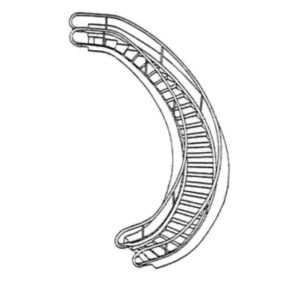
Spiral escalator

Mitsubishi Electric Corporation first developed the spiral escalator in 1985, and has been the world’s first and sole manufacturer of spiral escalators. Spiral escalator is a special design type of escalator in the form of a spiral/helical with curved steps.
On May 3, 2016, Mitsubishi Electric filed a trademark application for 3D shape of spiral escalator (see below) by designating escalators in class 7 to the JPO [TM application no. 2016-23374].

The JPO examiner totally refused the application based on Article 3(1)(iii) of the Japan Trademark Law stating that the applied mark can be easily seen as a 3D shape of escalator and the shape does solely consist of a common configuration to achieve the basic function of escalator. If so, the applied mark lacks distinctiveness as a source indicator.

To dispute the refusal, Mitsubishi Electric filed an appeal on May 12, 2017.

Appeal Board’s decision

The Appeal Board, however, upheld the examiner’s decision on the ground and dismissed Mitsubishi’s allegation by stating that relevant consumers and traders shall conceive of an escalator designed to enhance its function or sensuousness at the sight of applied mark.

Acquired distinctiveness

Mitsubishi Electric also argued that even if the applied mark is deemed descriptive in relation to escalators, it shall be registrable based on Article 3(2) due to acquired distinctiveness of the mark because Mitsubishi Electric Spiral Escalators has achieved 100 % market share in the world and continuously used the 3D shape on escalators for more than three decades.

Article 3(2) is a provision to allow registration of applied mark if, as a result of substantial use of the mark in fact, consumers are able to connect the mark with a source indicator of designated goods or services.

Under the totality of the circumstances, the Appeal Board dismissed the allegation as well.

The Board found that regardless of 100 % market share in the category of spiral escalators, Mitsubishi Electric’s domestic supply record of 24 units in the last thirty years shall be a trivial quantity in comparison with total number of escalators in operation. Besides, questionnaire result rather shows a source of the applied mark is unknown to more than 60% of the questionee.

Based on the foregoing, the Board questioned whether applied mark has acquired distinctiveness through actual use in relation to escalators and consequently refused to register the mark based on Article 3(1)(iii) and 3(2) of the Trademark Law.

Never trademark “BON GOÛT” in food-service business

The Appeal Board of the Japan Patent Office (JPO) decided to register a term of “bon goût” in relation to various foods of class 30 and restaurant service of class 43 by finding that the term is deemed a coined word to relevant public in Japan.
[Appeal case no. 2017-7985]

“BON GOÛT”

Disputed mark (see below), written in a common font design, was filed in December 14 by designating various foods of class 30, e.g. buns and breads, confectioneries, hamburgers, pizza, hot dogs, spices, noodles, pasta, coffee, tea, and restaurant service, rental of cooking apparatus and microwave ovens and others of class 43 in the ultimate.

Lack of distinctiveness

JPO examiner entirely refused the mark due to lack of distinctiveness based on Article 3(1)(iii) of the Trademark Law. In refusal decision, examiner asserted the term of “bon goût” is a French term to mean “good taste” in English.

If so, relevant consumers and traders are likely to conceive the term in association with quality of goods and services.

Besides, given the mark is written in a common font design, it shall be objectionable under Article 3(1)(iii) since the mark is solely composed of elements just to indicate, in a common manner, the place of origin, place of sale, quality, raw materials, efficacy, intended purpose, quantity, shape (including shape of packages), price, the method or time of production or use.


Appeal Board decision

In the meantime, the Appeal Board overruled examiner’s rejection and granted registration of “bon goût”.

The Board admitted the terms of “bon” and “goût” are French words meaning good and taste respectively by referring to French dictionary, but, in contrast, considered a combined word of “bon goût” is unfamiliar to Japanese public with an ordinary care.
If so, disputed mark shall be deemed a coined word in its entirety and relevant consumers are unlikely to conceive any specific meaning from the mark.

Besides, the Board held, as a result of ex officio examination, there found no circumstance to convince “bon goût” is ordinarily used as a mere descriptive indication in food-service business.

Consequently, it is groundless to reject the trademark “bon goût” based on Article 3(1)(iii) since it does not give rise to any descriptive meaning in relation to the goods and services in question.


This case gives us a lesson.
Descriptive term in foreign language has a potential risk to be registered in Japan if we are unfamiliar to the term.

JPO refused to register word mark “ROMEO GIGLI” due to lack of consent from Italian fashion designer

In a recent decision, the Appeal Board of Japan Patent Office (JPO) refused to register trademark application no. 2015- 100245 for a red-colored word mark “ROMEO GIGLI” in gothic script (see below) designating goods of Class 24 and 25 on the grounds that applicant failed to obtain a consent from Italian fashion designer, Romeo Gigli, based on Article 4(1)(viii) of the Trademark Law.[Case no. 2017-3558]

Disputed mark was filed on October 16, 2015 in the name of ECCENTRIC SRL, an Italian legal entity, by designating following goods in Class 24 and 25.

Class 24:

“woven fabrics; elastic woven material; bed and table linen; towels of textile; bed blankets; table cloths of textile; bed covers; bed sheets; curtains of textile or plastic; table napkins of textile; quilts”

Class 25:

“clothing; T-shirts; shirts; jumpers; trousers; pants; jackets; skirts; jeans; neckties; overcoats; coats; belts; gloves; mufflers; sweat suits; underwear; swimsuits; headgear; hats; caps; footwear; special footwear for sports”


Article 4(1)(viii)

On December 9, 2016, JPO examiner refused the mark based on Article 4(1)(viii) of the Trademark Law.

Article 4(1)(viii) is a provision to prohibit registration of trademarks which contain the representation or name of any person, famous pseudonym, professional name or pen name of another person, or famous abbreviation thereof. Notwithstanding the provision, the article is not applicable where the applicant of disputed mark produces the written consent of the person.

The Supreme Court of Japan has ruled the article shall be interpreted to protect personal rights of a living individual. In line with the Supreme Court ruling, Trademark Examination Manuals (TEM) set forth that the article is applicable not only to natural persons (including foreigners) and corporations but also associations without capacity. Familiar name of foreigners falls under the category of “abbreviation” if its full name contains middle name(s) unknown to Japanese consumer.

Click here to access TEM on the JPO website.

Finding that disputed mark just consists of an individual name of famous fashion designer, Romeo Gigli, the examiner raised an objection based on Article 4(1)(viii) unless ECCENTRIC SRL obtains a consent from the designer.


APPEAL

The applicant filed a notice of appeal with the Appeal Board, a body within JPO responsible for hearing and deciding certain kinds of cases including appeals from decisions by JPO Examiners denying registration of marks, on March 9, 2017 and contended against the refusal decision by examiner.

During the appeal trial, ECCENTRIC SRL argued inadequacy of the decision by demonstrating following facts.

  • ECCENTRIC SRL is a legitimate successor of trademark rights owned by Romeo Gigli as a consequence of mandatory handover resulting from bankruptcy of company managed by Romeo Gigli irrespective of his intention. Under the circumstance, it is almost impossible to obtain a written consent from him.
  • In the meantime, ECCENTRIC SRL has already obtained trademark registrations for the word mark “ROMEO GIGLI” in several jurisdictions.
  • Besides, ECCENTRIC SRL is a current registrant of Japanese TM registration no. 2061302 for identical wordmark in Class 4,18,21 and 26.
  • There has been no single complaint from consumers, traders or Romeo Gigli in person.

ECCENTRIC SRL alleged that the above facts shall amount to having obtained an implicit consent from Romeo Gigli in fact. Thus, disputed mark shall be allowed for registration even without a written consent in the context of purpose of the article.

The Appeal Board dismissed the appeal, however, and sustained the examiner’s decision by saying that trademark registrations in foreign countries shall not be a decisive factor in determining registrability of disputed mark under Article 4(1)(viii) in Japan. Absence of complaint from Romeo Gigli shall not be construed that he has consented to register his name in the territory of Japan explicitly or implicitly.

Unless applicant produces evidence regarding a consent from Romeo Gigli otherwise, disputed mark shall be refused to register based on Article 4(1)(viii) of the Trademark Law.


According to the JPO database, ECCENTRIC SRL filed an appeal against the Board decision to the IP High Court in November 2017. The Court decision will be rendered within a couple of months.


How can a combination of descriptive words become a source indicator?

In a recent decision, the Appeal Board of Japan Patent Office (JPO) granted to protect a word mark “TOUGH CARRY” in relation to carts and trolleys of class 12.
[Appeal case no. 2017-7976]

“TOUGH CARRY”

As a result of substantive examination, the JPO examiner refused trademark application no. 2016-28871 for a mark “TOUGH CARRY” composed of descriptive words combination in relation to carts, trolleys, sleighs and sleds[vehicles], rickshaws, horse drawn carriages, bicycle trailers [Riyakah], and casting carriages of class 12 on the ground that the mark lacks distinctiveness under Article 3(1)(iii) of the Trademark Law. Examiner raised her objection based on the facts that a word of “TOUGH” means “strong and durable; not easily broken or cut”. “CARRY” means “to take or support from one place to another; convey; transport”. Besides, it is obvious that relevant consumers are familiar with both words. If so, consumers with an ordinary care will surely conceive the meaning of “being able to transport items with strong and durable capability” at the sight of trademark “TOUGH CARRY” when used on designated goods.

Appeal Board decision

In the meantime, the Appeal Board cancelled the examiner’s rejection and admitted registration of “TOUGH CARRY”.

The Board decided that, even if respective word, highly known among consumers, inherently lacks distinctiveness in relation to goods of class 12 and the entire mark gives rise to the meaning as examiner asserted, it does not mean the mark as a whole is just a direct and clear qualitative indication of specific goods.

On the case, the Board found, as a result of ex officio examination, no evidence to demonstrate the descriptive words combination of “TOUGH CARRY” is ordinarily used in transaction of carts and trolleys. Besides, there exists no circumstance to use the combination as a qualitative indication in relation to any other goods.

Consequently, it is groundless to reject the trademark “TOUGH CARRY” based on Article 3(1)(iii) since it does not give rise to any descriptive meaning in relation to the goods in question.


Occasionally, a trademark composed of descriptive words combination becomes controversial. Such disputes mostly focus on distinctiveness of the entire mark. In case the JPO found that combination of respective word is unique and remains suggestive in relation to disputed goods/service by taking account of transactional circumstance, the mark is eligible for registration regardless of descriptive meaning of each word.
In other words, it depends on competitor’s behavior and perception of relevant consumers whether a combination of descriptive words can be protected as a source indicator.

Masaki MIKAMI, Attorney at IP law – Founder of MARKS IP LAW FIRM

How do you pronounce “Q-revo” mark?

In an administrative appeal disputing trademark similarity between TM registration no. 2705284 for word mark “REVO” and a junior trademark represented as below, the Appeal Board of Japan Patent Office (JPO) decided that both marks are deemed dissimilar and allowed to register the junior trademark accordingly.
[Appeal case no. 2017-8341]

Disputed mark

Disputed mark (see above) was applied for trademark registration on October 30, 2015 by designating goods of telecommunication machines, electronic machines and others belonging to class 9.

As a result of substantive examination by the JPO, examiner refused the disputed mark by citing a senior TM registration “REVO” based on Article 4(1)(xi) of the Trademark Law to find that the citation has also covered telecommunication machines, electronic machines in the designation which are deemed identical with disputed mark.

Subsequently, the applicant of disputed mark filed an appeal to the case.

TRADEMARK APPEAL

Main issue at the appeal rested on how disputed mark should be pronounced in the assessment of trademark similarity.

In this respect, the Board held that disputed mark gives rise to a sole pronunciation of “kju- riːvo” in view of overall configuration fully consolidated from appearance.

Based on the finding, the Board compared the disputed mark and the citation in the aspect of visual appearance, sound and concept, and concluded, inter alia, both sounds, “kju- riːvo” and “ riːvo”, are distinctively dissimilar.


It has been recognized in Japan that hyphen (-) serves as a separator of words at fore-and-aft position. To see a graphical distinction between the “Q” logo and “revo”, I believe the decision isn’t quite persuasive enough.