Trademark race for the 2020 Tokyo Olympic Games

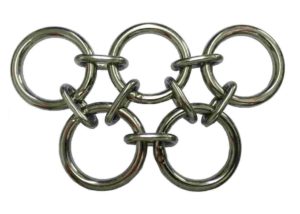
The Appeal Board of Japan Patent Office (JPO) refused Trademark Application No. 2016-85559 for a device mark consisting of metallic rings on goods of metallic fishing nets in class 6 on the ground of conflict with Article 4(1)(vi) of the Japan Trademark Law.

Metallic ring device mark

Mark in question ( see below) was filed on August 8, 2016 by designating goods of metallic fishing nets in class 6.
Article 4(1)(vi) of the Trademark Law

The JPO examiner refused the mark by citing the Olympic Rings based on Article 4(1)(vi) of the Trademark Law.
Article 4(1)(vi) is a provision to refuse any mark which is identical with, or similar to, a famous mark indicating the State, a local government, an agency thereof, a non-profit organization undertaking a business for public interest, or a non-profit enterprise undertaking a business for public interest.
JPO trademark examination guidelines clearly refer to the Olympic Symbol as an example of the mark to indicate a non-profit business for public interest.

Olympic Rings

The Olympic symbol, widely known throughout the world as the Olympic Rings, is the visual ambassador of Olympism for billions of people.
The Olympic symbol is defined in Olympic Charter, Rule 8 as

“The Olympic symbol consists of five interlaced rings of equal dimensions (the Olympic rings), used alone, in one or in five different colours. When used in its five-colour version, these colours shall be, from left to right, blue, yellow, black, green and red. The rings are interlaced from left to right; the blue, black and red rings are situated at the top, the yellow and green rings at the bottom.”

The Olympic Rings, publicly presented for the first time in 1913, remain a global representation of the Olympic movement and its activity.

Appeal Board decision

In an appeal, the Board sustained examiner’s refusal and decided the mark in question shall be refused on the same ground.
The Board stated that mark in question has same configuration with the Olympic Rings and thus consumers at the sight of the mark are likely to conceive a well-known Olympic symbol from appearance regardless of difference in small rings to connect five symbolic rings.
[Appeal case no. 2018-1590, Gazette issued date : August 31, 2018]

Is Polaroid Photo Frame trademarked?

In a recent decision, the Appeal Board of Japan Patent Office (JPO) admitted trademark registration for the Polaroid Photo Frame design mark (see below) in relation to services of photo printing, digital on-demand printing, processing of photographic films, photographic retouching (class 40).
[Appeal case no. 2017-9599, Gazette issue date: June 28, 2018]


Polaroid Photo Frame

Disputed mark (see below), apparently looking like Polaroid Photo Frame, was filed in the name of PLR IP Holdings, LLC, the ex-owner of the Polaroid brand and related intellectual property, by covering services of photo printing, digital on-demand printing, processing of photographic films, photographic retouching under class 40 on June 24, 2015.

As a result of substantive examination by the JPO examiner, disputed mark was refused due to a lack of inherent distinctiveness based on Article 3(1)(vi) of the Trademark Law.

Article 3(1)(vi) is a comprehensive provision to prohibit any mark lacking inherent distinctiveness from being registered.

Any trademark to be used in connection with goods or services pertaining to the business of an applicant may be registered, unless the trademark:
(vi)
 is in addition to those listed in each of the preceding items, a trademark by which consumers are not able to recognize the goods or services as those pertaining to a business of a particular person.


Appeal Board decision

The Appeal Board sided with applicant and overruled examiner’s refusal decision by stating that the Board could not detect actual use of the applied design as a representation of shape or quality in connection with the designated services.

Besides, it is questionable to conclude that disputed mark, a combination of White Square and black rectangle, solely consists of a very simple and common sign. If so, the Board considers disputed mark is capable of serving as a source indicator so that consumers may distinguish the source with the clue of disputed mark.

Based on the foregoing, the Board admitted trademark registration of the Polaroid Photo Frame device mark in class 40.

JPO refused to register 3D shape of Mitsubishi Electric’s spiral escalator

The Appeal Board of Japan Patent Office (JPO) disallowed registration of 3D shape of Mitsubishi Electric’s spiral escalator due to lack of inherent distinctiveness and secondary meaning in relation to escalators, class 7. [Appeal case no. 2017-6855]

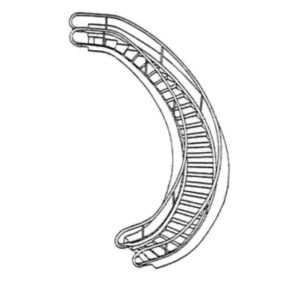
Spiral escalator

Mitsubishi Electric Corporation first developed the spiral escalator in 1985, and has been the world’s first and sole manufacturer of spiral escalators. Spiral escalator is a special design type of escalator in the form of a spiral/helical with curved steps.
On May 3, 2016, Mitsubishi Electric filed a trademark application for 3D shape of spiral escalator (see below) by designating escalators in class 7 to the JPO [TM application no. 2016-23374].

The JPO examiner totally refused the application based on Article 3(1)(iii) of the Japan Trademark Law stating that the applied mark can be easily seen as a 3D shape of escalator and the shape does solely consist of a common configuration to achieve the basic function of escalator. If so, the applied mark lacks distinctiveness as a source indicator.

To dispute the refusal, Mitsubishi Electric filed an appeal on May 12, 2017.

Appeal Board’s decision

The Appeal Board, however, upheld the examiner’s decision on the ground and dismissed Mitsubishi’s allegation by stating that relevant consumers and traders shall conceive of an escalator designed to enhance its function or sensuousness at the sight of applied mark.

Acquired distinctiveness

Mitsubishi Electric also argued that even if the applied mark is deemed descriptive in relation to escalators, it shall be registrable based on Article 3(2) due to acquired distinctiveness of the mark because Mitsubishi Electric Spiral Escalators has achieved 100 % market share in the world and continuously used the 3D shape on escalators for more than three decades.

Article 3(2) is a provision to allow registration of applied mark if, as a result of substantial use of the mark in fact, consumers are able to connect the mark with a source indicator of designated goods or services.

Under the totality of the circumstances, the Appeal Board dismissed the allegation as well.

The Board found that regardless of 100 % market share in the category of spiral escalators, Mitsubishi Electric’s domestic supply record of 24 units in the last thirty years shall be a trivial quantity in comparison with total number of escalators in operation. Besides, questionnaire result rather shows a source of the applied mark is unknown to more than 60% of the questionee.

Based on the foregoing, the Board questioned whether applied mark has acquired distinctiveness through actual use in relation to escalators and consequently refused to register the mark based on Article 3(1)(iii) and 3(2) of the Trademark Law.

JPO refused 3M Company to register “3M” in relation to vehicles regardless of renowned 3M logo

In a recent decision, the Appeal Board of Japan Patent Office (JPO) did not allow registration of a word mark “3M” written in standard character due to a lack of distinctiveness in relation to vehicles (class 12). [Appeal case no. 2017-3200]

Disputed mark – “3M” in standard character

Disputed mark, a word consisting of “3M” written in standard character, was filed by designating various types of vehicles (class 12) in the name of 3M Company, an American multinational technology company that engages in the manufacture of industrial, safety and consumer goods, and equipment on October 28, 2014 (TM application no. 2014-90835).

Article 3(1)(v)

On December 6, 2016, The JPO examiner totally refused disputed mark based on Article 3(1)(v) of the Trademark Law, stating that sign consisting of a digit and an alphabet is commonly used in transaction to represent article number, model number or standards. If so, disputed mark lacks inherently distinctiveness as a source indicator.

The article prohibits applied mark from registering if the mark consists solely of a very simple and common mark. Trademark Examination Guidelines (TEG) provides that a trademark composed of a numeral followed by one or two Roman characters, e.g. 2A, is subject to the article.

3M Company filed an appeal against the refusal and asserted that “3M” has become famous among public in general as a trade name and source indicator of applicant or its Japanese subsidiary.

Appeal Board decision

The Board, however, dismissed the assertions by finding that:

  1. Evidences just reveal longtime use of “3M” as a trade name of applicant or its subsidiary. But most of them show disputed “3M” mark is used to represent a commercial name in the context of newspapers and web articles. If so, there shall not be seen as a source indicator.
  2. Renowned 3M logo is different from disputed 3M mark in appearance.
  3. Even if “3M” keyword extraction from the web pages demonstrates substantial numbers of articles pertinent to applicant’s business and less possibility to use “3M” by unrelated business entities as article number, model number or standards, these facts are insufficient not to apply Article 3(1)(v).
  4. Precedent administrative decisions and judicial rulings are cases relating to renowned 3M logo. If so, as long as disputed mark consists of “3M” written in standard character, the Board can’t find any reason to bind the case in dispute.

NIKE unsuccessful in registering JUST DO IT on cosmetics

In a recent decision, the Appeal Board of Japan Patent Office (JPO) dismissed an appeal filed by NIKE Innovate C.V., who attempted to register a word mark “JUST DO IT” in standard character on cosmetics and other goods classified in class 3 by means of “defensive mark” under Article 64 of the Japan Trademark Law.
[Appeal case No. 2015-23031, Gazette issued date: February 23, 2018]


DEFENSIVE MARK

According to Article 64, famous brand owner is entitled to register its brand as “defensive mark” with respect to dissimilar goods/services that are not designated under the basic registration, where the owner shall demonstrate that the mark has acquired remarkable prestige in relation to the goods/services on which the mark has been substantially used, and thus there will be likely to occur confusion with the owner if an identical or similar mark is used on dissimilar or remotely associated goods/services with basic registration.


JUST DO IT

NIKE Innovate C.V. owns trademark registration no. 4206837 for the word mark “JUST DO IT” on apparels, shoes and sportswear and other goods in class 25 since 1998.

NIKE sought to register the mark as defensive mark on cosmetics (class 3) on October 22, 2014 (Trademark application no. 2014-88774). Examiner refused the application by stating that it is unclear whether the mark has been used in connection with applicant’s goods of class 25. If so, the mark can be recognized merely as a commercial slogan to represent sports event. Consequently, examiner considers the mark has not become well-known mark as a source indicator of applicant.

To contest the refusal, NIKE filed an appeal on December 15, 2015.


BOARD DECISION

The Appeal Board likewise questioned whether “JUST DO IT” has been used as a source indicator of apparel, shoes, or sportswear.

Board admitted a certain degree of popularity and reputation on the term “JUST DO IT” as a corporate message from NIKE, however, upheld the refusal by stating that the produced advertisement and evidences regarding “JUST DO IT” are insufficient and vague to connect the term with goods designated under basic registration.


Apparently, the Board underestimated “JUST DO IT” on the grounds that NIKE failed to advertise the term in a manner closely connected with specific goods.


No Violation of the US President’s Personality Rights

The Appeal Board of Japan Patent Office (JPO) admitted trademark registration for a mark consisting of jigsaw puzzles design and “TA TRUMP” (see below), saying that it does not violate personality rights of Mr. Donald John Trump, the President of the United States.


MARK IN QUESTION

A Japanese individual filed a trademark application for the mark consisting of jigsaw puzzles design and a word of “TA TRUMP” (see below) on November 23, 2016 by designating “psychology education cards” in class 16.

JPO examiner refused the mark on the grounds that it comprises a famous abbreviation of Mr. Donald John Trump, the President of the United States and presumably the applicant would not obtain consent from him.


Article 4(1)(viii)

Article 4(1)(viii) of the Trademark Law prohibits registration of trademarks which contain the representation or name of any person, famous pseudonym, professional name or pen name of another person, or famous abbreviation thereof. Notwithstanding the provision, the article is not applicable where the applicant of disputed mark produces the written consent of the person.

The Supreme Court of Japan ruled the article has aimed to protect personality rights of a living individual. A diminutive of foreign celebrity falls under the category of “abbreviation” even if his/her full name is not so familiar among Japanese citizen.


To contest the refusal, the applicant filed an appeal on August 11, 2017.


Appeal Board

In the decision rendered on January 10, 2018, the Appeal Board overruled the refusal and admitted registration of the mark in question by stating that:

  1. “TRUMP” has been known as an English term meaning playing cards among the public in Japan.
  2. In the meantime, “TRUMP” admittedly corresponds to a surname of Mr. Donald John Trump and it becomes evident he is a well-known person as the 45th President of the United States to be called “President Trump”.
  3. Overall appearance of the applied mark easily reminds us of a kind of playing card back designs.
  4. If so, the term of “TRUMP” depicted in the mark shall not be considered to suggest President Trump at all.
  5. Based on the foregoing, accordingly it is groundless to refuse the mark based on Article 4(1)(viii).


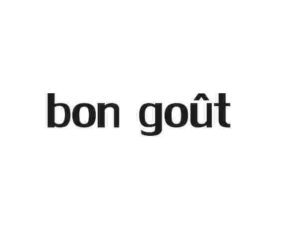
Never trademark “BON GOÛT” in food-service business

The Appeal Board of the Japan Patent Office (JPO) decided to register a term of “bon goût” in relation to various foods of class 30 and restaurant service of class 43 by finding that the term is deemed a coined word to relevant public in Japan.
[Appeal case no. 2017-7985]

“BON GOÛT”

Disputed mark (see below), written in a common font design, was filed in December 14 by designating various foods of class 30, e.g. buns and breads, confectioneries, hamburgers, pizza, hot dogs, spices, noodles, pasta, coffee, tea, and restaurant service, rental of cooking apparatus and microwave ovens and others of class 43 in the ultimate.

Lack of distinctiveness

JPO examiner entirely refused the mark due to lack of distinctiveness based on Article 3(1)(iii) of the Trademark Law. In refusal decision, examiner asserted the term of “bon goût” is a French term to mean “good taste” in English.

If so, relevant consumers and traders are likely to conceive the term in association with quality of goods and services.

Besides, given the mark is written in a common font design, it shall be objectionable under Article 3(1)(iii) since the mark is solely composed of elements just to indicate, in a common manner, the place of origin, place of sale, quality, raw materials, efficacy, intended purpose, quantity, shape (including shape of packages), price, the method or time of production or use.


Appeal Board decision

In the meantime, the Appeal Board overruled examiner’s rejection and granted registration of “bon goût”.

The Board admitted the terms of “bon” and “goût” are French words meaning good and taste respectively by referring to French dictionary, but, in contrast, considered a combined word of “bon goût” is unfamiliar to Japanese public with an ordinary care.
If so, disputed mark shall be deemed a coined word in its entirety and relevant consumers are unlikely to conceive any specific meaning from the mark.

Besides, the Board held, as a result of ex officio examination, there found no circumstance to convince “bon goût” is ordinarily used as a mere descriptive indication in food-service business.

Consequently, it is groundless to reject the trademark “bon goût” based on Article 3(1)(iii) since it does not give rise to any descriptive meaning in relation to the goods and services in question.


This case gives us a lesson.
Descriptive term in foreign language has a potential risk to be registered in Japan if we are unfamiliar to the term.

Appeal Board reversed examiner’s rejection in the BOB trademark dispute

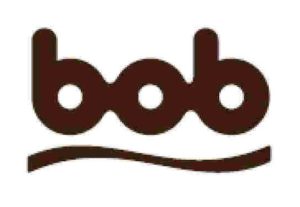
In an administrative appeal disputing trademark similarity between TM registration no. 5719997 for word mark “BOB” and a junior application no. 2016-49394 for the “bob” device mark represented as below, the Appeal Board of the Japan Patent Office decided that both marks are deemed dissimilar and reversed examiner’s rejection.
[Appeal case no. 2017-10420, Gazette issued date: January 26, 2018]


TM Registration no. 5719997

The cited mark, consisting of a word “BOB” in standard character, was registered on November 21, 2014 by designating various items of furniture in class 20.


Junior Application no. 2016-49394

Applied junior mark consists of the following “bob” device mark.

It was applied for registration on May 5, 2016 by designating furniture in class 20.

As a result of substantive examination by the JPO examiner, applied mark was rejected due to a conflict with the cited mark based on Article 4(1)(xi) of the Trademark Law.
Subsequently, the applicant filed an appeal against the rejection and disputed dissimilarity of both marks.


Board decision

In the decision, the Appeal Board held that:

applied mark is a device in dark brown, consisting of two circles protruding upward on the left side, a circle connected with the two circles in line, and wavy lines underneath.

From appearance, even if it may happen the circle design is recognized as a stylized design of “bob”, the Board opines that the design is unlikely to be considered as alphabetical letters due to a remarkable extent of stylization or abstraction. Thus, it is reasonable to conclude that applied mark shall not give rise to any specific pronunciation and meaning.

Based on the foregoing, in the assessment of trademark similarity, the Board decided that:

Obviously, both marks are distinguishable in appearance. As long as applied mark does not give rise to a specific pronunciation and meaning, it is meaningless to compare the pronunciation and meaning of both marks. Consequently, the Board finds no ground to affirm examiner’s rejection from visual, phonetic, and conceptual point of view.


Astonishingly, JPO considered the bob device mark is unreadable.