MONSTER STRIKE vs MONSTER ENERGY

The Japan Patent Office (JPO) did not decide in favour of Monster Energy Company in its opposition to Defensive Mark Reg. No. 5673517 for the word mark “MONSTER STRIKE” in Classes 29, 30, and 32.
[Opposition case no. 2023-900135, decided on November 4, 2025]


MONSTER STRIKE

Monster Strike, a popular mobile “slingshot hunting RPG” developed by the Japanese company Mixi, is famous for its simple pull-and-release gameplay, deep co-op mode for up to four players, frequent collaborations, and immense revenue. Monster Strike essentially saved Mixi’s social network legacy, becoming a cultural phenomenon in Japan and generating billions in revenue while fostering family communication.

Since 2014, Mixi has owned trademark registration for the word mark “MONSTER STRIKE” in Classes 9 and 41 in connection with game programs [TM Reg no. 5673517].

On March 29, 2021, Mixi filed a defensive mark application for the mark to expand the scope of protection in Classes 14, 16, 18, 21, 24, 25, 26, 28, 29, 30, 32, and 33, including beverages [TM Application no. 2021-37152].


Defensive mark

Article 64 of the Japan Trademark Law provides the requirements for defensive mark registration.

“Where a registered trademark is well known among consumers as an indicator of the designated goods or service in connection with the owner’s business and confusion is likely if the mark is to be used on dissimilar goods or services by a third party, the owner is entitled to obtain a defensive mark registration for the same mark in connection with such goods or services.”

A trademark can be registered as a defensive mark for dissimilar goods or services not covered by the original registration if the owner can demonstrate that the mark has gained significant prestige for the goods or services for which it has been used. This is because relevant consumers are likely to confuse the source of the goods or services if they are remotely associated with or dissimilar to those in the original registration due to the substantial reputation of the mark.

It is noteworthy that the JPO does not examine whether a defensive mark may confuse earlier marks that have been registered on the goods and services designated in the defensive mark application.

The JPO granted registration of the mark MONSTER STRIKLE in Classes 14, 16, 18, 21, 24, 25, 26, 28, 29, 30, 32, and 33 as a defensive mark on March 24, 2023, and published it for a post-grant opposition on April 3, 2024.

Subsequently, Monster Energy Company filed an opposition against the defensive mark registration, claiming cancellation for goods, inter alia, beverages, in Classes 29, 30, and 33, in contravention of Article 64.


JPO decision

The JPO Opposition Board found that “MONSTER STRIKE” has been widely recognised among not only consumers for game programs designated under the original registration, but also relevant consumers unrelated to the game industry.

The Board noted a trade practice that, in general, there are a lot of goods, including food and beverages, distributed bearing well-known contents and characters in collaboration with other suppliers. Bearing this in mind, it is reasonable to find that the contested goods are to some extent associated with the goods and services in the original registration.

Therefore, where the contested goods bearing the term “MONSTER STRIKE” are placed in the market by a third party, relevant consumers are likely to consider that the goods originate from Mixi or economically linked undertakings, and thus confuse the source accordingly.

The opponent claimed their substantial use of the mark “MONSTER” on the energy drink. However, such facts are irrelevant to evaluate the likelihood of confusion stipulated under Article 64(1).

Based on the above findings, the JPO dismissed the opposition and declared registration of the defensive mark as the status quo.
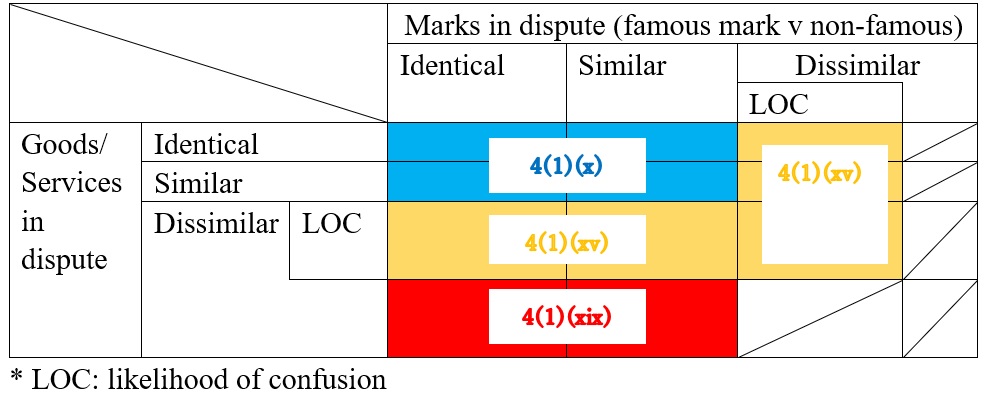
Famous mark Protection under Trademark Law

Japan is a rigid “first-to-file” jurisdiction, meaning that it is necessary to register a trademark in order to obtain proprietary rights over it in principle. Prior use of the trademark is insufficient to be protected under the Trademark Law. The only meaningful exception to this rule is the treatment of so-called famous trademarks even if they have not been filed yet. But it should note owners of famous trademarks can’t file an infringement lawsuit based on the trademark right without registration in Japan. The Trademark Law provides special provisions to protect the famous trademarks. However, the statute never refers to the “famous” mark. It only refers to “recognized” marks, “widely recognized” marks, and “highly recognized” marks.


Relative grounds for refusal, opposition, invalidation

Like other jurisdictions, the Japan Trademark Law prohibits registration of junior marks which are the same as or similar to senior marks that are effectively registered in Japan under Article 4(1)(xi). In order to provide broader protection of famous trademarks, the Law stipulates extra grounds for refusal, opposition, and invalidation on Article 4(1)(x), (xv), (xix).

Article 4(1)(x)

Trademarks that are the same as or similar to trademarks that are widely recognized by consumers as marks indicating the goods or services of another and are used on the same goods or services or similar to those of the other party may not be registered.

Article 4(1)(xv)

Trademarks that are likely to cause confusion in connection with the goods or services related to another’s business may not be registered.

Article 4(1)(xix)

Trademarks which are the same as or similar to trademarks that are widely recognized among consumers either in Japan or in foreign countries as identifying the goods or services related to another’s business and are used for illicit purposes such as trading off the goodwill of another or causing damage to another may not be registered.

These articles spotlight that the Japan Trademark Law considers (1) “similarity” as a most critical issue to determine the scope of protection to famous trademark and (2) “likelihood of confusion” as other legal concepts different from “similarity”.


Defensive mark

A famous trademark may be registered as a defensive mark to cover other identified goods or services than those listed in the original registration under Article 64. These additional goods or services need to be dissimilar to the original goods or services and the registrant needs to prove (1) that the mark is “widely recognized by consumers” and (2) that confusion is likely if the mark is used on these additional goods or services by a third party.

Noteworthy is that defensive mark registration would not be vulnerable to non-use cancellation. Besides, the registrant is entitled to take action against a third party for trademark infringement even if the mark was used on the goods or services that are remotely associated with his business.


Prior use rights

As stated above, a mere prior use is insufficient to be protected under the Trademark Law. Prior user is entitled to defense for trademark infringement only where the mark is “widely recognized by consumers” as identifying the goods or services of the prior user at the filing date of initial trademark application by the registrant under Article 32.


Enforcement/Infringement

Unauthorized use of the mark that is the same as or similar to the registered mark constitutes trademark infringement under Articles 25 and 37(i).

As a matter of law, the Trademark Law does not provide broader protection of famous trademarks in enforcement. No specific provision is given to prohibit famous trademark dilution and parody. There is a considerable gray zone in the Trademark Law when it comes to the unauthorized use of “non-similar” marks that are likely to cause confusion with famous trademarks.

NIKE unsuccessful in registering JUST DO IT on cosmetics

In a recent decision, the Appeal Board of Japan Patent Office (JPO) dismissed an appeal filed by NIKE Innovate C.V., who attempted to register a word mark “JUST DO IT” in standard character on cosmetics and other goods classified in class 3 by means of “defensive mark” under Article 64 of the Japan Trademark Law.
[Appeal case No. 2015-23031, Gazette issued date: February 23, 2018]


DEFENSIVE MARK

According to Article 64, famous brand owner is entitled to register its brand as “defensive mark” with respect to dissimilar goods/services that are not designated under the basic registration, where the owner shall demonstrate that the mark has acquired remarkable prestige in relation to the goods/services on which the mark has been substantially used, and thus there will be likely to occur confusion with the owner if an identical or similar mark is used on dissimilar or remotely associated goods/services with basic registration.


JUST DO IT

NIKE Innovate C.V. owns trademark registration no. 4206837 for the word mark “JUST DO IT” on apparels, shoes and sportswear and other goods in class 25 since 1998.

NIKE sought to register the mark as defensive mark on cosmetics (class 3) on October 22, 2014 (Trademark application no. 2014-88774). Examiner refused the application by stating that it is unclear whether the mark has been used in connection with applicant’s goods of class 25. If so, the mark can be recognized merely as a commercial slogan to represent sports event. Consequently, examiner considers the mark has not become well-known mark as a source indicator of applicant.

To contest the refusal, NIKE filed an appeal on December 15, 2015.


BOARD DECISION

The Appeal Board likewise questioned whether “JUST DO IT” has been used as a source indicator of apparel, shoes, or sportswear.

Board admitted a certain degree of popularity and reputation on the term “JUST DO IT” as a corporate message from NIKE, however, upheld the refusal by stating that the produced advertisement and evidences regarding “JUST DO IT” are insufficient and vague to connect the term with goods designated under basic registration.


Apparently, the Board underestimated “JUST DO IT” on the grounds that NIKE failed to advertise the term in a manner closely connected with specific goods.