SERAPIAN Successful in Registering iconic MOSAICO braided pattern as trademark

The Italian-based fashion house Stefano Serapian S.r.l. was successful in an appeal to overturn the examiner’s rejection of TM App no. 2022-131488 for the Serapian’s signature “Mosaico” leather pattern in Class 18.
[Appeal case no. 2023-16337, decided on December 17, 2025]


SERAPIAN MOSAICO

Stefano Serapian S.r.l. filed a trademark application for a braided pattern (see below) for use on bags, suitcases, tote bags, backpacks, key cases, porches, wallets, coin cases, and handbags in Class 18 with the JPO on November 17, 2022 [TM App no. 2022-131488].
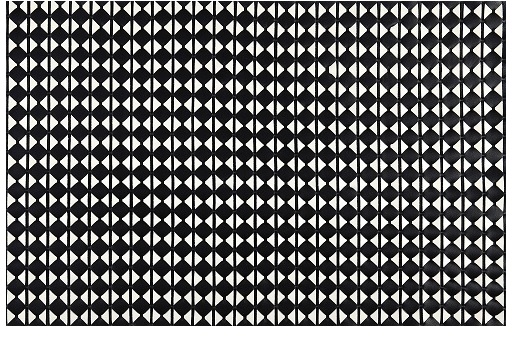
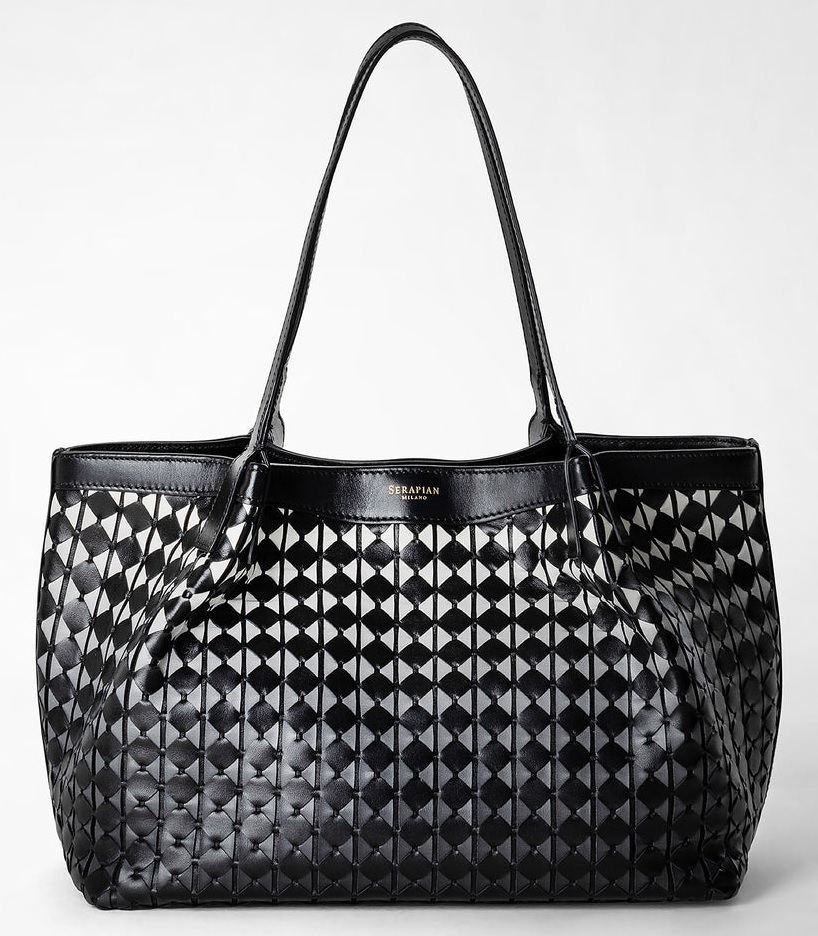
The Serapian Mosaico pattern is known for its iconic hand-weaving technique, which dates back to 1947 and serves as an emblem of the Italian luxury brand, Serapian.

JPO Examination

On June 26, 2023, the examiner rejected the mark based on Article 3(1)(vi) of the Japan Trademark Law by finding that:

The applied-for mark represents a continuous and repetitive geometric pattern consisting of a white square with a vertical line in the middle and a black square in a diagonal position. As a whole, it will be perceived merely as a decorative background design. Besides, there is no distinctive element that identifies the source of the goods in question. Consequently, consumers are unable to recognize it as a source indicator due to its lack of inherent distinctiveness.

Serapian filed an appeal against the rejection on September 27, 2023, to dispute the inherent distinctiveness of the mark based on substantial use and advertising of the Mosaico collection in Japan since 2014.


JPO Appeal Board Decision

The JPO Appeal Board noted the following facts.

  • Founded in 1928, the applicant is known for its line of bags favored by the late British actress Audrey Hepburn. The applicant’s bags, which depict the applied-for mark and were designed in 1947, have been sold nationwide in Japan for over 10 years and have been distributed in Japan since 2014.
  • Major fashion magazines and online articles have featured the bags and their iconic “MOSAICO” pattern design.
  • The bags are also sold in major department stores and online malls. Despite being expensive and high-end goods, annual sales exceeded JPY 50 million in 2023 and JPY 9 million in 2024.
  • A discretionary survey by the Board did not reveal the actual use of a similar pattern by others.

Based on the foregoing, the Board found that relevant consumers and traders can distinguish the applicant’s goods from others based solely on the Mosaico pattern.

Therefore, since the applied-for mark is not subject to Article 3(1)(vi) of the Japan Trademark Law, the Board overturned the examiner’s rejection.

Audemars Piguet Unsuccessful Challenge of TM Registration for Iconic Shape of “ROYAL OAK” Timepiece

On June 8, 2023, the Japan Patent Office (JPO) dismissed an appeal filed by Audemars Piguet Holding SA, a Swiss luxury watchmaker, and affirmed the examiner’s rejection of TM App no. 2020-20319 for a device mark representing AP’s iconic “ROYAL OAK” watch collection by finding a lack of inherent and acquired distinctiveness. [Appeal case no. 2021-013234]


Audemars Piguet “ROYAL OAK” Watch Collection

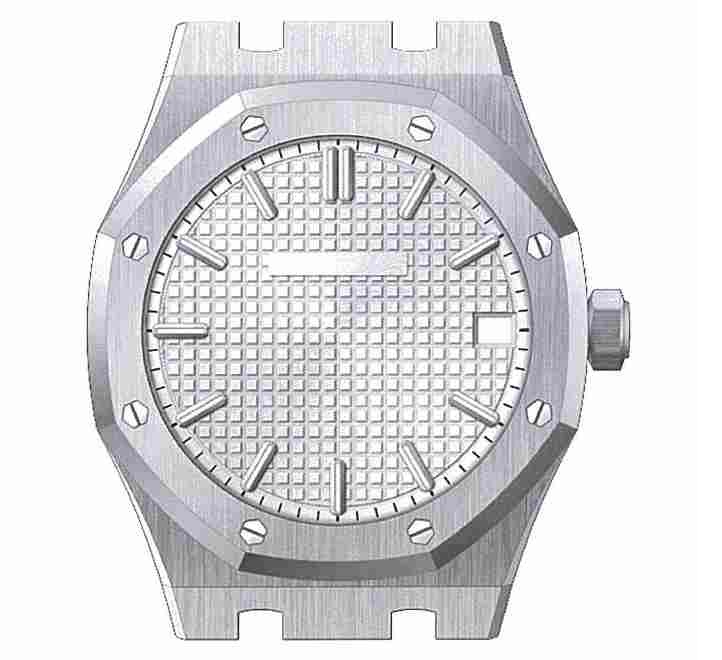
On February 26, 2020, Audemars Piguet Holding SA (AP) filed a trademark application for the shape of the flagship watch collection “ROYAL OAK” (see below) to be used on ‘watches’ in class 14 with the Japan Patent Office (JPO) [TM application no. 2020-20319].

The mark consists of a dial with tapisserie pattern and hour markers, minute track, date window, an octagonal bezel with 8 hexagonal screws, case, crown, and a lug of the famed “ROYAL OAK” watch collections.

On July 1, 2021, the JPO examiner rejected the applied mark due to a lack of inherent distinctiveness based on Articles 3(1)(iii) of the Japan Trademark Law by stating that relevant consumers would simply recognize it as a generic shape of a wristwatch, not a specific source indication. Besides, from the produced evidence, the examiner did not find the shape per se has acquired nationwide recognition as a source indicator of AP’s watches.


Appeal against the examiner’s rejection by AP

AP filed an appeal against the rejection on October 1, 2021, and alleged inherent distinctiveness as well as acquired distinctiveness of the shape in relation to watches.

AP argued the shape shall be considered inherently distinctive by virtue of a combination of three unique features, namely, (i) an octagonal bezel, (ii) 8 hexagonal screws, and (iii) tapisserie pattern on the surface of a dial. It is inappropriate for the examiner to negate the distinctiveness of the applied mark based on similar watches by third parties that imitate “ROYAL OAK” collections.

Allegedly, “ROYAL OAK” luxury watches have been promoted for sale in Japan since 1972. Annual sales exceed JPY 8 billion on average in the past six years. Each year, AP spent more than JPY400 million on advertisement and promotion in Japan. As a result of the substantial use of the shape on famous AP watches over four decades, even if the shape inherently lacks distinctiveness, it has acquired a significant role as a source indication.


JPO Appeal Board decision

In the decision, the Board held “There are plenty of wristwatches placed in the marketplace by many watchmakers that have a similar shape to the dial, bezel, case, crown, and lug of the applied mark (see below examples). Therefore, the shape, even if it does not contain hands and strap, is unlikely to indicate the origin of goods and distinguish them from competitors”. If so, the examiner’s findings are adequate and the Board did not find any error in applying Article 3(1)(iii) of the Trademark Law on the case.

Besides, the Board questioned if the shape per se has played a role in the source indication of AP’s watches regardless of admitting the presence of “ROYAL OAK” watches in the market for long years on the following grounds.

  1. Number of official stores, 11 is by no means numerous.
  2. The evidence did not suggest any transaction of wristwatches using the applied mark (namely, a watch without strip and hands)
  3. AP did not submit objective evidence to support the sales of “ROYAL OAK” watches
  4. Since AP did not make clear the market share of “ROYAL OAK” watches, it is impossible to compare them with competitors’ watches.
  5. Publications and internet articles pertinent to the “ROYAL OAK” watches always features literal elements “ROYAL OAK”, “AP” or “AUDEMARS PIGUET”.
  6. AP did not produce a market survey to demonstrate how many consumers can identify a source of the wristwatch from the applied mark.

Based on the foregoing, the Board found the applied mark has not acquired a certain degree of recognition as a source indicator of a specific entity among relevant consumers in relation to watches under Article 3(2), and decided to refuse the shape of AP’s “ROYAL OAK” watches.

Appeal Board reversed examiner’s rejection in the BOB trademark dispute

In an administrative appeal disputing trademark similarity between TM registration no. 5719997 for word mark “BOB” and a junior application no. 2016-49394 for the “bob” device mark represented as below, the Appeal Board of the Japan Patent Office decided that both marks are deemed dissimilar and reversed examiner’s rejection.
[Appeal case no. 2017-10420, Gazette issued date: January 26, 2018]


TM Registration no. 5719997

The cited mark, consisting of a word “BOB” in standard character, was registered on November 21, 2014 by designating various items of furniture in class 20.


Junior Application no. 2016-49394

Applied junior mark consists of the following “bob” device mark.

It was applied for registration on May 5, 2016 by designating furniture in class 20.

As a result of substantive examination by the JPO examiner, applied mark was rejected due to a conflict with the cited mark based on Article 4(1)(xi) of the Trademark Law.
Subsequently, the applicant filed an appeal against the rejection and disputed dissimilarity of both marks.


Board decision

In the decision, the Appeal Board held that:

applied mark is a device in dark brown, consisting of two circles protruding upward on the left side, a circle connected with the two circles in line, and wavy lines underneath.

From appearance, even if it may happen the circle design is recognized as a stylized design of “bob”, the Board opines that the design is unlikely to be considered as alphabetical letters due to a remarkable extent of stylization or abstraction. Thus, it is reasonable to conclude that applied mark shall not give rise to any specific pronunciation and meaning.

Based on the foregoing, in the assessment of trademark similarity, the Board decided that:

Obviously, both marks are distinguishable in appearance. As long as applied mark does not give rise to a specific pronunciation and meaning, it is meaningless to compare the pronunciation and meaning of both marks. Consequently, the Board finds no ground to affirm examiner’s rejection from visual, phonetic, and conceptual point of view.


Astonishingly, JPO considered the bob device mark is unreadable.