POLO RALPH LAUREN vs. US POLO ASSN

The Appeal Board of the Japan Patent Office (JPO) affirmed Examiner’s refusal to register the wordmark “U.S. POLO ASSN.” due to similarity to and a likelihood of confusion with earlier registered mark “POLO” owned by The Polo/Lauren Company, L.P.
[Appeal case no. 2018-5222, Gazette issued date: July 31, 2020]

“U.S. POLO ASSN.”

United States POLO Association filed a trademark registration for wordmark “U.S. POLO ASSN.” in standard character on January 13, 2016, over various kinds of bags, leather products, and other goods in class 18. [TM application no. 2016-3277]
On January 12, 2018, the JPO Examiner rejected the applied mark in contravention of Article 4(1)(xi) and (xv) of the Japan Trademark Law on the grounds that “U.S. POLO ASSN.” contains a term “POLO” which has become famous as a source indicator of The Polo/Lauren Company, L.P in connection with clothing and home décor. Relevant consumers with ordinary care would conceive the term as a prominent portion of the applied mark. If so, both marks shall be deemed similar or likely to cause confusion when used on the goods in question.

Article 4(1)(xi) is a provision to prohibit from registering a junior mark that is deemed identical with, or similar to, any senior registered mark.

Article 4(1)(xv) is a provision to prohibit any mark from being registered where it is likely to cause confusion with other business entity’s well-known goods or services, to the benefit of brand owner and users’ benefits.

U.S. POLO ASSN filed an appeal against Examiner’s refusal on April 16, 2018.

JPO decision

JPO admitted a high degree of reputation and popularity of “POLO” as a source indicator of The Polo/Lauren Company, L.P in connection with clothing as well as bags based on following fact-findings.

  1. American company Polo Ralph Lauren was founded in 1967 in New-York by fashion designer Ralph Lauren. The 1980s and 90s saw massive expansion for the Ralph Lauren brand and it became a worldwide phenomenon.
  2. “POLO” appears with definitions of ‘trademark of US designer, Ralph Lauren’ and ‘leather products designed by Ralph Lauren’ in some dictionaries which clearly demonstrate “POLO” is known as an abbreviation of ‘POLO RALPH LAUREN’.
  3. “POLO” has been substantially used adjacent to “RAPLH LAUREN” on various goods and frequently advertised as a famous brand of RALPH LAUREN in the media.
  4. A customer survey conducted in January 2010 from 900 adults age 20 years and older revealed that RALPH LAUREN has ranked 3rd-most popular brand in clothing after Burberry and UNIQLO.
  5. Annual sales exceed USD4,800 million in 2008, USD7,450 in 2013.

The Board found the applied mark “U.S. POLO ASSN.” shall be seen as a composite mark consisting of “U.S.”, “POLO” and “ASSN.” Since the last word “ASSN.” is too unfamiliar to average Japanese consumers to see it as an abbreviation of ‘association’, the applied mark would not give rise to any specific meaning as a whole. Besides, its pronunciation ‘ˌjuː.es poʊ.loʊ eɪeɪesén’ sounds redundant. Even if the second word “POLO” means ‘a game played on horseback by two teams of four players each’, given a high reputation of the word as a source indicator or an abbreviation of ‘POLO RALPH LAUREN’ the Board can’t overlook the fact that it has the same spelling as RALPH LAUREN’s famous apparel brand.

If so, relevant consumers would consider “POLO” as a prominent portion of the applied mark and it shall be permissible to compare the portion with the cited mark in assessing similarity of mark.

In this viewpoint, the applied mark would give rise to a sound of ‘poʊ.loʊ’ and the meaning of “RALPH LAUREN’s famous apparel brand”. Therefore, the applied mark shall be deemed confusingly similar to senior registered mark “POLO” owned by The Polo/Lauren Company, L.P in class 18, and others (TM Registration no. 4040052, 4931614, and 4931615).

Based on the foregoing, the Board found that Examiner didn’t error in fact-finding nor applying Article 4(1)(xi) and (xv) of the Trademark Law and decided to refuse the applied mark accordingly.


TWITTER Unsuccessful in “TWEET” Trademark Opposition at JPO

The Japan Patent Office (JPO) dismissed a trademark opposition claimed by social media giant, Twitter, Inc. against trademark registration no. 6138010 for word mark “TWEET” in class 33 by finding the TWEET mark is relatively unknown as a source indicator of Twitter Inc.
[Opposition case no. 2019-900193, Gazette issued date: April 24, 2020]

Opposed mark

A wordmark “TWEET” in standard character was filed by a Japanese sake brewery, Shirataki Sake on June 21, 2018, over Japanese sake [Nihonsyu]; sake, distilled rice spirits; sake substitute; Japanese white liquor [Shochu]; Japanese sweet rice-based mixed liquor [Shiro-zake]; Naoshi [Japanese liquor]; Japanese Shochu-based mixed liquor [Mirin]; western liquors; alcoholic fruit beverages; Japanese Shochu-based beverages [Chuhai]; Chinese liquors; flavored liquors in class 33, and published for opposition on May 14, 2019, after registration on April 12, 2019.

Opposition by Twitter, Inc.

On July 12, 2019, US social media giant, Twitter, Inc. filed an opposition and argued opposed mark shall be revocable in contravention of Article 4(1)(xv) and (xix) of the Japan Trademark Law due to a likelihood of confusion with, or identical with its famous “TWEET” mark registered in various classes other than 33.

Article 4(1)(xv)

Article 4(1)(xv) prohibits registering a trademark which is likely to cause confusion with the business of other entities.

Twitter is a ‘microblogging’ system that allows users to send and receive short posts called “tweets”. Tweets can be up to 140 characters long and can include links to relevant websites and resources. The Japanese version of Twitter was launched in 2008 and its MAU (monthly active users) has been increasing since. Compared to the American population, 35.7% of Japanese actively use Twitter actively while only 20.7% of Americans actively use Twitter. Now, 17% of Twitter’s worldwide revenue comes from the Japanese market.

Twitter, Inc. argued that the above facts suggest “TWEET” has acquired substantial reputation and popularity among the general public in Japan as a source indicator of the opponent.

Even though goods in dispute are remotely associated with SNS services, a lot of alcoholic consumers have obviously made use of Twitter and “tweet” since major breweries advertise their goods on Twitter so frequently and gain a substantial number of followers on Twitter.

If so, relevant consumers of goods in dispute are likely to misconceive the source of goods bearing opposed mark with Twitter, Inc., or any entity systematically or economically connected with the opponent.

Board Decision

The Opposition Board admitted a remarkable degree of reputation and popularity of opponent trademark “Twitter” in connection with a real-time communication service based on the produced evidence boasting more than 45 million MAU in Japan as of December 2018.

Meanwhile, the Board questioned if “TWEET” has been used as a source indicator of opponent business since the evidence shows the term has been used to indicate function or usage of Twitter in a descriptive manner. Consequently, the Board found “TWEET” is relatively unknown as a source indicator of Twitter Inc.

Based on the foregoing, the Board decided opposed mark shall not be revocable in contravention of Article 4(1)(xv) and (xix) since it is unlikely that relevant consumers conceive of the opponent or connect the alcoholic beverages bearing opposed mark “TWEET” with Twitter.

BRIDGESTONE Victorious in Trademark Dispute for B Mark Logo

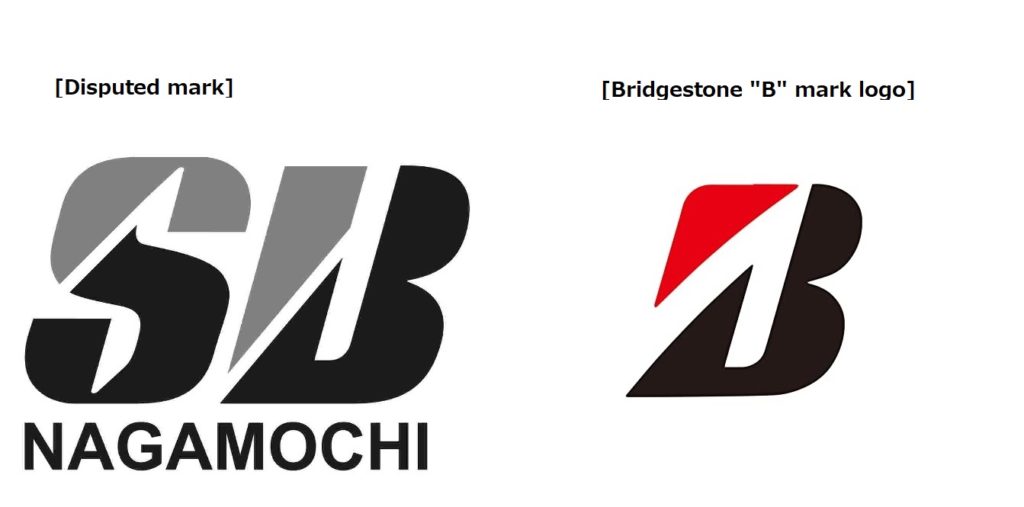
The Japan Patent Office (JPO) upheld an invalidation petition by the world’s largest tire and rubber company, Bridgestone Corporation against TM Reg. no. 5664068 for the “SB NAGAMOCHI” mark due to a likelihood of confusion with its well-known B mark logo.
[Invalidation case no. 2018-890068, Gazette issue date: March 27, 2020]

TM Registration no. 5664068

Disputed mark, consisting of “SB” logo and a word “NAGAMOCHI” in a smaller plain letter (see below left), was applied for registration on September 13, 2013 in respect of non-electric prime movers for land vehicles, not including their parts; AC motors or DC motors for land vehicles, not including their parts; automobiles and their parts and fittings; two-wheeled motor vehicles, bicycles and their parts and fittings; adhesive rubber patches for repairing tubes or tires in class 12.

Without confronting with a refusal during substantive examination, disputed mark was registered on April 18, 2014.

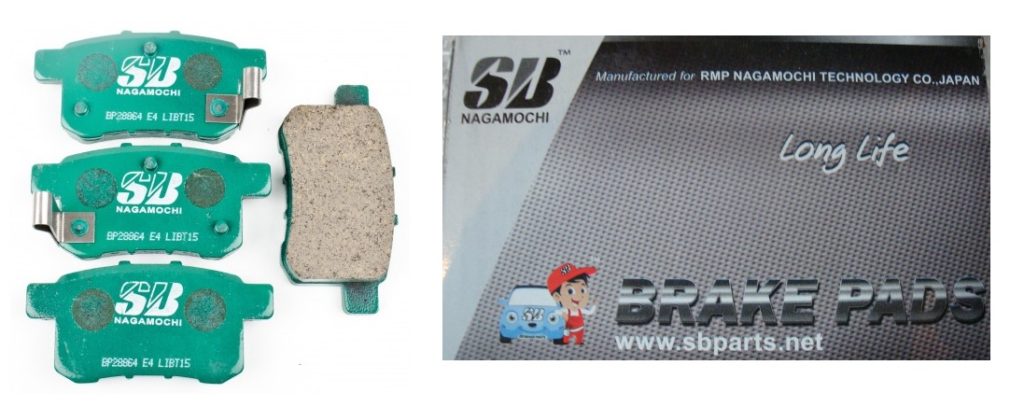
Applicant of disputed mark, RMP NAGAMOCHI Technology Japan Ltd promotes various structural parts for automobiles, e.g. cylinders, brakes and clutch hoses, brake calipers, brake pads, rubber parts, filters, gaskets. Disputed mark was actually used on brake pads (see below).

Petition for invalidation

Japan Trademark Law has a provision to retroactively invalidate trademark registration for certain restricted reasons specified under Article 46 (1) provided that interested party files an invalidation petition within five-year statute of limitations.

Bridgestone Corporation, a Japanese tire and rubber company, filed a petition for invalidation against disputed mark on September 5, 2018. Bridgestone argued the mark shall be invalidated due to a likelihood of confusion with its famous “B” mark logo (see above right) when used on all goods in class 12 based on Article 4(1)(xv) of the Trademark Law.

Article 4(1)(xv) provides that a mark shall not be registered where it is likely to cause confusion with other business entity’s well-known goods or services, to the benefit of brand owner and users.

Board Decision

In the decision, JPO Trial Board sided with Bridgestone by finding that:

  1. In 2016, Bridgestone holds top-ranked market share (14.6%) of automobiles tires in the world, the largest market share (55.9%) of tires and rubber products in Japan.
  2. Bridgestone has consecutively used “B” mark logo on goods and promotions as a symbolic house mark of Bridgestone group since 1984 and even when announcing sponsorship partnership with the Olympic Games and Tokyo2020 Paralympic Games Gold Partner.
  3. Based on the foregoing, it is unquestionable that “B” mark logo has acquired strong and considerable reputation as a source indicator of Bridgestone tires and rubber products among relevant traders and consumers of goods in question.
  4. “B” logo is a ‘strong’ mark because it is depicted with distinctive figurative element so that the mark as a whole can be seen sufficiently distinguishable from an ordinary “B” letter.
  5. Both marks look different when compared in its entirety, however, 2nd letter of “SB” logo is considered highly similar to “B” mark logo from visual point of view.
  6. Disputed goods “automobiles and their parts and fittings; two-wheeled motor vehicles, bicycles and their parts and fittings” and “tires” have the potential to be connected in the minds of the consumers. Since respective products share distributors or can be found in the same stores, there finds proximity in channels of trade and marketing of the products on which the marks are used.
  7. Foregoing weighs in favor of finding confusion. Thus, disputed mark shall be invalidated in violation of Article 4(1)(xv) of the Trademark Law.

Adidas defeated in 3-stripe trademark dispute

The Japan Patent Office (JPO) held in an opposition filed by Adidas AG that trademark registration no. 6085087 for horizontal three-stripes (Opposed mark) shall remain as valid as ever and entirely dismissed Adidas’ claims based on its famous three stripes.
[Opposition case no. 2018-900382, Gazette issued on February 28, 2020]

ULTRA MUSIC FESTIVAL

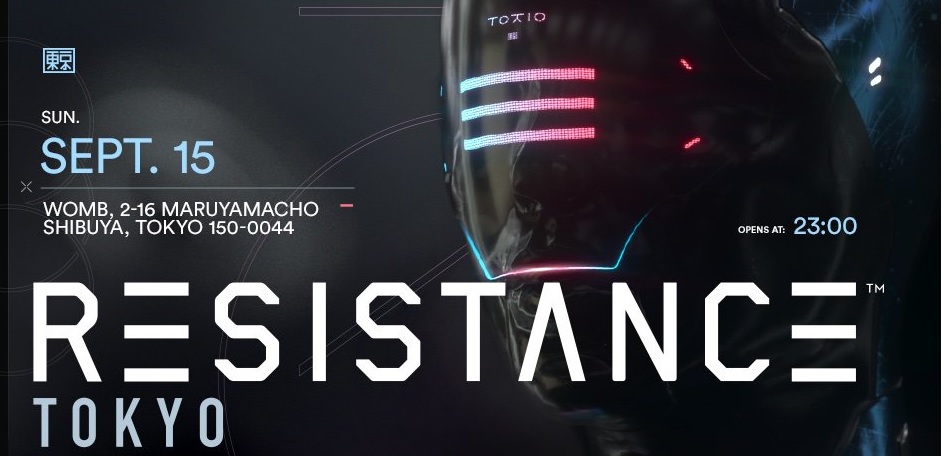
Opposed mark (see below) was applied for registration on October 10, 2017 over clothing, headwear, footwear in class 25, advertisement and promotion of music festival, concert in class 35, arrangement and conducting of musical performances, music festival, concerts in class 41 by Ultra Enterprises Inc., a U.S. business entity organizing outdoor electronic music event “ULTRA MUSIC FESTIVAL (UML)”, and published for registration on October 23, 2018.

Apparently, opposed mark is used as a symbolic logo for Ultra Music Festival’s RESISTANCE set.

Opposition by Adidas

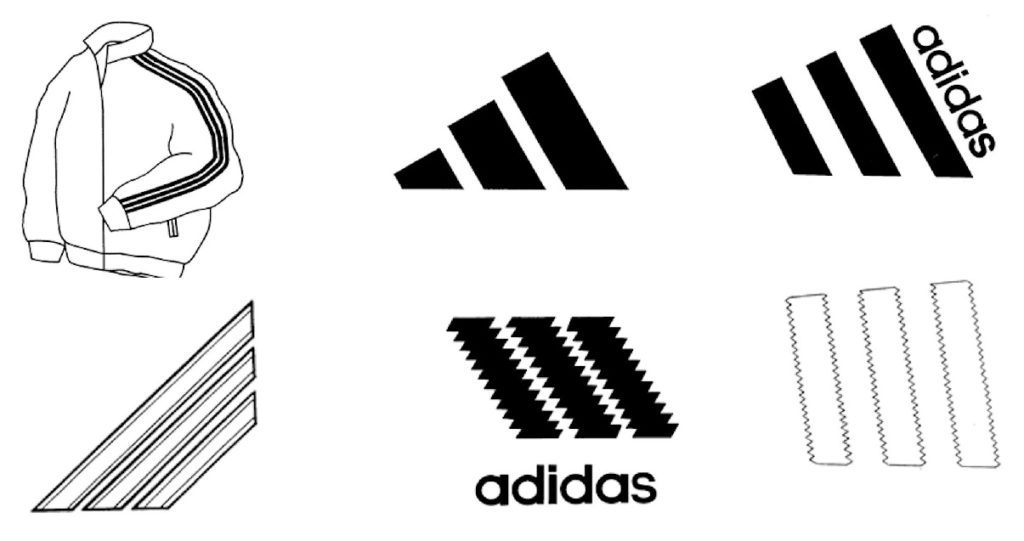
On December 21, 2018, Adidas AG filed an opposition and argued opposed mark is revocable under Article 4(1)(vii) and 4(1)(xv) of the Japan Trademark Law in relation to its famous three stripes (see below).

Article 4(1)(vii)

Article 4(1)(vii) prohibits any mark likely to offend public order and morals from registering.

Based on a remarkable degree of reputation and popularity to Adidas three stripes, opponent asserted, applicant must have been aware of Adidas three stripes and filed opposed mark with a malicious intention to take advantage of the reputation and credit of opponent’s famous trademark and impair the goodwill embodied on its iconic three stripes.

Article 4(1)(xv)

Article 4(1)(xv) prohibits to register a trademark which is likely to cause confusion with a business of other entity.

Adidas argued that, from appearance and concept, opposed mark evidently gives rise to a same impression with Adidas three stripes since each stripe of the mark is depicted in the same direction, width and shape, besides a space between stripe also has the same width with the stripe.

Average consumers with an ordinary care of goods/services in question who have been quite familiar with Adidas are likely to associate opposed mark with Adidas’ three-stripes. Inter alia, when opposed mark is used on apparels with a smaller configuration printed in one spot, so-called ‘one-point mark’, it must be difficult for relevant consumers to distinguish opposed mark with Adidas three-stripes because of its resemblance. Besides, goods/services in question are closely related to opponent business, namely sportswear, sports shoes, sports events. If so, it is highly anticipated that relevant consumers would confuse a source of opposed mark with opponent.

JPO Decision

The Opposition Board admitted a high degree of reputation and popularity to Adidas three stripes in relation to sport shoes, sportswear, sports gear at the time of initial filing and registration of opposed mark.

In the meantime, the Board found a low degree of originality of three stripes and similarity between the marks, from visual, phonetic, and conceptual points of view. The Board stated opposed mark can be perceived as ‘three-stripes’ deployed inside a vertically long rectangle. On the other hand, opponent’s marks consist of ‘three-stripes’ deployed inside a triangle or parallelogram. Even if Adidas three stripes have acquired remarkable reputation, because of a low degree of similarity and the originality, relevant consumers at the sight of opposed mark would not hesitate to consider a source of opposed mark unrelated to Adidas.
Thus, the Board held it is unlikely that relevant consumers confuse or associate opposed mark with Adidas.

The Board also negated opponent’s allegation of ‘one-point mark’ theory by stating that even if average consumers have tendency to pay less attention to details of a mark when used on apparels with smaller configuration, due to dissimilar impression caused by a different outline (vertically long rectangle, triangle, and parallelogram) of respective mark, opposed mark shall be undoubtedly perceived as a distinctive three-stripes unrelated to Adidas by relevant consumers with an ordinary care.

Besides, from the produced evidences, the Board found it was not foreseen a circumstance to offend public order and morals from registering opposed mark and give harmful effect to the international faith.

Based on the foregoing, the Board concluded opposed mark shall be irrevocable under Article 4(1)(vii) as well as (xv) and granted registration a status quo.

SWATCH Defeated in SWATCH vs iWATCH Trademark Dispute

The Trial Board of Japan Patent Office (JPO) dismissed an invalidation petition by Swiss watch giant, Swatch against TM Reg. no. 5849925 for word mark “iWATCH” owned by U.S. tech giant, Apple Inc.
[Invalidation case no. 2017-890071, Gazette issue date: January 31,2020]

iWATCH

Disputed mark, consisting of a word “iWATCH” in plain block letters (see below), was applied for registration in the name of Apple Inc. on April 25, 2014 in respect of watches, clocks and other goods in class 14.

Immediately after registration on May 13, 2016, Swatch filed an opposition to challenge registrability of disputed mark based on Article 3(1)(iii), 3(1)(vi), 4(1)(xi), 4(1)(xv), 4(1)(xvi) of the Japan Trademark Law, but in vain. [Opposition case no. 2016-900234]

Article 3(1)(iii) is a provision to prohibit any mark from registering where the mark solely consists of elements just to indicate, in a common manner, the place of origin, place of sale, quality, materials, efficacy, intended purpose, quantity, shape (including shape of packages), price, the method or time of production or use.

Article 3(1)(vi) is a comprehensive provision to prohibit any mark lacking inherent distinctiveness from being registered.

Article 4(1)(xi) is a provision to refrain from registering a junior mark which is deemed identical with, or similar to, any senior registered mark.

Article 4(1)(xv) provides that a mark shall not be registered where it is likely to cause confusion with other business entity’s well-known goods or services, to the benefit of brand owner and users’ benefits.

Article 4(1)(xvi) is a provision to prohibit registration of any mark likely to mislead quality of goods or services.

Invalidation Trial

Japan Trademark Law provides a provision to retroactively invalidate trademark registration for specific grounds under Article 46 (1).

In an effort to argue against the opposition decision, Swatch filed a petition for invalidation against disputed mark on October 23, 2017. Swatch argued disputed mark “iWATCH” shall be invalid because of following reasons:

  1. Given disputed mark consists of an alphabet letter “i” and a generic term in relation to a designated goods ‘watch’, the mark can be merely perceived to indicate a value, code, type, mode or standard of ‘watch’. If so, disputed mark shall be lack of distinctiveness and revocable under Article 3(1)(vi) in relation to the goods.
  2. Likewise, relevant consumers would misconceive quality of goods when disputed mark is used on goods other than ‘watch’ in class 14, e.g. jewelry, key holders, jewelry boxes, accessories. If so, disputed mark shall be revocable under Article 4(1)(xvi) in relation to goods other than ‘watch’.
  3. Disputed mark “iWATCH” resembles “SWATCH” from visual and phonetic points of view. It is unquestionable SWATCH has become remarkably famous for watches and fashion items of Swatch Group. If so, a likelihood of confusion will arise between “iWATCH” and “SWATCH” when disputed mark is used on goods in class 14. Thus, disputed mark is revocable under Article 4(1)(xi).

Board Decision

In the decision, the Board sided with Apple Inc. and found that:

  • The Board considers the term “iWATCH” is a coined word in its entirety which does not give rise to any specific meaning at all. Therefore, it is unlikely that relevant consumers conceive disputed mark just as a qualitative indication of goods in question.
  • The Board admits “SWATCH” has been acquired a high degree of reputation and popularity among relevant consumers and traders as famous watch of Swatch Group. In the meantime, the term appears less unique and creative since it is a dictionary word meaning ‘a sample piece (as of fabric) or a collection of samples’.
  • Difference on initial letter of both marks shall not be negligible on the case. The Board has no good reason to believe both marks are deemed similar from visual, phonetic and conceptual points of view.
  • If so, it is unlikely to happen that relevant consumers with an ordinary care would associate or misconceive disputed mark with Swatch or any entity systematically or economically connected with claimant even when used on ‘watch’.

Based on the foregoing, the Board concluded “iWATCH” shall be irrevocable in relation to “SWATCH” and dismissed Swatch’s invalidation petition wholly.

KUMAMON triumphs over bear mascot trademark battle

The Japan Patent Office (JPO) sided with Kumamon and declared invalidation of trademark registration no. 5997141 for a bear-like design mark due to a likelihood of confusion with Kumamon.
[Invalidation case no. 2019-890004, Gazette issue date: February 28, 2020]

KUMAMON

Have you ever heard of “Kumamon”?

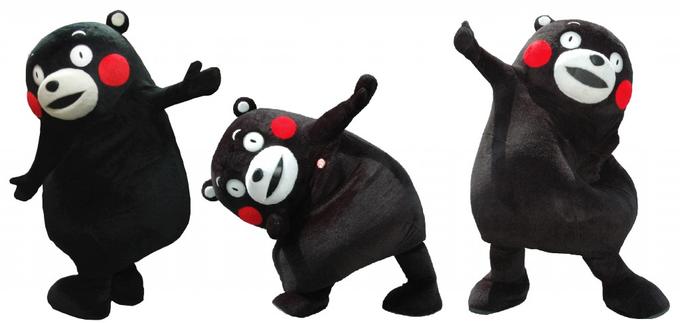
Nowadays, we are accustomed to see there are many organizations that create and use mascots to further their brands. Kumamon is a cuddly character with its pitch-black fur, red cheeks and white eyes designed as the official mascot (see below) of the Kumamoto Prefecture, a small prefecture in western Japan.

Kumamon made its debut in 2011 as part of a tourism promotion campaign for the Kyushu high-speed railway line. At the time a wave of local municipalities and companies sought to use ‘yuru-kyara’, or ‘relaxing characters’, to promote local products and attractions. Kumamon was hired as a part-time civil servant at Kumamoto before being elevated to sales manager. Such topics generated headlines and helped push Kumamon’s popularity beyond Kumamoto.

As an iconic symbol of ‘relaxing characters’, Kumamon has become a social and cultural phenomenon nationwide. Sales of goods using the Kumamon mascot topped 150 billion yen ($1.4 billion) in 2018.

To protect and promote the mascot, the Kumamoto Prefecture has registered its figurative image reproduced in 2D for various classed of goods and services in Japan as well as neighboring countries.

Disputed Mark

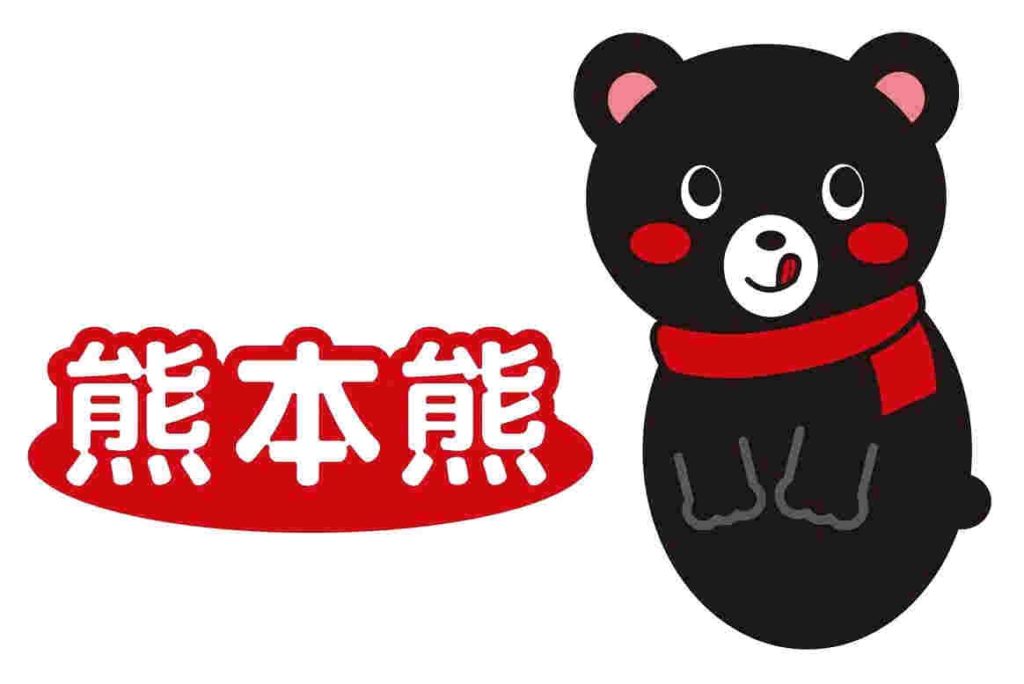
On March 21, 2017, Unique Design Company Limited (Belize) , sought to register the mark consisting of a bear-like design and three Chinese characters “熊本熊” which mean Kumamoto’s bear (see below) to be used on goods in class 11. The JPO granted protection of opposed mark on October 27, 2017.

Invalidation Trial

To challenge the validity of disputed mark, on January 25, 2019, the Kumamoto Prefecture filed an invalidation action to the JPO based on Article 4(1)(vi), (vii), (xi), (xv) and (xix) of the Japan Trademark Law. Kumamoto Prefecture argued that the figurative element of disputed mark closely resembles to the Kumamon character well-known for the official mascot of the Kumamoto Prefecture from appearance. Besides, the literal element of disputed mark gives rise to a similar meaning related to the Kumamoto Prefecture and Kumamon. If so, disputed mark as a whole shall be invalid due to a likelihood of confusion with Kumamon.

JPO Decision

The Invalidation Board of JPO found that:

  1. Unquestionably, Kumamon has acquired a remarkable degree of reputation and popularity nationwide as the official mascot of the Kumamoto Prefecture well before the filing date of disputed mark through continuous activities, promotions, and actual use on various goods since 2011. In addition, it becomes public among relevant consumers that the literal element of disputed mark “熊本熊” gets to be known as a Chinese name of Kumamon in China and neighboring countries.
  2. Since Kumamon has distinctive features visually different from wild bear, the mascot shall be deemed unique, creative, and impressive in itself.
  3. From appearance the bear-like design of disputed mark is confusingly similar to Kumamon. It gives rise to a similar meaning to Kumamon, the mascot originated from bear in the Kumamoto Prefecture. Likewise, the literal element of disputed mark gives rise to the same meaning. If so, both marks are considered highly similar.
  4. Due to free-use policy for brand promotion to domestic merchants (Kumamoto lets domestic companies use the character for free, but charges a license fee of a few percent on product sales by foreign companies), Kumamon mascot has been commercially used on wide range of goods over 10,000 items. 7-year cumulative sales exceed 510 billion JP-yen. If so, disputed goods in class 11, e.g. oil stoves, heaters, pocket warmers, electric foot warmers, shall be closely associated with the Kumamon goods in channels and consumers.

Based on the above findings, the Board concluded that relevant consumers and traders are likely to confuse disputed mark with Kumamon or misconceive a source from any entity systematically or economically connected with the Kumamoto Prefecture. Thus, disputed mark shall be invalidated in violation of Article 4(1)(xv) of the Trademark Law.

Trademark Battle – PUMA vs KUMA

The Japan Patent Office (JPO) decided to invalidate trademark registration no. 5661816 for a stylized word “KUMA”, which means ‘bear’ in Japanese, due to similarity to, and a likelihood of confusion with a world-renowned sports brand, PUMA. [Invalidation case no. 2019-890021, Gazette issue date: January 31,2020]

KUMA mark

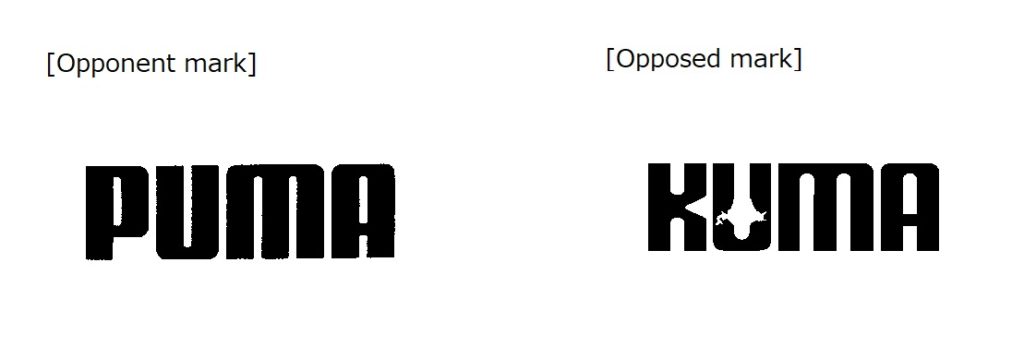
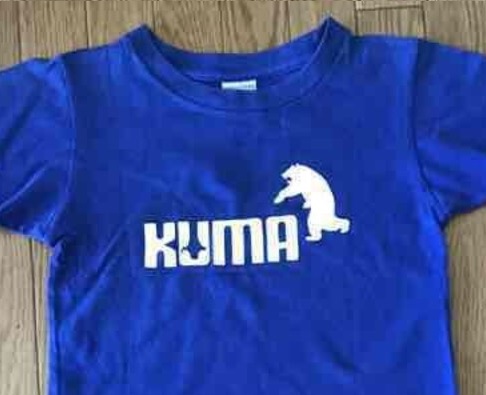
Disputed mark (see below),consisting of a stylized word “KUMA” with a partial island shape of Hokkaido, Japan’s most northerly main island, depicted on the inside of letter “U”, was filed on October 24, 2013 by a Japanese business entity having its principal place of business in Hokkaido over various goods in class 25 including sportswear and shoes.

It was found Applicant has used the KUMA mark on T-shirts and other goods with a bear silhouette facing left in the upper right of the mark.

The JPO admitted registration on April 4, 2014 and published for opposition on May 13, 2014.

PUMA’s Opposition / Invalidation Trial

On June 13, 2014, PUMA SE filed an opposition against the KUMA mark based on Article 4(1)(vii) and 4(1)(xv) of the Trademark Law. PUMA argued relevant consumers or traders are likely to confuse or misconceive a source of disputed mark with PUMA when used on designated goods in class 25 because of a high reputation and close resemblance between PUMA word logo and the KUMA mark.

The Opposition Board admitted a high degree of popularity and reputation of PUMA word logo, however, Board dismissed the opposition entirely due to unlikelihood of confusion because of a low degree of similarity between the marks (Opposition case no. 2014-900177).

Subsequently, PUMA SE entrusted the case to us. On April 3, 2019, just one day before the lapse of five-year Statute of limitations, MARKS IP LAW FIRM on behalf of PUMA SE requested for an invalidation trial and challenged invalidating the KUMA mark based on Article 4(1)(vii), (xi), (xv) and (xix) of the Japanese Trademark Law.

Article 4(1)(vii) of the Trademark Law prohibits any mark likely to cause damage to public order or morality from registration.

Article 4(1)(xi) is a provision to refrain from registering a junior mark which is deemed identical with, or similar to, any senior registered mark on identical or similar goods/service.

Article 4(1)(xv) prohibits to register a trademark which is likely to cause confusion with a business of other entity.

Article 4(1)(xix) prohibits to register a trademark which is identical with, or similar to, other entity’s famous mark, if such trademark is aimed for unfair purposes, e.g. gaining unfair profits, or causing damage to the entity.

Invalidation Decision

The Invalidation Board reversed the opposition decision and decided in favor of PUMA on all grounds by finding that:

  1. PUMA word logo has been continuously well-known in Japan for a source indicator of PUMA in connection with sports shoes, sportswear and others among relevant consumers and traders.
  2. A mere difference on initial letter of both marks and the Hokkaido island shape shall be insufficient to overturn an overall impression of the mark from visual and phonetic points of view. Conceptually, the KUMA mark, having a meaning of bears in Japanese, would give rise to a similar meaning with PUMA word logo, four-footed mammal. If so, by taking into consideration a high degree of reputation and popularity of PUMA word logo, both marks shall be deemed similar.
  3. Configuration of PUMA word logo looks unique, creative, and impressive in itself.
  4. Besides, given close association between designated goods in class 25 and PUMA’s business, relevant consumers of the goods in question with an ordinary care are likely to confuse its source with PUMA.
  5. It has good reasons to believe that the applicant of disputed mark did fraudulently apply the KUMA mark for registration with an aim to free-ride and dilute PUMA’s goodwill based on totality of the circumstances.
  6. If so, applicant must have filed disputed mark with a malicious intention to dilute or do harm to PUMA’s goodwill, which was impermissible to protect public order and morals

Based on the foregoing, the JPO decided to invalidate the KUMA mark based on Article 4(1)(vii), (xi), (xv) as well as 4(1)(xix) of the Japan Trademark Law.

French fashion magazine “ELLE” Victorious in Trademark Opposition against “ELLEROSE”

The Japan Patent Office (JPO) upheld an opposition filed by HACHETTE FILIPACCHI PRESSE, société anonyme (FR) and decided cancellation of Japanese trademark registration no. 6010765 for a composite mark containing “ELLROSE” due to a likelihood of confusion with a French fashion magazine “ELLE”.
[Opposition case no. 2018-900085, Gazette issued date: December 27, 2019]

ELLEROSE

Opposed mark, a composite mark consisting of three terms “ELLEROSE”, “STYLE UP”, “BODY SHAPE WEAR” aligned vertically in different font size and a silhouette of female lower body depicted in between ‘STYLE’ and ‘UP’ (see below), was applied for registration on July 25, 2017 for ‘underwear, socks, thermal supporters [clothing], waistbands, belts [clothing], special clothing for sports’ in class 25 by ELLEROSE Co., Ltd., a Japanese company. The JPO published opposed mark for registration on February 6, 2018.

ELLEROSE promoted the sales of women’s shapewear using the “STYLE UP” mark. Click here.

Opposition by ELLE

On April 6, 2018, just before the lapse of a two-months opposition period, HACHETTE FILIPACCHI PRESSE, société anonyme (hereinafter referred to as HFP), a French company responsible for the well-known women’s magazine ELLE, which had the largest readership of any fashion magazine in the world, with culturally specific editions published on six continents in the early 21st century, filed an opposition to “ELLEROSE”.

In the opposition, HFP contended that opposed mark shall be cancelled under Article 4(1)(xv) of the Japan Trademark Law, stating that relevant consumers are likely to confuse or misconceive opposed mark with HFP or any business entity systematically or economically connected with opponent due to high popularity of opponent’s fashion brand “ELLE” and close resemblance between opposed mark and “ELLE”.

Article 4(1)(xv)

Article 4(1)(xv) provides that a mark shall not be registered where it is likely to cause confusion with other business entity’s well-known goods or services, to the benefit of brand owner and users’ benefits.

Board decision

The Board admitted “ELLE” has acquired a high degree of reputation and popularity among relevant consumers and traders as a source indicator of opponent in connection with magazine as well as fashion items based on the facts that (i) “ELLE japon” fashion magazine has been published in Japan since 1982. Annual circulation of the magazine was 940,000 in 2014, (ii) HSP has continuously promoted and licensed the ELLE mark on various fashion items since 1987. The number of licensees increased over 30. It turned over JPY 4.8billion (approx. USD 43million) in 2017.

Besides, the Board found that it is allowed to cut out and compare respective element of opposed mark with opponent mark “ELLE” in assessing similarity of both marks since the Board can’t identify any visual, conceptual or phonetic linkage between the elements to comprehend opposed mark as a whole. Given the elements of “STYLE UP”, “BODY SHAPE WEAR” and a silhouette of female lower body are less distinctive, there is reasonable ground to believe that relevant consumers shall be impressed with the term “ELLEROSE” and consider it a dominant part of opposed mark.

Averages consumers would easily notice the term “ELLEROSE” consists of “ELLE” and “ROSE” which is a familiar French term meaning ‘a garden plant with thorns on its stems and pleasant-smelling flowers’, and then conceive a famous fashion brand, ELLE from the term when used on goods in class 25.

Based on the foregoing, the Board concluded that, relevant traders or consumers are likely to confuse or misconceive a source of opposed mark with HFP or any entity systematically or economically connected with the opponent when used on goods in class 25 and declared cancellation based on Article 4(1)(xv).

Partial revision of the Japan Trademark Law in force on May 27, 2019

Partial revision of the Japan Trademark Law which aims to amend the Article 31 (1) was promulgated on May 17, 2019 and takes effect on May 27, 2019.


Non-exclusive license for famous mark owned by public entity

Existing Trademark Law permits to register a mark which is identical with, or similar to, a famous mark representing (i) the nation, (ii) a local government, (iii) an agency thereof, (iv) a non-profit organization undertaking a business for public interest, or (v) a non-profit activity for public interest [Article 4(1)(vi)], provided that an applicant of the mark corresponds with the public entity from (i) to (iv), or an individual who is managing (v) [Article 4(2)].


Article 31 is a provision pertinent to “non-exclusive trademark license”.

Under the existing law, owner of trademark right (licensor) may grant a non-exclusive permission for the use of its mark to another [Article 31(1)]. In the meantime, the article has an exceptional clause and disallows a non-exclusive license for the use of registered mark which was granted based on Article 4(2).


New Revision

According to announcement from the Japan Patent Office, “Recently, public entity aiming to encourage regional development and collaboration with industry gets involved in necessity to advertise or promote goods or products originated from the entity. Inter alia, universities/colleges are desirous to secure financial resources, publicize achievements of academic research and increase publicity of the school by means of granting permission for the use of famous mark to a business entity”.


By the revision, the exceptional clause is deleted from Article 31(1).

From May 27, 2019, it enables an owner of trademark right for famous mark, i.e. (i) the nation, (ii) a local government, (iii) an agency thereof, (iv) a non-profit organization undertaking a business for public interest, or (v) an individual who manages non-profit activity for public interest, to grant “non-exclusive license” permission for the use of its famous mark.

It should be noted that the revision does not apply to “exclusive trademark license” provided in Article 30 (1). It remains impermissible. 

IP High Court admitted high reputation of Red Bull mark in relation to automobiles as well

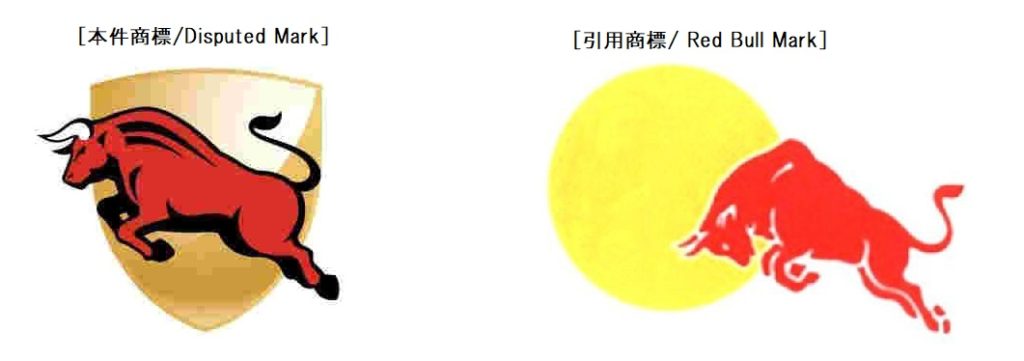
In a lawsuit disputing similarity of red-colored bull device marks, the IP High Court nullified the JPO decision in favor of Red Bull GmbH known for Red Bull energy drink, and ruled to invalidate TM registration no. 5664585 (Disputed Mark) on the ground that it is likely to cause confusion with the Red Bull Mark.
[Case no. Heisei29(Gyo-ke)10080,  Judgement date: December 25, 2017]

Disputed Mark, filed on October 4, 2013 by designating various goods for automobiles in class 1,3,4 and 5, e.g. detergent additives to gasoline, was registered on April 18, 2014 by a Korean distributor dealing with goods related to automobiles. Prior to the appeal to the IP High Court, Red Bull was unsuccessful to attack Disputed Mark in an opposition and invalidation trial.

The Court concluded that relevant traders and consumers at the sight of designated goods using Disputed Mark would likely connect it with famous Red Bull Mark, and consequently misbelieve the source of the goods from Red Bull, an entity economically related to Red Bull, or a paerner authorized to use Red Bull Mark in business based on the following findings.

Trademark similarity

Both marks are visually confusing irrespective of differences in detail since the marks share basic configuration of depicting a left-pointing horned red bull in a vibrant motion over yellow and warm color of background. Besides, Disputed Mark gives rise to a meaning of a red-colored jumping bull and Red Bull Mark does a meaning of a red-colored rushing bull. If so, it is obvious that both marks are almost identical or similar in concept. Therefore, Disputed Mark is deemed substantially similar to Red Bull Mark.

High reputation of Red Bull Mark

Red Bull Mark, as a source indicator of plaintiff, becomes well-known not only in the field of energy drinks but also among traders and consumers of goods related to automobiles. Admittedly, it has acquired a high degree of reputation.

Consumers

Consumes of automobile goods are not limited to car enthusiast. They can be purchased by the general consuming public. Plaintiff has distributed various types of goods relating to automobiles and car race with Red Bull Mark for promotional purpose under the scheme of trademark license. It is undeniable that most of the public with an ordinary care are neither precisely familiar with trademark and brand in detail, nor always mindful to manufacturer and source indicators in the selection of goods.


It is noteworthy that the Court admitted high reputation of Red Bull Mark in the field of automobiles as well even if it evidently represents one of sponsors for car racing team

Masaki MIKAMI, Attorney at IP Law – Founder of MARKS IP LAW FIRM