SERAPIAN Successful in Registering iconic MOSAICO braided pattern as trademark

The Italian-based fashion house Stefano Serapian S.r.l. was successful in an appeal to overturn the examiner’s rejection of TM App no. 2022-131488 for the Serapian’s signature “Mosaico” leather pattern in Class 18.
[Appeal case no. 2023-16337, decided on December 17, 2025]


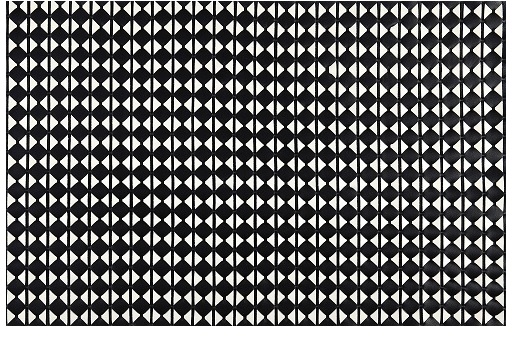
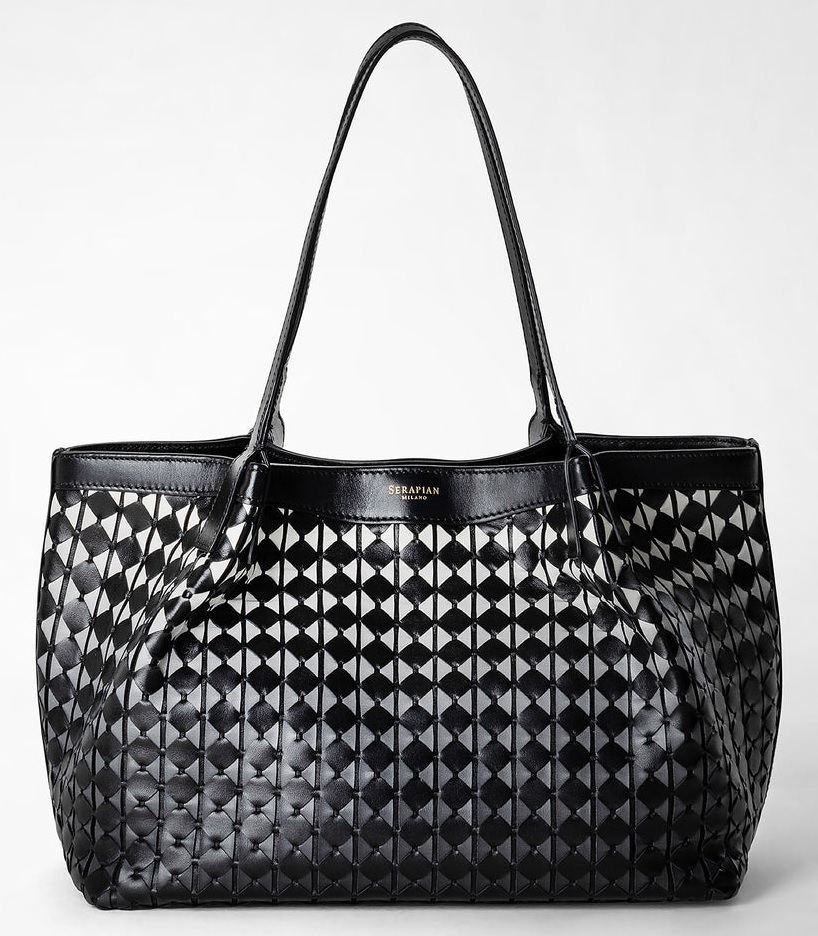
SERAPIAN MOSAICO

Stefano Serapian S.r.l. filed a trademark application for a braided pattern (see below) for use on bags, suitcases, tote bags, backpacks, key cases, porches, wallets, coin cases, and handbags in Class 18 with the JPO on November 17, 2022 [TM App no. 2022-131488].

The Serapian Mosaico pattern is known for its iconic hand-weaving technique, which dates back to 1947 and serves as an emblem of the Italian luxury brand, Serapian.


JPO Examination

On June 26, 2023, the examiner rejected the mark based on Article 3(1)(vi) of the Japan Trademark Law by finding that:

The applied-for mark represents a continuous and repetitive geometric pattern consisting of a white square with a vertical line in the middle and a black square in a diagonal position. As a whole, it will be perceived merely as a decorative background design. Besides, there is no distinctive element that identifies the source of the goods in question. Consequently, consumers are unable to recognize it as a source indicator due to its lack of inherent distinctiveness.

Serapian filed an appeal against the rejection on September 27, 2023, to dispute the inherent distinctiveness of the mark based on substantial use and advertising of the Mosaico collection in Japan since 2014.


JPO Appeal Board Decision

The JPO Appeal Board noted the following facts.

  • Founded in 1928, the applicant is known for its line of bags favored by the late British actress Audrey Hepburn. The applicant’s bags, which depict the applied-for mark and were designed in 1947, have been sold nationwide in Japan for over 10 years and have been distributed in Japan since 2014.
  • Major fashion magazines and online articles have featured the bags and their iconic “MOSAICO” pattern design.
  • The bags are also sold in major department stores and online malls. Despite being expensive and high-end goods, annual sales exceeded JPY 50 million in 2023 and JPY 9 million in 2024.
  • A discretionary survey by the Board did not reveal the actual use of a similar pattern by others.

Based on the foregoing, the Board found that relevant consumers and traders can distinguish the applicant’s goods from others based solely on the Mosaico pattern.

Therefore, since the applied-for mark is not subject to Article 3(1)(vi) of the Japan Trademark Law, the Board overturned the examiner’s rejection.

YONEX Scored Win in Registering Color mark

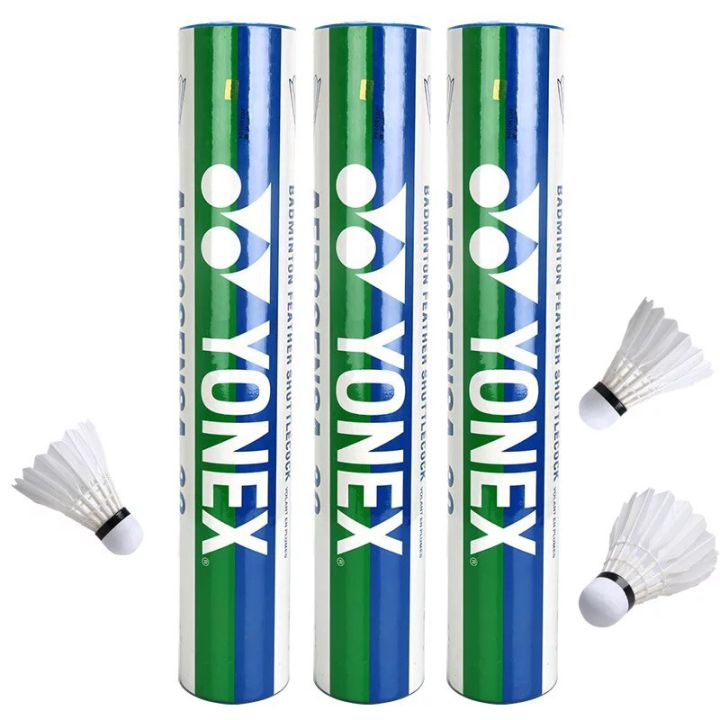
On October 21, 2025, the Japan Patent Office (JPO) granted registration of a color mark that consists of blue and green colors, filed by Yonex Co., Ltd. to use on badminton shuttlecocks by finding acquired distinctiveness of the color combination.
[Appeal case no. 2022-17481]


YONEX Color Mark

Yonex Co., Ltd. filed a trademark application with the Japan Patent Office on September 6, 2019, for a mark that consists of a combination of blue (Pantone 2935C) and green (Pantone 355C) (color ratio 50%:50%), designating “sports equipment; badminton equipment” and other goods in Class 28 [TM App no. 2019-118815].


Rejection by JPO examiner

On July 27, 2022, the JPO examiner rejected the mark under Article 3(1)(iii) of the Japan Trademark Law, due to a lack of inherent distinctive character. Furthermore, while acknowledging that a certain number of traders and consumers recognize the color combination perse as an indicator of the applicant’s goods in view of the applicant’s extensive use of the mark on badminton shuttlecocks for years, and its leading market share, the examiner had an opinion that a significant number of people do not recognize it as a source indicator to distinguish from others. Accordingly, the examiner concluded that the mark does not satisfy the requirements to apply Article 3(2) since the applicant failed to demonstrate acquired distinctiveness of the mark in relation to the goods in question.

Subsequently, the applicant filed an appeal against the rejection on November 1, 2022, and then restricted the designated goods to “Shuttlecocks” in Class 28.


JPO Appeal Board decision

The JPO Appeal Board observed that the evidence submitted by the applicant would sufficiently demonstrate that the color combination has played a role in identifying the specific source of Shuttlecocks by taking into account the following facts.

  1. The mark has been used continuously for over 48 years, since at least 1976, on Yonex Badminton shuttlecocks. The color combination appears on the applicant’s website, in product catalogs, internet articles, magazines, newspapers, and television programs. The shuttlecocks bearing the mark have been officially used at numerous international badminton tournaments, including the Olympic Games and World Championships.
  2. Yonex shuttlecocks ranked first in the domestic market for 11 consecutive years from 2009 to 2019, with a market share of approximately 70% to 80% during that period.
  3. According to survey results targeting 1,053 men and women aged 15 to 59 who currently play or have played badminton or tennis, 57.87% of the respondents who have played both tennis (including soft tennis) and badminton could associate the color combination with the applicant in the answer to an open or closed (multiple choice) question. For those who have experienced badminton, but not tennis, 56.59% could associate it with the applicant in either question.

Based on the foregoing, the Board found that the examiner erred in applying Article 3(2), and thus decided to register the color combination as a trademark.

JPO Rejected 3D shape of KitKat 2 Finger Mini Chocolate Wafers as Trademark

The Japan Patent Office (JPO) Appeal Board upheld the examiner’s decision to reject TM App no. 2020-121513 for the 3D shape of Nestle’s KitKat 2 Finger Mini Chocolate Wafers, due to a lack of inherent and acquired distinctiveness.
[Appeal case no. 2024-75, decided on September 29, 2025]


KitKat 2 Finger Mini Chocolate Wafers

Société des Produits Nestlé S.A. filed a trademark application for the 3D shape of KitKat 2 Finger Mini Chocolate Wafers (see below) in connection with chocolate confections (Cl. 30) with the JPO on October 1, 2020. [TM App no. 2020-121513]

The JPO examiner gave Nestle a notice of grounds for refusal on August 30, 2021, based on Article 3(1)(iii) of the Japan Trademark Law due to a lack of inherent distinctiveness.

As a response, Nestle argued not only the inherent distinctiveness of the 3D shape, but also acquired distinctiveness since the shape has been used since 2011 on their world-famous chocolate wafers “KitKat 2 Finger Mini”. To demonstrate the acquired distinctiveness, Nestle conducted market research targeting 1,001 men and women aged 15 to 64 residing in Tokyo or Osaka, or these neighboring areas, and who have purchased and eaten chocolate confections more than once a month. 85% of respondents, when shown the 3D shape of the KitKat 2 Finger Mini chocolate wafers without any accompanying text, identified it as “KitKat” in response to an open-ended question.

However, the examiner considered the market research biased by excluding children aged under 15 and over 65, who are unquestionably relevant consumers, and limiting respondents who reside in the Tokyo or Osaka areas and have purchased and eaten chocolate confections more than once a month.

On October 2, 2023, the examiner decided to reject the mark based on Article 3(1)(iii), and noted that the evidence is insufficient to find 3D shape perse has already played a role in identifying the source of the KitKat 2 Finger Chocolate Wafers.

To contest, Nestle filed an appeal with the JPO on January 4, 2024.

Subsequently, Nestle conducted 2nd market research targeting 1,080 men and women aged 15 to 99 without restricting their residence and preference to chocolate confections. The result shows that 72.9% of respondents, when shown the 3D shape of the KitKat 2 Finger Mini chocolate wafers without any accompanying text, identified it as “KitKat” in response to an open-ended question.


JPO Appeal Board decision

The JPO Appeal Board recognized the high popularity and recognition of KitKats sold in Japan since 1973, which holds a 17% market share — the top ranking in Japan. Annual sales exceeded 27 billion JPY in 2019.

In the meantime, the Board questioned whether the applied 3D shape perse has acquired distinctiveness in connection with the KitKat 2 Finger Mini chocolate wafers by stating that:

  1. KitKats come in various shapes, such as spherical or stick-shaped, as well as the ‘2 Finger Mini’. Therefore, the applied 3D shape would not be identical to all KitKat chocolates.
  2. KitKats are sold in individually wrapped pieces that are then packed in boxes or bags for display and sale. This suggests that the 3D shape would not be distinctive enough to catch consumers’ attention at the time of purchase.
  3. Of the sixty KitKats, only two represent an image of the 3D mark on their packaging.
  4. There is insufficient evidence to conclude that relevant consumers can securely identify the source of KitKats by relying solely on the 3D mark in question.
  5. Advertising for KitKats has not prominently featured the 3D shape to the extent that it could be perceived as a source indicator by consumers. Even if market research shows that many consumers associate the 3D shape with KitKats, it cannot be concluded that consumers distinguish KitKats based solely on the shape of the goods.

Based on the above findings, the JPO upheld the examiner’s decision, and declared rejection of the 3D shape due to a lack of inherent and acquired distinctiveness.

The JPO’s decision is appealable until February 11, 2026.

JPO Found Tissa Fontaneda’s Bubble Pattern Descriptive of Bags

The Japan Patent Office (JPO) sustained the examiner’s decision rejecting International Registration No. 1599413 for a three-dimensional, rounded “bubble” pattern in Class 18, known as the Tissa Fontaneda “Bubble Bag,” on the ground that the mark lacks inherent distinctiveness.
[Appeal Case no. 2023-650049, decided on August 26, 2025]


Tissa Fontaneda “Bubble Bag”

TISSA FONTANEDA, S.L. sought protection in Japan, via the Madrid Protocol, for a mark consisting of a repetitive pattern formed by the arrangement of a plurality of three-dimensional elements placed in a staggered manner on the surface of goods, in respect of “bags; tote bags; handbags; shoulder bags; clutch bags; traveling bags; pouches; trunks; suitcases; hip bags; rucksacks; purses; pocket wallets; wallets; credit card sleeves; traveling sets [leatherware]; credit card cases [wallets]; vanity cases, not fitted; tie cases,” in Class 18. [IR No. 1599413, filed on April 19, 2021]


Examiner’s Decision

On February 24, 2023, the examiner rejected the application under Article 3(1)(vi) of the Japan Trademark Law, on the following grounds:

A pattern can be perceived as an indication of origin only when it has acquired a certain degree of recognition among consumers. Although it appears that goods bearing the applied-for mark have been used by certain celebrities, the applicant did not establish the scale of sales, the duration of use, or the market share of such goods. Accordingly, it cannot be concluded that the applied-for mark has, through use, acquired nationwide recognition or come to be recognized by consumers as an indication of origin.

The applicant filed an appeal on June 20, 2023, asserting that the applied-for mark is inherently distinctive.


Appeal Board’s Findings

The Board finds as follows:

(1) In the representation of the applied-for mark, no distinctive element can be identified beyond the form of the pattern that would enable the mark to function as an indication of origin. Accordingly, the applied-for mark is perceived merely as a decorative background pattern.

(2) Even if competitors have not produced bags decorated with a three-dimensional rounded “bubble” pattern, this fact is insufficient to establish inherent distinctiveness, since bags bearing repetitive patterns formed by regularly arranging three-dimensional elements on their surfaces are commonly distributed.

(3) The fact that the applied-for mark is registered in other jurisdictions, such as the United States, Spain, Ireland, the Benelux, Brazil, Italy, and Mexico, is irrelevant, as distinctiveness must be assessed based on consumers and trade practices in Japan.

Consequently, the Board finds the examiner made no error in applying Article 3(1)(vi) of the Trademark Law.

JPO Said No to Register Kawasaki Green Color Mark

On March 19, 2025, the Japan Patent Office (JPO) finally decided to reject a color mark application filed a decade ago by Kawasaki Heavy Industries, Ltd., which sought to register a green color used on the world-famous Kawasaki motorcycles.
[Appeal case no. 2022-11189]


Narrow gate to color mark registration

On April 1, 2015, the Japan Trademark Law has opened the door to the registration of marks consisting solely of a color or colors. To date, 589 color marks have been filed with the JPO, and only 11 have been granted registration. This represents a success rate of only 1.9%.


Kawasaki Green

On the very first day, Kawasaki Heavy Industries, Ltd., famous for sports and racing bikes, sought for registration of a color mark consisting solely of light green (R105, G190, B40) in connection with motorcycles (cl.12). [TM App no. 2015-30667]

In addition, Kawasaki filed two color mark applications for a single light green color represented on fuel tank (position) and a color combination of light green and black as shown below for use on motorcycles (cl. 12) with the JPO on the same day, but these were all withdrawn or rejected due to a lack of inherent and acquired distinctiveness. [TM App nos. 2015-30668, 2015-30696]

Allegedly, Kawasaki has been using the light green color on their Ninja, KX, KLX and other motorcycles since 1975, but, according to the catalogs, the color was used on less than 40 % of the total Kawasaki motorcycles. Besides, annual sales of the motorcycles using the light green color averaged approximately 23.4%.

On April 19, 2022, the JPO examiner rejected the color mark based on Article 3(1)(iii) of the Japan Trademark Law.

Kawasaki filed an appeal against the rejection and agued acquired distinctiveness of the light green in connection to motorcycles on July 19, 2022.

In order to demonstrate the acquired distinctiveness of the light color as a source indicator of Kawasaki motorcycles, Kawasaki conducted the market research that targeted a total of 1,000 men and women aged from 16 to 79 who has a motorcycle driver’s license, 90.5% of the interviewees who answered that they had seen the color in connection with motorcycles or motorcycle shops (66.1% of the total interviewees) could associate the color with Kawasaki.


JPO decision

The JPO Appeal Board noted the light green has acquired a certain degree of recognition among relevant consumers as a source indicator of Kawasaki motorcycles in view of substantial use for the past five decades.

However, the Board found that the market research was insufficient to objectively assess the acquired distinctiveness of the applied mark, as it was only targeted at motorcycle license holders. Moreover, competitors also manufacture many motorcycles with a similar green color.

According to the IP High Court’s decision, a mark consisting of a single color is not registrable unless it has acquired an extremely high degree of recognition as an indication of a particular source as a result of substantial use, to the extent that the exclusive use of the color would not cause detriment to the public in general.

In light of the fact that the light green color was used on less than 40 % of Kawasaki’s motorcycles, and the annual sales of the motorcycles using the light green color averaged approximately 23.4%, the Board has no reason to believe that the applied color has acquired a high degree of secondary meaning to outweigh the detrimental effect on the public at large if registered.

Based on the foregoing, the Board affirmed the examiner’s rejection and decided to refuse the applied mark based on Article 3(1)(iii) of the Japan Trademark Law.

It is appealable to the IP High Court until May 8, 2025.

Is “WEBmetaverse” registrable as a trademark?

The Japan Patent Office (JPO) affirmed the examiner’s rejection to TM App no. 2022-131131 for wordmark “WEBmetaverse” by finding a lack of inherent distinctiveness in relation to the designated goods and services in classes 9, 35, 38, 41 and 42.
[Appeal case no. 2024-1154, decided on February 13, 2025]


WEBmetaverse

COLOPL, Inc. filed a trademark application for mark “WEBmetavese” in standard character with the JPO on November 16, 2022 (TM App no. 2022-131131).

The mark covers various goods and services in classes 9, 35, 38, 41, and 42 relating to computer programs, virtual reality, SaaS, and others.

The applied mark has been in use on their platform for users to experience the metaverse.

On October 24, 2023, the JPO examiner rejected the mark based on Article 3(1)(vi) of the Japan Trademark Law by finding that:

“WEB” is an abbreviation of World Wide Web. “metaverse” means a virtual-reality space in which users can interact with a computer-generated environment and other users. Therefore, the applied mark is recognized just to indicate ‘a virtual-reality space provided on internet’ as a whole. If so, the relevant consumers will not be able to identify a specific source of the goods and services from the mark applied for.

Article 3(1)(vi) is a provision to comprehensively prohibit from registering any mark lacking inherent distinctiveness.

Any trademark to be used in connection with goods or services pertaining to the business of an applicant may be registered, unless the trademark:

(vi) is in addition to those listed in each of the preceding items, a trademark by which consumers are not able to recognize the goods or services as those pertaining to a business of a particular person.

The applicant filed an appeal against the examiner’s refusal on January 23, 2024, contesting the inherent distinctiveness of the mark “WEBmetaverse” based on the fact that the mark applied for was not actually used by any entity other than the applicant.


JPO decision

The JPO Appeal Board stated that:

Recently, “Metaverse” has been at the center of attention in the public. There is a circumstance that the metaverse accessible from a web browser without specific devices or applications is referred to as a “Web-type Metaverse”.

Therefore, the mark applied for just gives rise to a meaning of “Metaverse using the Web” as a whole. If so, relevant consumers at the sight of the mark used on the goods and services in question would simply recognize it to indicate the purpose or function of the goods and services for “Metaverse using the Web”. It is reasonable to say that the mark applied for cannot play a role in distinguishing goods and services with competitors.

A fact that plenty of mark containing the term “Metaverse” have been registered would not be binding and relevant because these registrations are different from the mark applied for. 

Article 3(1)(vi) of the Trademark Law should be applied on a case-by-case basis, with due consideration given to the configuration of the mark as well as the common practices of transactions at the time of examination or trial decision.

Based on the foregoing, the Board decided to dismiss an appeal entirely and found “WEBmetaverse” unregistrable as a trademark.

No Green Light to Kawasaki Green Color Mark

On November 15, 2024, Kawasaki Heavy Industries, Ltd. dropped their nine-year fight with the Japan Patent Office (JPO) over a green color mark used on the Kawasaki motorcycles.


Narrow gate to color mark registration

On April 1, 2015, the JPO commenced registration of marks consisting solely of a color or colors. To date, 585 color marks have been filed with the JPO, and only 11 have been granted registration. This equates to a success rate of just 1.9%.


Kawasaki Green

On the very first day, Kawasaki Heavy Industries, Ltd., famous for sports and racing bikes in Japan, filed an application for a color mark consisting of light green (R105, G190, B40) represented on fuel tank as shown below in connection with motorcycles (cl.12).

[TM App no. 2015-30696]

JPO decision

As anticipated, the JPO examiner rejected the mark due to a lack of inherent and acquired distinctiveness on April 18, 2022 based on Article 3(1)(iii) of the Japan Trademark Law in seven years after the initial filing.

In the refusal decision, the examiner found from the produced evidence that Kawasaki has used the applied color on fuel tank of motorcycles since 1998, however, more than 70% of the Kawasaki motorcycles in average have a fuel tank painted in other color.

The results of the interview, which targeted men and women aged 16 to 79 who own motorcycles or a license to drive one, indicate that 54.7% of license holders and 67.5% of bike owners were able to recognize Kawasaki from the color. In this respect, the examiner had a view that the results were not persuasive to find acquired distinctiveness of the applied mark given Honda, Yamaha, Suzuki, and Kawasaki, the four major motorcycle manufacturers, have held a near monopoly of the market for years, and each manufacturer is known to have its own distinctive color.

Accordingly, the examiner held the applied mark shall not be registrable under Article 3(2) of the Japan Trademark Law.

Kawasaki filed an appeal against the examiner’s rejection on July 19, 2022 and argued acquired distinctiveness of the color “green” to indicate a source of the Kawasaki motorcycles. After two years of dispute with the JPO Appeal Board, Kawasaki voluntarily withdrew the appeal on November 15, 2024.

P&G Unsuccessful attempt to register 3D shape of SK-II bottle

In an attempt to register TM App no. 2020-1611 for 3D mark representing a bottle shape of the SK-II Facial Moisturizing Lotions, the Japan Patent Office (JPO) upheld the examiner’s rejection and dismissed the appeal filed by The Procter & Gamble Company (P&G).
[Appeal case no. 2022-6, decided on May 9, 2024]


SK-II

P&G filed a trademark application for 3D bottle shape of the SK-II cosmetic lotions (see below) in class 3 with the JPO on February 14, 2020 (TM App no. 2020-1611).

SK-II is a Japanese-based multinational beauty brand with premium skincare solutions sold in East Asia, North America, Europe, and Australia, launched in the early 1980s.

Allegedly, domestic sales of the “SK-II” facial treatment essence (moisturizing lotions) contained in the applied 3D mark were approximately JPY 10 billion to 16.5 billion in each of the fiscal years from 2016 to 2020.


Article 3(1)(iii)

The JPO examiner rejected the 3D mark based on Article 3(1)(iii) of the Japan Trademark Law due to a lack of inherent distinctiveness.

Article 3(1)(iii) is a provision to prohibit registration of any mark that is descriptive in relation to designated goods and service. Trademark Examination Guideline (TEG) refers to 3D bottle shape of goods as an example subject to the article.

Where trademark is merely recognized as the shapes of designated goods (including shape of packages), it is evaluated just to indicate the “shape” of the goods. Moreover, the same principle shall apply to cases where a trademark is recognized as part of the shapes of designated goods (including their packages).


Article 3(2)

P&G argued acquired distinctiveness of the 3D mark as a result of substantial use. However, the examiner rejected the argument, stating that since the applied mark has been consistently used with the word mark “SK-II” on every bottle, there is no reason to believe that the 3D shape perse has played a role in identifying the source of the cosmetics.
Therefore, the applied mark shall not be registrable based on Article 3(2) of the Trademark Law due to a lack of acquired distinctiveness.


JPO decision

The JPO Appeal Board found the applied mark should be rejected in accordance with Article 3(1)(iii) due to the prevalence of cylindrical bottles in the contexts of cosmetics and other industries.

In its decision, the Board noted that a considerable amount of sales had been made to date and that advertising and promotional activities had been conducted at a considerable expense. The SK-II cosmetics bearing the 3D mark have been extensively advertised through a variety of channels, including magazine advertisements, TV commercials, events, and other campaign activities. They have also been widely covered by the web media and other media outlets.

In the meantime, the Board pointed out the use of distinctive words, such as “SK-II”, “SECRET KEY II”, “MAX FACTOR” etc., on the bottle of the CK-II facial moisturizing lotions. In this respect, there is no sufficient evidence and material featuring the 3D mark so that consumers at the sight of advertisements can consider the bottle shape as a source indicator.

Besides, P&G did not produce evidence of brand awareness survey to demonstrate acquired distinctiveness of the bottle shape. The registration of the same mark in other jurisdictions, such as the United Arab Emirates and South Korea, does not have any binding power in Japan when it comes to evaluating distinctiveness.

Based on the above findings, the Board concluded that the 3D mark per se has not acquired distinctiveness and should not apply Article 3(2).

IP High Court Rejected TM Registration of AP “ROYAL OAK” Watch Design

On March 28, 2024, the Japan IP High Court decided to dismiss the appeal filed by Audemars Piguet Holding SA, a Swiss luxury watchmaker, against the JPO’s decision (Appeal No. 2021-013234) to reject TM Application No. 2020-20319 for the device mark representing AP’s iconic “ROYAL OAK” watch collection for lack of both inherent and acquired distinctiveness.
[Court case no. Reiwa5(Gyo-ke)10119]


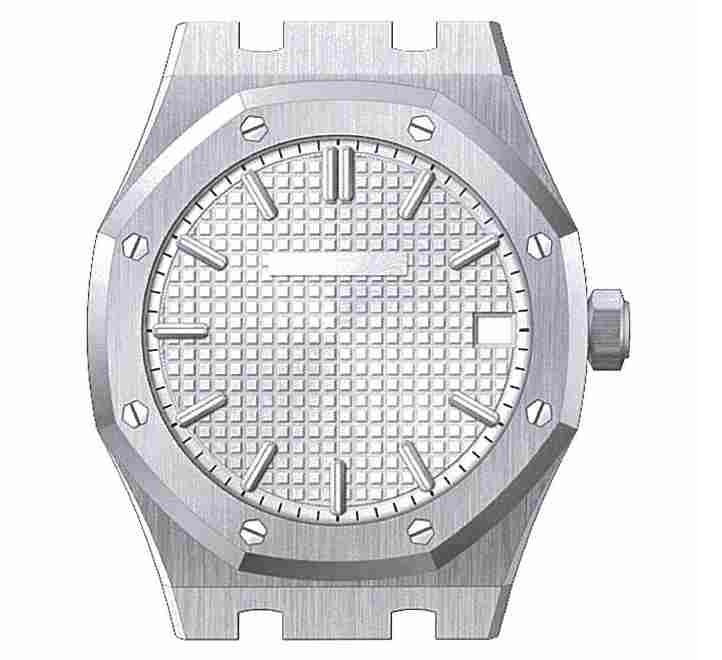
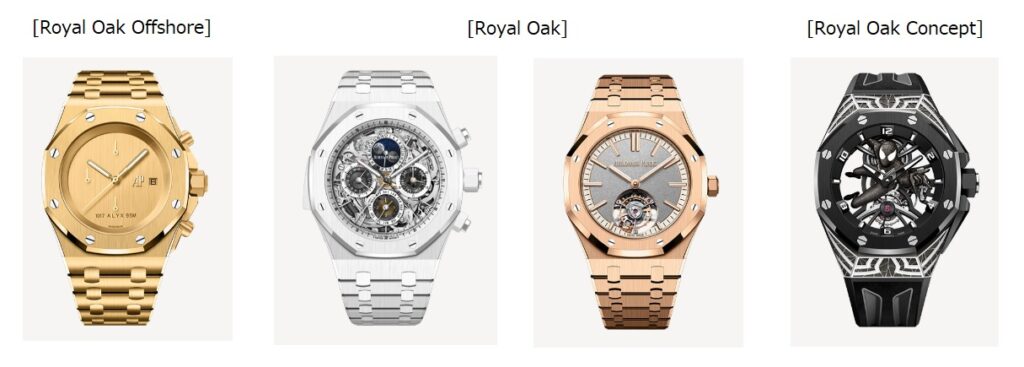
Audemars Piguet “ROYAL OAK” Watch Collection

On February 26, 2020, Audemars Piguet Holding SA (AP) filed a trademark application for the shape of the flagship watch collection “ROYAL OAK” (see below) to be used on ‘watches’ in class 14 with the Japan Patent Office (JPO) [TM application no. 2020-20319].

The mark consists of a dial with tapisserie pattern and hour markers, minute track, date window, an octagonal bezel with 8 hexagonal screws, case, a crown, and a lug of the famed “ROYAL OAK” watch collections.


JPO Refusal

On June 8, 2023, the JPO Appeal Board affirmed the examiner’s rejection and decided to refuse registration of the applied mark due to a lack of inherent distinctiveness based on Articles 3(1)(iii) of the Japan Trademark Law by stating that relevant consumers would simply recognize it as a generic shape of a wristwatch, not a specific source indication since many watchmakers have supplied with similar shape to the dial, bezel, case, crown, and lug of the applied mark (see below examples).

Besides, the Board found the produced evidence is insufficient to determine whether the shape per se has acquired nationwide recognition as a source indicator of AP’s watches.

Audemars Piguet Holding SA filed a lawsuit with the Japan IP High Court on October 20, 2023, and disputed inherent and acquired distinctiveness of the applied mark.


IP High Court ruling

  • Inherent distinctiveness: Article 3(1)(iii)

In the decision, the judge said “There is no particular circumstance in which the shape represented by the applied mark is taken novel in comparison with the shapes of other wristwatches. If so, it is considered within the range of shapes normally required to achieve basic function of the goods. Even supposing that the shape is unique as a whole, the shape of each component is made in a form suitable for use as a wristwatch, and selected from the viewpoint to achieve the function of the goods. Therefore, the applied mark lacks distinctiveness since it remains within the scope of expected selection of the shape for functional reasons of a wristwatch.”

AP claimed the JPO finding is inadequate because none of competitors watches have the same combination of three unique features, namely, (i) an octagonal bezel, (ii) 8 hexagonal screws, and (iii) tapisserie pattern on the surface of a dial. Visual similarity in one or two components are insufficient to deny inherent distinctiveness of the applied mark.

However, the court did not agree with this allegation and said “It is sufficient to assess whether each shape of components is distinctive as part of the shape of wristwatch”.

  • Acquired distinctiveness: Article 3(2)

AP argued acquired distinctiveness of the applied mark as a result of substantial use since 1972. Allegedly, annual sales of the “ROYAL OAK” luxury watches exceed JPY 8 billion on average in the past six years. Each year, AP spent more than JPY400 million on advertisement and promotion in Japan.

In this respect, the court pointed out the “ROYAL OAK” watches have some collections that do not represent three unique features, such as, “Royal Oak Offshore” and “Royal Oak Concept” (see below). If so, the annual sales and expenditures on advertisement and promotion would not all attribute to watches representing the applied mark.

Besides, AP has not produced the result of market research to demonstrate a certain degree of recognition of the applied mark. Accordingly, the court has no reason to believe the applied mark per se has played a role in identifying the source of famous luxury watch, Audemas Piguet.

Based on the foregoing, the court determined that the JPO did not err in its findings and that the application of Article 3(1)(iii) and 3(2) was appropriate. As a result, the court decided to dismiss the appeal in its entirely.

Hummel Victory in Appeal to Overcome Rejection against Chevron Position Mark

The Japan Patent Office (JPO) Appeal Board disaffirmed the examiner’s rejection and granted registration of TM App nos. 2018-133121 and 2018-133123 for a position mark consisting of chevron devices in relation to jackets and pants (trousers) of class 25 by finding inherent distinctiveness of the position marks.
[Appeal case nos. 2022-13211, 2022-13212 decided on December 20, 2023]


Hummel Chevron Position Mark

Hummel Holding AS filed two position marks with the JPO (TM App nos. 2018-133121, 2018-133123) on October 25, 2018. TM App no. 2018-133121 consists of 15 chevron devices positioned in series from shoulder to sleeve (see below left), and designates long-sleeved jackets in class 25. TM App no. 2018-133123 consists of 21 chevron devices positioned in series from waist to hem (see below right), and designates pants and trousers in class 25.


JPO Examination

On May 25, 2022, the JPO examiner rejected both marks based on Article 3(1)(vi) of the Japan Trademark Law by stating that:

In fashion industry, there are plenty of jackets and pants with decorations aiming to enhance aesthetic effect of the goods and attract consumers.  Under the circumstances, relevant consumers at the sight of pants or jackets bearing the position mark would not see it as a source indicator, but as a pattern for decorative or functional indication.

Article 3(1)(vi) is a provision to comprehensively prohibit from registering any mark lacking inherent distinctiveness.

Any trademark to be used in connection with goods or services pertaining to the business of an applicant may be registered, unless the trademark:

(vi) is in addition to those listed in each of the preceding items, a trademark by which consumers are not able to recognize the goods or services as those pertaining to a business of a particular person.

Hummel Holding AS filed an appeal against the rejection on August 23, 2022 and argued inherent distinctiveness of the position marks.


JPO Appeal Board decision

The Appeal Board found that respective mark would be far from a common or descriptive device as a whole.

In relevant industries, competitors often provide jackets and pants bearing their brand on the same position with the Hummel Chevron mark. If so, consumers are also accustomed to distinguishing a source of the goods by means of devices depicted on the position.

Bearing in mind that the applicant has been extensively and continuously using the position marks on their jackets and pants, presumably the marks have become famous as a source indicator of the applicant among relevant consumers.

Besides, the Board could not find any evidence of a common use of the chevron device on the same position as a decorative or functional indication.

Based on the foregoing, the Board held that relevant consumers would recognize the position marks as a source indicator. If so, the examiner made an error in finding distinctiveness of respective mark. Therefore, the Board disaffirmed the examiner’s rejection and decided in favor of Hummel Holding AS consequently.