Trademark dispute over Shogun Emblem of the Samurai Era

In a recent appeal trial over trademark dispute, the Trademark Appeal Board within the Japan Patent Office (JPO) overturned the Examiner’s determination and held that a combination mark with Tokugawa crest image and literal elements written in Chinese characters is dissimilar to, and unlikely to cause confusion with a senior trademark registration for the “TOKUGAWA CREST” device mark in connection with pickled plums of class 29.
[Appeal case no. 2018-6893, Gazette issue date: March 29, 2019]


TOKUGAWA CREST

The Tokugawa clan was the family that established the Edo shogunate, also known as the Tokugawa shogunate, (1603–1867), the final period of traditional Japan, a time of internal peace, political stability, and economic growth under the shogunate (military dictatorship) founded by Tokugawa Ieyasu. The Tokugawa shogunate continued to rule Japan for a remarkable 250 years and ended in 1868, with the Meiji Restoration when the Emperor regained power.

The Tokugawa crest was a circle in closing three leaves of the awoi (a species of mallow, found in Central Japan) joined at the tips, the stalks touching the circle (see below).

This gilded trefoil is gleaming on the property of the shogun and mausoleum even now in Japan.


YUME-AWOI

Kabushiki Kaisha Kiwa-Nouen Products, a Japanese merchant dealing with plums and its products filed a trademark application for a combination mark with Tokugawa crest image and literal elements written in Chinese characters (see below) covering pickled plums in class 29 on June 21, 2016 [TM application no. 2016-72127].
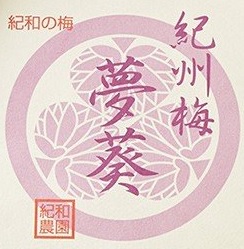
Three Chinese characters “紀州梅” in the upper right of the mark lacks distinctive since the term means plums made in Kishu, the name of a province in feudal Japan (the area corresponds to nowadays Wakayama Prefecture and southern Mie Prefecture), as a whole. Two characters “夢葵” in the center of the mark to be pronounces as “yume-awoi” is obviously a coined word and distinctive in relation to pickled plums.

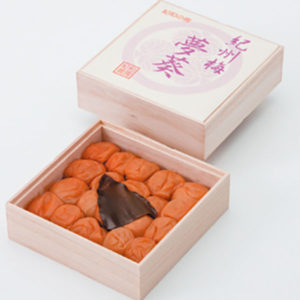
The mark is actually in use on high-class pickled plums produced by applicant.
Tokugawa Museum

Going through substantive examination by the JPO examiner, applied mark was totally refused registration based on Article 4(1)(vi), (vii), (xv) of the Trademark Law on the ground that the mark contains a device resembling the Tokugawa crest which becomes famous as a source indicator of ‘Public Interest Incorporated Foundation The Tokugawa Museum’.
If so, using the mark on the designated goods by an unauthorized entity may free-ride goodwill vested in the Tokugawa crest and anything but conductive to the public interest. Besides, relevant consumers are likely to confuse or misconceive pickled plums using applied mark with goods from The Tokugawa Museum or any business entity systematically or economically connected with the museum.

Article 4(1)(vi) is a provision to refuse any mark which is identical with, or similar to, a famous mark indicating the State, a local government, an agency thereof, a non-profit organization undertaking a business for public interest, or a non-profit enterprise undertaking a business for public interest.

Article 4(1)(vii) of the Trademark Law prohibits any mark likely to cause damage to public order or morality from registration.

Article 4(1)(xv) provides that a mark shall not be registered where it is likely to cause confusion with other business entity’s well-known goods or services, to the benefit of brand owner and users’ benefits.


Applicant filed an appeal against the refusal on May 21, 2018 and argued dissimilarity of the marks.


Appeal Board decision

The Board reversed the examiner’s refusal and admitted applied mark to registration by stating that:

It becomes trade practice to print family crest on the packaging of food products. Especially, trefoil awoi crest has been commonly used on the packaging of specialty products or souvenir from Aichi (Owari), Wakayama (Kishu) and Ibaragi (Mito) Prefectures where descendants from clan founder Tokugawa Ieyasu’s three youngest sons governed during the Edo shogunate. Besides, from appearance, Tokugawa crest image in applied mark looks like a background pattern and thus relevant consumers are unlikely to aware that the pattern serves the legally defined role of a trademark because the image is colored washier than literal elements. If so, two Chinese characters “夢葵” of the mark functions primarily as a source indicator.

Based on the foregoing, the Board considered, given the Tokugawa crest image in the applied mark does not play a role of source indicator at all, both marks are dissimilar and unlikely to cause confusion from visual, phonetic and conceptual points of view even if the Tokugawa crest becomes famous as a source indicator of Public Interest Incorporated Foundation The Tokugawa Museum in fact. Likewise, the Board found no specific reason to cause damage to public order or morality from applied mark.

JPO decision: TESLA is dissimilarly pronounced to Tesla

In a recent appeal decision over trademark dispute, the Appeal Board of Japan Patent Office (JPO) overturned the Examiner’s refusal and held the stylized TESLA mark is dissimilarly pronounced to a senior trademark registration for the “Tesla” word mark.

[Appeal case no. 2017-650037, Gazette issue date: February 22, 2019]


Stylized TESLA mark

U.S. electric automaker Tesla, Inc. (formerly Tesla Motors, Inc.) filed an application with the Japan Patent Office to register stylized TESLA mark as a trademark for “Articles of clothing, namely, t-shirts, shirts, jackets, hats; headgear, namely, sports hats, caps, sun visors.” in class 25 and “Providing financial services relating to automobiles, namely, automobile financing and lease-purchase financing; financing services for the purchase and leasing of motor vehicles; lease-purchase financing; credit services, namely, providing financing for motor vehicles; providing financial advice in the field of motor vehicles.” in class 36.


Senior TM registration for “Tesla”

Going through substantive examination by the JPO examiner, applied mark was completely refused registration based on Article 4(1)(xi) of the Trademark Law due to a conflict with a senior trademark registration no. 5533558 for word mark “Tesla” in standard character for clothing, caps and foot wears in class 25 owned by a Korean individual.

There is criterion that the examiner is checking when assessing the similarity between the marks:

  • visual similarity
  • aural similarity
  • conceptual similarity

and taking into account all these three aspects examiner makes a decision if a mark is similar (at least to some extent) with the earlier mark and if there is a likelihood of confusion for the consumers.

Applicant filed an appeal against the refusal on June 30, 2017 and argued dissimilarity of the marks.


Appeal Board decision

The Board reversed the examiner’s refusal and admitted applied mark to registration by stating that:

From appearance, both marks are sufficiently distinguishable because the 2nd and last letter of applied mark are too indecipherable to be perceived as a specific term in its entirety.

As long as applied mark does not give rise to any specific sound and meaning as a whole, applied mark is incomparable with cited mark “Tesla” in the aspects of pronunciation and connotation.

Based on the foregoing and criterion to assess similarity of mark, the Board is of a view that the stylized TESLA mark shall be dissimilar to senior registration for the word mark “Tesla” even if the designated goods are deemed identical or similar in class 25.

HISAMITSU unsuccessful in registering a shape of “Salonpas”

The Appeal Board of Japan Patent Office (JPO) disallowed registration of a shape of famous Japanese pain relief patches in the name of “Salonpas” manufactured by Hisamitsu Pharmaceutical Co., Inc. due to lack of inherent distinctiveness in relation to poultices, class 5. [Appeal case no. 2017-12694]


Salonpas

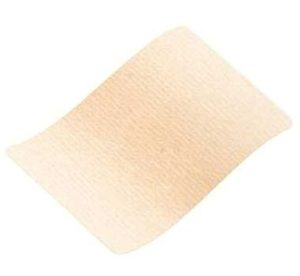
Hisamitsu Pharmaceutical Co., Inc. filed a trademark application for a shape of Over-The-Counter Topical Pain Patch known for “Salonpas” (see below) by designating pharmaceutical preparations, gauze for dressings, bandages for dressings, adhesive plasters and other goods in class 5 [TM application no. 2015-7479].

Salonpas is a product of Hisamitsu Pharmaceutical, a company whose history dates back to the mid-1800s. Salonpas was introduced in 1934 and was first distributed in Asia. The FDA approved the Salonpas Pain Relief Patch for the US market in 2008. Approximately 20 billion Salonpas transdermal patches have been sold in the last 20 years. Salonpas has been acknowledged as World’s No.1 OTC Topical Analgesics in patch format.


JPO Examination

The JPO examiner totally refused the application based on Article 3(1)(iii) of the Japan Trademark Law stating that the applied mark can be easily seen as a shape of poultices and the shape does solely consist of a common configuration to achieve the basic function of poultices. If so, the applied mark lacks distinctiveness as a source indicator.

Article 3(1)(iii) is a provision to prohibit any mark from registering where the mark solely consists of elements just to indicate, in a common manner, the place of origin, place of sale, quality, raw materials, efficacy, intended purpose, quantity, shape (including shape of packages), price, the method or time of production or use.


To dispute the refusal, Hisamitsu filed an appeal on August 28, 2017.


Appeal Board’s decision

The Appeal Board, however, upheld the examiner’s decision on the ground and dismissed Hisamitsu’s allegation by stating that relevant consumers and traders shall conceive of a mere qualitative representation to indicate the shape of poultices and plasters at the sight of applied mark given similar indications are depicted on the packages of other supplier’s goods on the market (see below).


Based on the foregoing, the Board consequently refused to register the mark based on Article 3(1)(iii) of the Trademark Law.

IP High Court ruling: “BULK AAA” confusingly similar to “BULK HOMME”

On March 7, 2019, the Japan IP High Court revoked a decision by the Japan Patent Office (JPO) to invalidation trial over a dispute of similarity between trademark “BULK AAA” and “BULK HOMME”, and ruled “BULLK AAA” shall be retroactively invalid. [Judicial case no. Heisei30(Gyo-ke)10141]


BULK HOMME

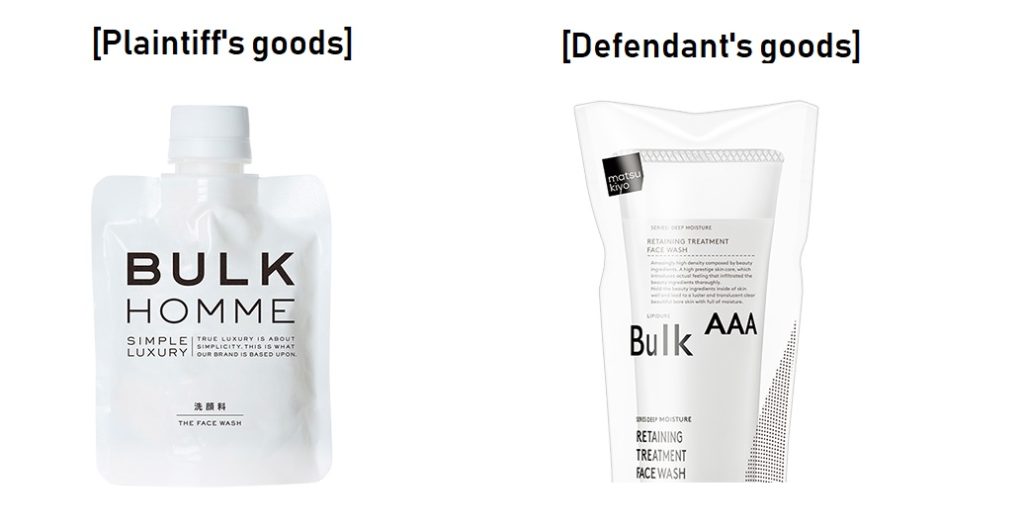
The case was brought into the IP High Court after the JPO decided to dismiss an invalidation trial (case no. 2017-890079) claimed by BULK HOMME Co., Ltd. (Plaintiff), an owner of senior trademark registration no. 5738351 for a  mark consisting of “BULK HOMME” and other literal elements (see below) over goods of cosmetics, skin care products for men in class 3.


INVALIDATION TRIAL AGAINST “BULK AAA”

In the invalidation trial, plaintiff asserted trademark registration no. 5931607 for word mark “BULK AAA” in standard character shall be invalid in violation of Article 4(1)(xi) of the Trademark Law since the mark is confusingly similar to “BULK HOMME” and designates cosmetics (class 3) which is undoubtedly identical with or similar to the goods designated under its own senior registration.

Article 4(1)(xi) is a provision to prohibit from registering a junior mark which is deemed identical with, or similar to, any senior registered mark.

Inter alia, plaintiff vehemently argued the term “AAA” in disputed mark lacks distinctiveness as a source indicator in relation to cosmetics since “AAA” is a term commonly used to represent the highest possible rating assigned to the bonds of an issuer by credit rating agencies. Given the circumstance, relevant consumes of cosmetics are likely to consider the term in disputed mark a qualitative indication of the goods even if the term has not been used as such  in connection with cosmetics in fact.

However, the Trial Board of JPO set aside the allegation by stating that disputed mark “BULK AAA” shall be assessed in its entirety. It is groundless to compare a word portion “BULK” of disputed mark with “BULK HOMME” given the Board could not identify any facts to assume relevant consumers of cosmetics conceive the term “AAA” of disputed mark as a qualitative indication. Both marks are sufficiently distinguishable from visual, phonetic, and conceptual points of view and dissimilar as a whole.

To contend against the decision, plaintiff filed an appeal to the IP High Court.


IP HIGH COURT DECISION

The IP High Court, to the contrary, sided with plaintiff and completely negated fact-findings made by the Trial Board of JPO. The Court held the term “AAA” is recognized as a qualitative indication even when used on cosmetics and thus the word portion of “BULK” is likely to play a dominant role of source indicator. If so, it is anything but inappropriate to pick up the word “BULK” from disputed mark and compare it with other mark in the assessment of mark similarity.

Besides, “HOMME” is a French word meaning “for men”. From the produced evidences, it seems apparent the word has been used in relation to men’s cosmetics, and consumers are accustomed to it so that they can recognize the meaning. Given the term is depicted in a thinner font than “BULK” in the citation, “BULK” gives dominant impression as a source indicator in the mind of consumers. Accordingly, it is reasonable to pick up the word “BULK” from the citation and compare it with other mark in the assessment of mark similarity.

The Court found that the Trial Board materially erred in the fact-finding and assessing similarity of mark. As long as dominant portion “BULK” of both marks and designated goods are identical, disputed mark shall be invalid based on Article 4(1)(xi).

Serapian Loses Trademark Opposition against S device mark

The Italian-based fashion house Stefano Serapian S.r.l., known for its briefcases, handbags and purses opposed the registration in Japan of the trademark S logo owned by the Japanese company, Kabushiki Kaisha Overseas.


Opposed mark

Overseas filed an application to register S logo (see below) designating, among others, bags, purses, pouches and leather goods in class 18 on April 27, 2017. Going through substantive examination at the Japan Patent Office (JPO), it was registered on October 20 of that year (TM Reg no. 5990450).

Serapian Opposition

A trademark opposition proceeding filed on January 15, 2018, Serapian contended that opposed mark is confusingly similar to its registered famous “S” device mark (see below) by citing its owned IR no. 1117130 and thus shall be cancelled in violation of Article 4(1)(xi) and (xv) of the Japan Trademark Law.


Article 4(1)(xi) is a provision to refrain from registering a junior mark which is deemed identical with, or similar to, any senior registered mark.

Article 4(1)(xv) provides that a mark shall not be registered where it is likely to cause confusion with other business entity’s well-known goods or services, to the benefit of brand owner and consumers.

Theoretically, Article 4(1)(xv) is applicable to the case where a mark in question is deemed dissimilar to well-known brand, but still likely to cause confusion because of a high degree of popularity and reputation of the brand.


The Ruling

The Opposition Board of JPO negated a certain degree of popularity and reputation of Serapian’s “S” device mark, stating that produced materials are insufficient and non-objective to demonstrate famousness of the cited mark.

Besides, the Board found that both marks are sufficiently distinguishable from appearance in view of overall configuration. From phonetic and conceptual points of view, it is apparent that respective mark would not be perceived as an alphabetical letter ‘S’, but a geometric figure device without any specific concept and pronunciation. If so, both marks would not give rise to similar appearance, sound and meaning at all.

Even if taking account of originality of “S” device mark, as long as it remains unclear whether Serapian “S” device mark has become popular among relevant consumers in Japan, the Board had no reason to admit a likelihood of confusion.

As a conclusion, the Board decided opposed mark is not subject to Article 4(1)(xi) and (xv) of the Trademark Law and dismissed the opposition accordingly.

[Opposition case no. 2018-900017, Gazette issue date December 28, 2018]

Is Polaroid Photo Frame trademarked?

In a recent decision, the Appeal Board of Japan Patent Office (JPO) admitted trademark registration for the Polaroid Photo Frame design mark (see below) in relation to services of photo printing, digital on-demand printing, processing of photographic films, photographic retouching (class 40).
[Appeal case no. 2017-9599, Gazette issue date: June 28, 2018]


Polaroid Photo Frame

Disputed mark (see below), apparently looking like Polaroid Photo Frame, was filed in the name of PLR IP Holdings, LLC, the ex-owner of the Polaroid brand and related intellectual property, by covering services of photo printing, digital on-demand printing, processing of photographic films, photographic retouching under class 40 on June 24, 2015.

As a result of substantive examination by the JPO examiner, disputed mark was refused due to a lack of inherent distinctiveness based on Article 3(1)(vi) of the Trademark Law.

Article 3(1)(vi) is a comprehensive provision to prohibit any mark lacking inherent distinctiveness from being registered.

Any trademark to be used in connection with goods or services pertaining to the business of an applicant may be registered, unless the trademark:
(vi)
 is in addition to those listed in each of the preceding items, a trademark by which consumers are not able to recognize the goods or services as those pertaining to a business of a particular person.


Appeal Board decision

The Appeal Board sided with applicant and overruled examiner’s refusal decision by stating that the Board could not detect actual use of the applied design as a representation of shape or quality in connection with the designated services.

Besides, it is questionable to conclude that disputed mark, a combination of White Square and black rectangle, solely consists of a very simple and common sign. If so, the Board considers disputed mark is capable of serving as a source indicator so that consumers may distinguish the source with the clue of disputed mark.

Based on the foregoing, the Board admitted trademark registration of the Polaroid Photo Frame device mark in class 40.

Google victorious in trademark dispute for YouTube icon

The Trial Board of Japan Patent Office (JPO) recently upheld Google’s invalidation petition against TM Reg. no. 5665763 for the “Video Blog” mark in combination with figurative element (see below) due to similarity to YouTube icon and a likelihood of confusion with Google business.
[Invalidation case no. 2017-890005, Gazette issue date: July 27, 2018]


TM Registration no.5665763

Opposed mark, consisting of two words “Video Blog” in English and Japanese in two lines, and figurative elements depicted in between the words, was applied for registration on August 13, 2013 in respect of broadcasting services for internet in class 38.

Without confronting with a refusal during substantive examination, opposed mark was registered on April 25, 2014.

Petition for invalidation

Japan Trademark Law provides a provision to retroactively invalidate trademark registration for certain restricted reasons specified under Article 46 (1).

Google Incorporated filed a petition for invalidation against opposed mark on January 25, 2017. Google argued it shall be invalidated due to a conflict with famous YouTube icon (see below) and a likelihood of confusion with Google business when used on internet broadcasting services in class 38 based on Article 4(1)(x) and (xv) of the Trademark Law.

Board decision

The Board admitted that YouTube icon has acquired a high degree of popularity and reputation as a sign to play movies and TV shows on YouTube or an icon to start up YouTube application among relevant consumers of broadcasting service for internet.

In assessment of the similarity between two marks, at the outset the Board found that the words “Video Blog” of opposed mark in itself lack distinctiveness as a source indicator in relation to the designated service. If so, the figurative element of opposed mark plays key role as a source indicator. It is unquestionable that the figurative element is highly similar to Youtube icon. Besides, in view of Google’s business portfolio, it is highly predictable that Google launches broadcasting or news distributing business.

Users of Google services are also likely to receive internet broadcasting services.

Based on the foregoing, the Board concluded that, from totality of circumstances and evidences, relevant traders or consumers are likely to confuse or misconceive a source of opposed mark with Google or any entity systematically or economically connected with the opponent and declared invalidation based on Article 4(1)(x) and (xv).

JPO refused 3M Company to register “3M” in relation to vehicles regardless of renowned 3M logo

In a recent decision, the Appeal Board of Japan Patent Office (JPO) did not allow registration of a word mark “3M” written in standard character due to a lack of distinctiveness in relation to vehicles (class 12). [Appeal case no. 2017-3200]

Disputed mark – “3M” in standard character

Disputed mark, a word consisting of “3M” written in standard character, was filed by designating various types of vehicles (class 12) in the name of 3M Company, an American multinational technology company that engages in the manufacture of industrial, safety and consumer goods, and equipment on October 28, 2014 (TM application no. 2014-90835).

Article 3(1)(v)

On December 6, 2016, The JPO examiner totally refused disputed mark based on Article 3(1)(v) of the Trademark Law, stating that sign consisting of a digit and an alphabet is commonly used in transaction to represent article number, model number or standards. If so, disputed mark lacks inherently distinctiveness as a source indicator.

The article prohibits applied mark from registering if the mark consists solely of a very simple and common mark. Trademark Examination Guidelines (TEG) provides that a trademark composed of a numeral followed by one or two Roman characters, e.g. 2A, is subject to the article.

3M Company filed an appeal against the refusal and asserted that “3M” has become famous among public in general as a trade name and source indicator of applicant or its Japanese subsidiary.

Appeal Board decision

The Board, however, dismissed the assertions by finding that:

  1. Evidences just reveal longtime use of “3M” as a trade name of applicant or its subsidiary. But most of them show disputed “3M” mark is used to represent a commercial name in the context of newspapers and web articles. If so, there shall not be seen as a source indicator.
  2. Renowned 3M logo is different from disputed 3M mark in appearance.
  3. Even if “3M” keyword extraction from the web pages demonstrates substantial numbers of articles pertinent to applicant’s business and less possibility to use “3M” by unrelated business entities as article number, model number or standards, these facts are insufficient not to apply Article 3(1)(v).
  4. Precedent administrative decisions and judicial rulings are cases relating to renowned 3M logo. If so, as long as disputed mark consists of “3M” written in standard character, the Board can’t find any reason to bind the case in dispute.

NIKE unsuccessful in registering JUST DO IT on cosmetics

In a recent decision, the Appeal Board of Japan Patent Office (JPO) dismissed an appeal filed by NIKE Innovate C.V., who attempted to register a word mark “JUST DO IT” in standard character on cosmetics and other goods classified in class 3 by means of “defensive mark” under Article 64 of the Japan Trademark Law.
[Appeal case No. 2015-23031, Gazette issued date: February 23, 2018]


DEFENSIVE MARK

According to Article 64, famous brand owner is entitled to register its brand as “defensive mark” with respect to dissimilar goods/services that are not designated under the basic registration, where the owner shall demonstrate that the mark has acquired remarkable prestige in relation to the goods/services on which the mark has been substantially used, and thus there will be likely to occur confusion with the owner if an identical or similar mark is used on dissimilar or remotely associated goods/services with basic registration.


JUST DO IT

NIKE Innovate C.V. owns trademark registration no. 4206837 for the word mark “JUST DO IT” on apparels, shoes and sportswear and other goods in class 25 since 1998.

NIKE sought to register the mark as defensive mark on cosmetics (class 3) on October 22, 2014 (Trademark application no. 2014-88774). Examiner refused the application by stating that it is unclear whether the mark has been used in connection with applicant’s goods of class 25. If so, the mark can be recognized merely as a commercial slogan to represent sports event. Consequently, examiner considers the mark has not become well-known mark as a source indicator of applicant.

To contest the refusal, NIKE filed an appeal on December 15, 2015.


BOARD DECISION

The Appeal Board likewise questioned whether “JUST DO IT” has been used as a source indicator of apparel, shoes, or sportswear.

Board admitted a certain degree of popularity and reputation on the term “JUST DO IT” as a corporate message from NIKE, however, upheld the refusal by stating that the produced advertisement and evidences regarding “JUST DO IT” are insufficient and vague to connect the term with goods designated under basic registration.


Apparently, the Board underestimated “JUST DO IT” on the grounds that NIKE failed to advertise the term in a manner closely connected with specific goods.