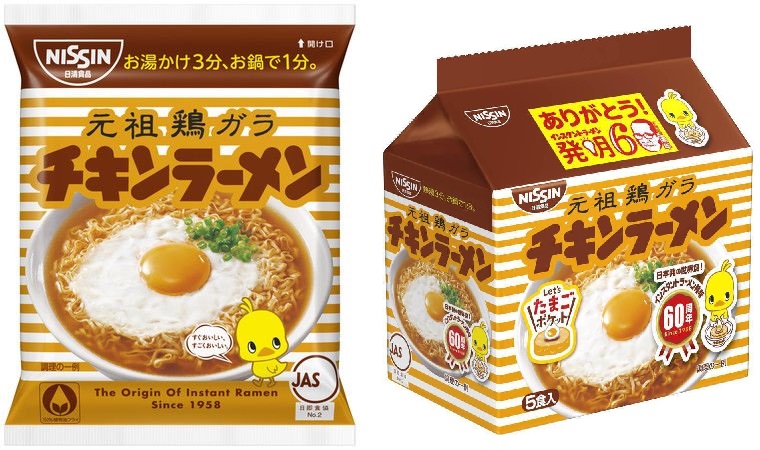
On March 25, 2022, the Japan Patent Office (JPO) granted protection of a color mark that has been used on the package of the first and a long-selling Japanese instant ramen “Nissin Chicken Ramen”. It is the 9th case for JPO to admit registration since opening the gate to color mark in April 2015.
Nissin Chicken Ramen
In 1958, NISSIN FOODS founder Momofuku Ando invented the world’s first instant noodles: Chicken Ramen, paired with a rich broth made of chicken and vegetables.
Nissin Chicken Ramen is a long-selling Japanese instant ramen loved by many generations and considered the world’s first instant noodles. According to the company’s release, more than 5 billion packages of Chicken Ramen had been sold.
Color mark on Package
The JPO opened the gate to Non-Traditional trademarks, namely, color, sound, position, motion, and hologram, in April 2015.
On July 12, 2018, Nissin Foods sought for registration of color combination on the Chicken Ramen package on instant noodles in class 30.
JPO examiner raised his objection because of a lack of distinctiveness based on Article 3(1)(iii) of the Trademark Law. However, the examiner eventually granted protection by finding acquired distinctiveness of the color mark (TM Reg no. 6534071).
Low Success rate -1.6%
563 color marks have participated in a race for trademark registration at the JPO as of now (May 14, 2022). 9 color marks could manage to award registration.
It is noteworthy that none of them is a mark consisting of a single color.
A previous post relating to colormark is accessible from here.
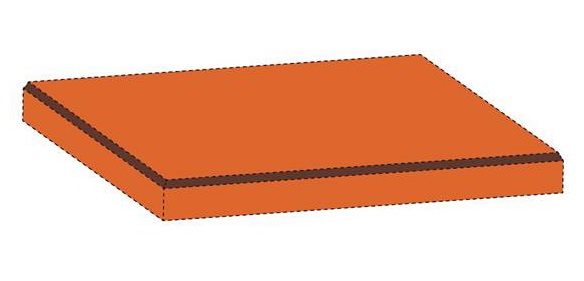
HERMES INTERNATIONAL, a French luxury fashion house, is in a legal battle to register its iconic packaging colors, orange and brown, as a color mark in Japan.
Color mark of Hermes box
On October 25, 2018, HERMES INTERNATIONAL filed a trademark application for its iconic packaging colors, orange and brown (see below), as a color mark to be used on various goods in class 3, 14, 16, 18, and retail services in class 35 with the Japan Patent Office (JPO) [TM application no. 2018-133223].
Article 3(1)(iii) and 3(1)(vi)
The JPO examiner rejected the color mark under Article 3(1)(iii) and 3(1)(vi) of the Japan Trademark Law by stating that colors per se are unlikely to play a role in source indicator because they are frequently aimed to attract consumers in association with function or quality of goods and services. Because of it, relevant consumers at the sight of goods or services bearing the applied color would not see the combination of colors, orange and brown, as a source indicator.
Acquired Distinctiveness
Hermes argued acquired distinctiveness of the color combination as a result of substantial use on Hermes box for the past six decades from the 1960s onward.
A bottleneck is that the Hermes box contains its name “HERMES” and horse and carriage logo as a conspicuous source indicator. Hermes conducted market research to demonstrate the acquired distinctiveness of the packaging color per se. The research targeted high-income men and women in their 30s to 50s with incomes JPY10,000,000 and above. According to the research report, 36.9% of the interviewees answered Hermes when shown three boxes in different shapes with the color mark. 43.1% chose Hermes from ten options.
JPO Rejection
The JPO examiner did not find the research persuasive to support acquired distinctiveness among relevant consumers of the goods and services in question.
The examiner stated the relevant consumers shall not be limited to the high-income class. Besides, even among high-income consumers, more than half of them did not link the color to Hermes. From the research, it is doubtful if relevant consumers would conceive the color per se as a source indicator.
Based on the above findings, the examiner totally rejected the applied color mark under Article 3(1)(iii) and (vi) on July 9, 2021.
HERMES INTERNATIONAL filed an appeal against the rejection on October 8, 2021.
In a recent decision, the Appeal Board of Japan Patent Office (JPO) overturned the examiner’s rejection and decided to register the wordmark “F1” in standard character by finding acquired distinctiveness as a source indicator in relation to automobile races in class 41.
[Appeal case no. 2021-1819, Decision date: November 5, 2021]
F1
Formula One Licensing BV, managing the trademarks for the FIA Formula One World Championship, applied wordmark “F1” in standard character for use on ‘organization, arranging and conducting of automobile races; providing information relating to automobile races’ in class 41 on May 7, 2018 (TM App no. 2018-58985).
Article 3(1)(v)
The JPO examiner rejected the mark “F1” because of lack of inherent distinctiveness based on Article 3(1)(v) of the Japan Trademark Law on the grounds that a sign consisting of a digit and an alphabet is commonly used in transactions to represent article number, model number or standards. If so, the applied mark shall not play a role in a specific source indicator.
Article 3(1)(v) prohibits any mark from registering if it solely consists of a very simple and common sign.
Trademark Examination Guidelines (TEG) sets forth that a mark consisting of one or two alphabetical letters followed by a numeral, e.g. “A2”, “AB2”, is unregistrable under the article.
Followings are also enumerated as unregistrable marks under the article.
Numerals
One or two alphabetical letters, e.g. “AA”
Two alphabetical letters combined with “-” or “&”, e.g. “A-B”, “C&D”
One or two alphabetical letters accompanied by “Co.”, e.g. “AB Co.”
A numeral followed by one or two alphabetical letters, e.g. “2A”
The applicant filed an appeal against the refusal and argued the distinctiveness of the “FS12” mark.
Formula One Licensing BV filed an appeal against the refusal and argued acquired distinctiveness of the “F1” mark on February 9, 2021.
JPO Appeal Board decision
The Appeal Board affirmed the examiner’s finding that the applied mark “F1” inherently lacks distinctiveness as a source indicator and shall not be registered under Article 3(1)(v).
In the meantime, the Board found the mark has acquired distinctiveness as a result of substantial use in relation to automobile races to indicate Formula One for more than seven decades. The Board could not find a single fact that the term “F1” has been used in relation to the services in question by any entity unrelated to the applicant. If so, the Board has a reasonable ground to believe that relevant consumers and traders would conceive the mark “F1” as a source indicator of Formula One and shall be exceptionally registered under Article 3(2).
Article 3(2)
Notwithstanding the preceding paragraph, a trademark that falls under any of items (iii) to (v) of the preceding paragraph may be registered if, as a result of the use of the trademark, consumers are able to recognize the goods or services as those pertaining to a business of a particular person.
Based on the above findings, the Board overturned the examiner’s rejection and granted protection of the wordmark “F1” in standard character for use on services relating to automobile races in class 41.
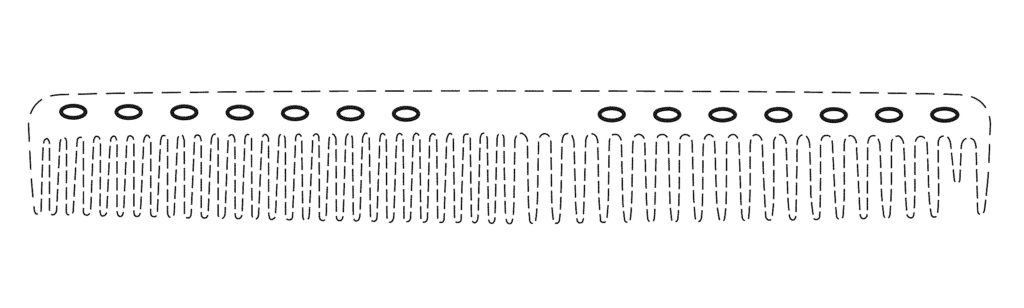
On August 27, 2020, the Japan IP High Court ruled to affirm the Japan Patent Office (JPO) decision and rejected TM application no. 2016-34650 for a position mark consisting of fourteen open ellipses built-in grip section of cutting combs in class 21 due to a lack of inherent distinctiveness. [Court case no. Reiwa1(Gyo-ke)10143]
YS Park Cutting Comb
The YS Park Cutting Comb features a non-slip grip section with fourteen air ellipses spaced in 1cm intervals to allow for great flexibility and sectioning.
Allegedly, the comb has been distributed in
many countries and its annual sales increased to 170,000~27,000 pieces for the
last five years.
Position Mark
Plaintiff, a Japanese corporation to distribute the YS Park Cutting Comb since 1989, sought for registration for fourteen open ellipses built-in grip section of the Cutting Comb as a Position Mark (see below) on March 28, 2016.
In Japan, by an enactment of the New Trademark Law in 2014, new types of mark, namely, color, sound, position, motion, hologram, was allowed for trademark registration since April 2015.
JPO decision
On September 17, 2019, the JPO refused the position mark under Article 3(1)(vi) of the Trademark Law by finding that there are plenty of competitor’s combs with a design, pattern, hole, or pit in short intervals on the grip section and it gives rise to an impression of the decorative or functional linear pattern as a whole. If so, relevant consumers at the sight of cutting comb bearing the position mark would just conceive it as a pattern for decorative or functional indication, not as a source indicator. Besides, consecutive use on the YS Park Cutting Comb over a decade would be insufficient to acquire secondary meaning from the produced evidence and business practice in relation to cutting comb. [Appeal case no. 2018-8775]
Article 3(1)(vi) is a provision to
comprehensively prohibit from registering any mark lacking inherent
distinctiveness.
Any trademark to be used in connection with goods or services pertaining to the business of an applicant may be registered, unless the trademark: (vi) is in addition to those listed in each of the preceding items, a trademark by which consumers are not able to recognize the goods or services as those pertaining to a business of a particular person.
To contend, the applicant filed a lawsuit to the IP High Court on October 29, 2019, and demanded cancellation of the decision.
IP High Court Ruling
This is the 2nd court case for the IP High Court to hear the registrability of Position Mark.
At the outset, the court stated the distinctiveness of Position Mark shall be assessed as a whole by taking account of a constituent of the mark and its position on goods or services.
The court upheld fact-findings by the JPO that plenty of competitors advertise and provide cutting combs with a pattern, pit, or open holes in short intervals on the grip section to enhance its function. In this regard, it is unlikely that relevant consumers (general consumers on the case) would consider the whole pattern as a source indicator of the comb. The court pointed that plaintiff has promoted features of fourteen open ellipses on YS Park Cutting Comb with an advertisement of “Air Suspension Function” in fact. If so, consumers would find the open holes as a functional indication.
Plaintiff produced interviews and statements by beauticians, hairstylists, school officials/staff of Cosmetology and Beauty school and argued the secondary meaning of the Position mark, however, the court negated the allegation on the ground that such evidence is insufficient and irrelevant to demonstrate acquired distinctiveness since the goods in question shall be broadly targeted to general consumers. Thus, the court decided the JPO did not error in finding secondary meaning in the case.
On 23 June 2020, the Japan IP High Court decided a case concerning a single color mark that was rejected for registration by the Appeal Board of the Japan Patent Office (“JPO”).
Single Color Mark
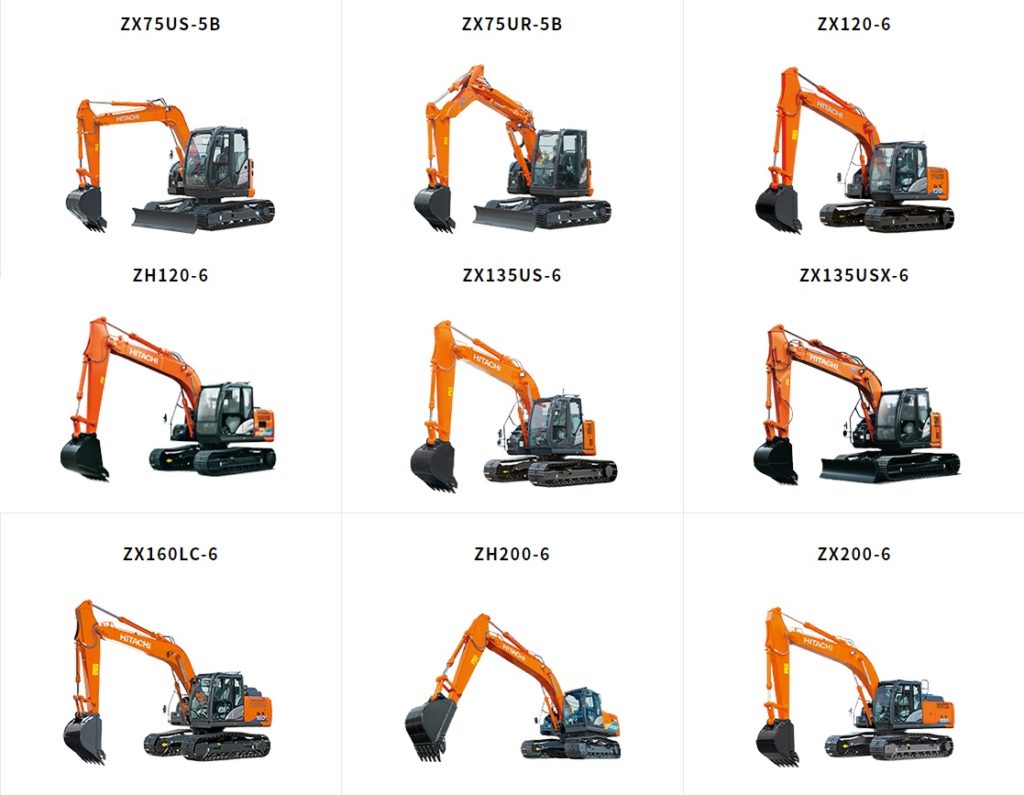
On 1 April 2015, Hitachi Construction Machinery (“Hitachi”) filed an application for trademark registration with JPO consisting of a single color per se, namely orange (Munsell: 0.5YR5.6/11.2) over the goods of hydraulic excavators, wheel loaders, road loaders, loaders [earch moving machines] in class 7, and rigid dump trucks in class 12 (TM Application no. 2015-29999).
TM Application No. 2015-29999
By the decision of 19 September 2019, the Appeal
Board of JPO declared the applied color mark to be refused in contravention of Article
3(1)(iii) and Article 3(2) of the Trademark Law, finding that the
graphic representation of the color mark constituted the “mere single orange
color, without contours”. If so, the mark is not inherently distinctive
and it is lacking acquired distinctiveness. In the course of the appeal trial,
Hitachi amended and restricted the designated goods to “hydraulic excavators”.
Article 3(2) is a provision to allow registration of any mark with which the relevant public will associate a particular source, manufacturer, or producer over time through the trademark owner’s usage.
On 30 October 2019, Hitachi appealed
against the JPO decision.
IP High Court decision
At the outset, the court stated it is inevitable
on the case concerning single color mark to take the interest of competitors who
deal with the goods in question into consideration since allowing one trader to
exclusively use this color would likely to cause unjust competitive practice in
form of monopolistic power of use in favor of one trader only.
From the produced evidence, Hitachi has allegedly used the color in question on hydraulic excavators and other construction machines since 1974.
Hitachi Hydraulic Excavators
Hitachi consecutively holds a 20% market share (14.6%) of hydraulic excavators over the past four decades in Japan. The research showed that approx. 95.9 % (185 out of 193) of traders in the construction industry were able to associate the color with Hitachi.
In the meantime, several competitors use similar color on hydraulic excavators
In the decision, the court found orange color is one of the colors commonly seen in our daily life. Besides, the Japan Industrial Standard (JIS) adopts orange as a safety sign-color aiming to prevent harm to the human body and damage to properties. Because of it, at construction sites, we often see several items colored in orange, e.g. helmets, rain suits, guard fens, work clothes, tower cranes, construction vehicles.
Hitachi Hydraulic Excavators have other colors, in fact, namely, a house mark “HITACHI” colored in white, buckets (attachments), cockpits, and crawlers colored in black. If so, the applied mark shall be capable of playing the role of source indicator in combination with these. Thus, the court would not find reasonable grounds to believe that the orange color per se acquired distinctiveness as a source indicator of Hitachi’s Hydraulic Excavators.
The court even suspected credibility of the research by finding that it narrowly targeted traders or consumers who own more than 10 hydraulic excavators, precisely it showed 36.8% in light of initial research number of targets, 502 persons, and the questionnaire ‘Please answer. What maker do you think hydraulic excavator is?” was insufficient to conclude acquired distinctiveness since its answer may simply suggest one of the colors of Hitachi’s Hydraulic Excavators.
Even if hydraulic excavators market in Japan is an oligopoly with five makers accounting for 90 % of the industry share, and the orange color has been consecutively used by Hitachi only, it does not mean every competitor agreed to refrain from using the color given orange has been used on various goods in the construction and agriculture industry in general.
Based on the foregoing, the court affirmed the JPO decision and dismissed Hitachi’s allegations in contravention of Article 3(1)(iii) and 3(2).
Thus, it is obvious that a very high standard of distinctiveness needs to be attached to a single-color mark if the same has to be claimed for trademark protection.
This case was a second court decision concerning a single color mark. The first case, Reiwa1(Gyo-ke)10119 ruled on March 11, 2020, also ended with the rejection of a single orange color mark in contravention of other ground, Article 3(1)(vi).
How JPO Examines Color Marks
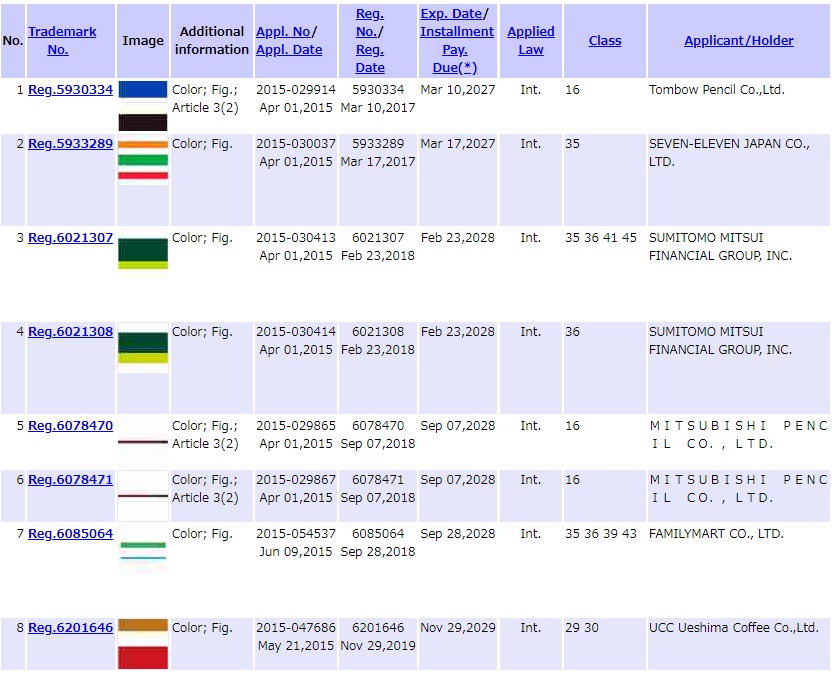
As of now (12 July 2020), 543 color marks were applied for registration with JPO since the commencement of the Non-Traditional trademark application in April 2015. So far, only 8 marks are successfully registered. See below.
In sum, the registration rate of color mark is barely 1.5%! It is noteworthy none of a ‘single’ color mark has been granted to registration.
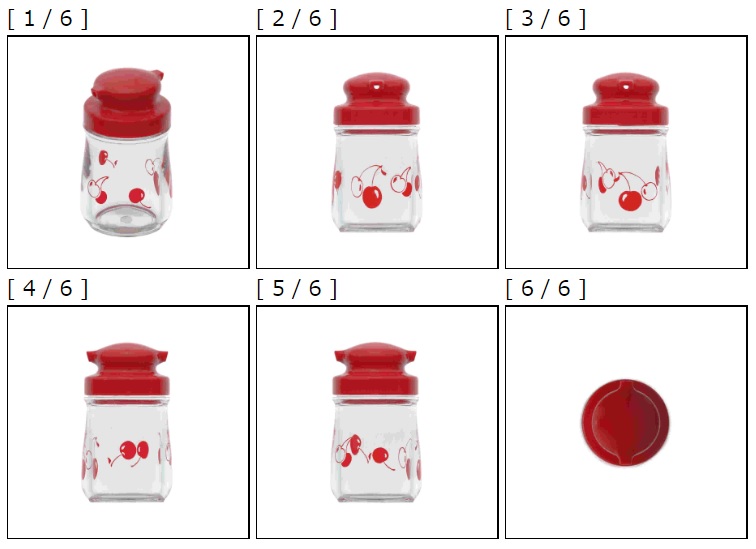
In a recent administrative decision, the Japan Patent Office (JPO) found 3D shape of cherry design bottle is inherently distinctive in relation to soy sauce dispensers in class 21 even without secondary meaning. [Appeal case no. 2019-7188, Gazette issue date: March 27, 2020]
3D shape of cherry design bottle
RISU Co., Ltd. filed a trademark application for three-dimensional shape of soy sauce bottle featuring cherry designs (see below) in relation to say sauce dispensers of class 21 on July 20, 2017 (TM Application no. 2017-96914).
From appearance, the 3D shape does not
differentiate from an ordinary soy sauce dispenser except cherry designs in red
encircling a clear cylindrical plastic bottle.
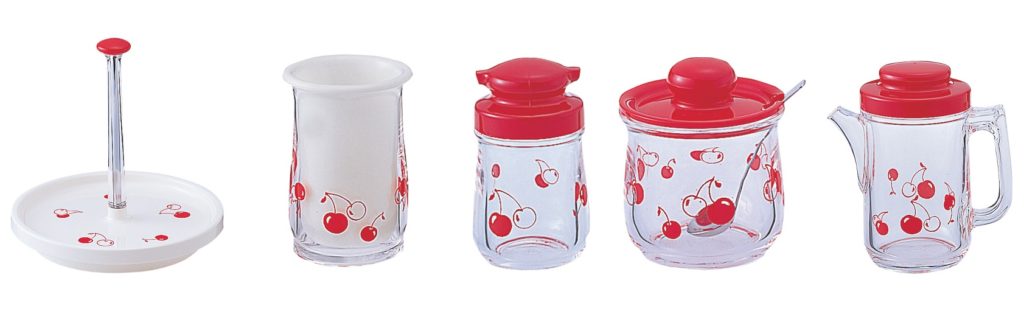
As a matter of fact, RISU Co., Ltd. has
produced various plastic products for home use as well as cherry patterned table
top condiment containers.
Article 3(1)(iii)
The JPO examiner rejected registration of
the 3D mark on the ground that relevant consumers would not conceive the shape
as a source indicator in relation to soy sauce dispensers since there exists
similar goods depicting decorative patterns and colors to aim at attracting their
attentions. The mark merely represents a shape of designated goods in a common
manner and thus is not eligible for registration based on Article 3(1)(iii) of
the Trademark Law.
Article 3(1)(iii) is a provision to prohibit any mark from registering where the mark
solely consists of elements just to indicate, in a common manner, the place of
origin, place of sale, quality, raw materials, efficacy, intended purpose,
quantity, shape (including shape of packages), price, the method or time of
production or use.
To dispute the refusal, applicant, applicant
filed an appeal on June 3, 2019.
Appeal Board’s decision
The Appeal Board disaffirmed examiner’s
rejection of the 3D shape by stating that:
Figurative elements depicted on a clear plastic cylindrical bottle would be rather perceived as a distinctive device created on a cherry motif, than a decoration for the purpose of enhancing function or aesthetic appeal of goods in question. If so, the 3D shape per se is deemed to play a role of source indicator sufficiently. It is obvious that examiner errored in finding distinctiveness of the 3D shape.
Thus, the 3D mark is eligible for
registration in connection with soy sauce dispensers of class 21 even without finding
secondary meaning because of inherent distinctiveness of the shape.
On July 3, 2019, the Japan IP High Court reversed a decision of the Japan Patent Office (JPO) finding that the company Daimler AG was entitled to registration of “EQ” for Motor vehicles in class 12, even though the term “EQ” by itself is descriptive for the goods. [Case no. Heisei31(Gyo-ke)10004, Daimler AG vs the JPO Commissioner]
The EQ Application
The JPO has refused registration to an application for EQ in standard characters (word only, see below) on the basis that the mark was descriptive for the goods “Motor vehicles” in class 12 based on Article 3(1)(v) of the Trademark Law.
The article prohibits an applied mark from registering if it consists solely of a very simple and common mark. Trademark Examination Guidelines (TEG) stipulates that a mark consisting of one or two alphabetical letters is not eligible for registration under the article. Click here.
A mark consisting of two alphabetical
letters is not capable of identifying the source of the goods due to a lack of distinctiveness
because a combination of two alphabetical letters is limited on quantity and currently
used to represent a model name of vehicle, e.g. BMW XS, TOYOTA Carina ED, Ferrari
FX, Nissan GT-R.
Descriptive terms falling under the article
are only capable for registration based on Article 3(2) if they have “acquired
distinctiveness”, which means the term has taken on a meaning in the public
view so that people see the term as a trademark identifying the goods rather
than simply describing the goods.
In this regard, Daimler AG argued the EQ
mark, a coined term originating from “Electric Intelligence” to appeal design,
extraordinary driving pleasure, high levels of everyday suitability and maximum
safety of electric car by Mercedes-Benz, has acquired distinctiveness since launching
the brand at the Paris Motor Show in September 2016.
JPO Decision
However, the JPO dismissed the argument on
the grounds that:
Daimler has neither used the EQ mark by itself as a name of electric car nor produced evidences of its plan to sell electric car named “EQ”.
Daimler uses the EQ mark in a stylized design in press releases. If so, it is questionable whether relevant consumers conceive the EQ mark in standard characters as a source indicator of Mercedes-Benz.
According to the produced evidences, Daimler uses the EQ mark in combination with other literal elements, e.g. “Generation EQ Concept”, “Concept EQA”, “EQC”, “smart vision EQ for two”, “EQ POWER”, “EQ POWER+”.
There are no actual domestic sales of the electric car using the applied mark during the past two years from the date Daimler launched the brand in fact.
A combination of two alphabetical letters, “E” and “Q”, has been generally used as a mode name in association with vehicles, e.g. TOYOTA electric car “eQ”, HYUNDAI luxury sedan “EQ900”, Zhengzhou Nissan truck “EQ1060”, Laufenn tyre “S FIT EQ”, ALPINE car navigation “EX11Z-EQ”, SPECIALLIZED bicycle “ALIBI SPORT EQ”. If so, the EQ term shall not be eligible for monopoly by a specific entity any longer.
The Appeal Board of JPO also upheld the refusal. [Appeal case no. 2018-650016]
To contest the administrative decision, Daimler
AG filed an appeal to the IP High Court on January 15, 2019.
IP High Court Ruling
The court first found the EQ mark in standard characters is not eligible for registration under Article 3(1)(v) of the Trademark Law.
In the meantime, the court found Daimler has newly released, promoted, and used the EQ mark with a combination of “POWER” as a new brand concept of electric car by Mercedes-Benz. Given a space for single letter between “EQ” and “POWER”, relevant consumers at the sight of promotional materials, advertisements and car magazines pertinent to Mercedes-Benz’s new electric car brand would perceive “EQ” as a specific source indicator. Taking account of enormous number of circulation of magazines (approx. 230,000) and advertisements for users (170,000 per year), the court held the EQ mark has been well known for a source indicator of Daimler electric car among relevant consumers and traders even if the duration of actual use and sales amount are not sufficient by themselves.
Notably, the court also negated
fact-finding by JPO regarding ordinary use of the term EQ in association with
vehicles by stating that since competitors use the term in a tight combination
with other literal elements, they can be simply perceived as a mode name. If
so, such use shall not be construed to negate acquired distinctiveness of the
EQ mark by Daimler.
Based on the foregoing, the court ruled the EQ mark is entitled to trademark registration based on Article 3(2) of the Trademark Law and reversed a decision by the JPO on that account.
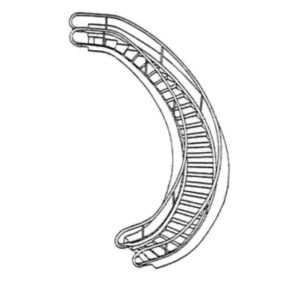
The Appeal Board of Japan Patent Office (JPO) disallowed registration of 3D shape of Mitsubishi Electric’s spiral escalator due to lack of inherent distinctiveness and secondary meaning in relation to escalators, class 7. [Appeal case no. 2017-6855]
Spiral escalator
Mitsubishi Electric Corporation first developed the spiral escalator in 1985, and has been the world’s first and sole manufacturer of spiral escalators. Spiral escalator is a special design type of escalator in the form of a spiral/helical with curved steps.
On May 3, 2016, Mitsubishi Electric filed a trademark application for 3D shape of spiral escalator (see below) by designating escalators in class 7 to the JPO [TM application no. 2016-23374].
The JPO examiner totally refused the application based on Article 3(1)(iii) of the Japan Trademark Law stating that the applied mark can be easily seen as a 3D shape of escalator and the shape does solely consist of a common configuration to achieve the basic function of escalator. If so, the applied mark lacks distinctiveness as a source indicator.
To dispute the refusal, Mitsubishi Electric filed an appeal on May 12, 2017.
Appeal Board’s decision
The Appeal Board, however, upheld the examiner’s decision on the ground and dismissed Mitsubishi’s allegation by stating that relevant consumers and traders shall conceive of an escalator designed to enhance its function or sensuousness at the sight of applied mark.
Acquired distinctiveness
Mitsubishi Electric also argued that even if the applied mark is deemed descriptive in relation to escalators, it shall be registrable based on Article 3(2) due to acquired distinctiveness of the mark because Mitsubishi Electric Spiral Escalators has achieved 100 % market share in the world and continuously used the 3D shape on escalators for more than three decades.
Article 3(2) is a provision to allow registration of applied mark if, as a result of substantial use of the mark in fact, consumers are able to connect the mark with a source indicator of designated goods or services.
Under the totality of the circumstances, the Appeal Board dismissed the allegation as well.
The Board found that regardless of 100 % market share in the category of spiral escalators, Mitsubishi Electric’s domestic supply record of 24 units in the last thirty years shall be a trivial quantity in comparison with total number of escalators in operation. Besides, questionnaire result rather shows a source of the applied mark is unknown to more than 60% of the questionee.
Based on the foregoing, the Board questioned whether applied mark has acquired distinctiveness through actual use in relation to escalators and consequently refused to register the mark based on Article 3(1)(iii) and 3(2) of the Trademark Law.
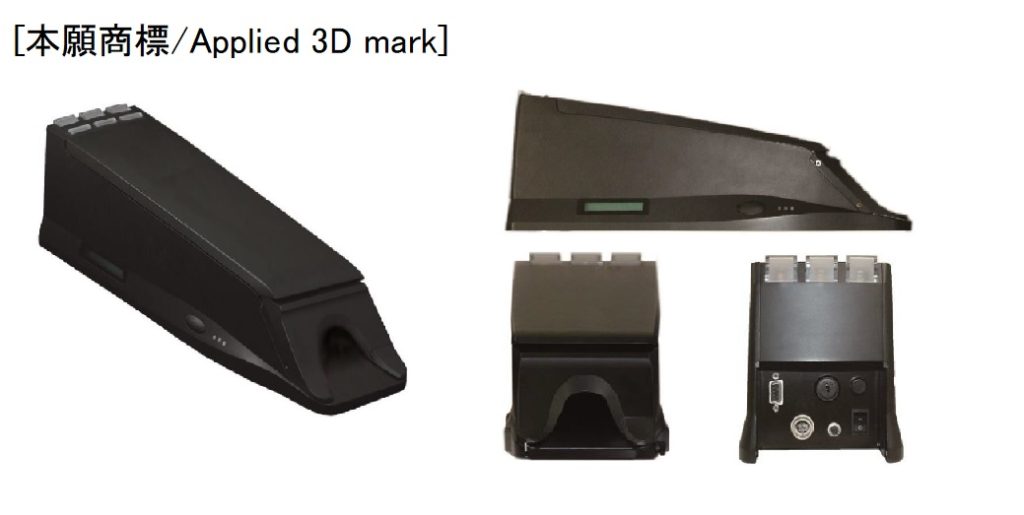
In a lawsuit disputing adequacy of decision by the JPO Appeal Board (Appeal case no. 2015-907) to refuse the applied 3D mark (TM2014-5943, class 28), consisting of a three-dimensional shape of electronic baccarat shoe with the program enabling to reduce the chance of foreign cards and eliminate dealer mistakes, due to lack of distinctiveness and secondary meaning, the IP High Court sustained the decision being appealed.
[Case no. Heisei28(Gyo-ke)10266, Decision date: September 27, 2017]
Inherent distinctiveness of the 3D shape
Plaintiff, a Japanese manufacturer and distributor of the ANGEL EYE electronic baccarat shoe, asserted that the 3D shape of ANGEL EYE, being the first products in the industry, is not an essential shape to make it free for public use since no competitors have dealt with same type of product other than plaintiff so far. Besides, a fact that the 3D shape has been registered in the legal gambling countries, e.g. US, EU, AU, RU, Malaysia and NZ, will rather bolster necessity to allow exclusive right on the shape.
However, the Court opposed to plaintiff. “It is inadequate to allow plaintiff to use the 3D shape exclusively. Applied 3D mark can be perceived objectively as a general shape of electronic baccarat shoe aimed to fulfill its original function and produce aesthetic image. If so, it may disorder a fair marketplace to allow exclusive use to plaintiff just because of a first-to-file. A mere fact of trademark registrations in countries where the ANGEL EYE has been distributed is insufficient to admit trademark registration in our nation since the goods is yet to be distributed in Japan.” Accordingly, the Court refused Applied 3D mark based on Article 3(1)(iii).
Secondary meaning of Applied 3D mark
Plaintiff argued Applied 3D mark has already served to function as a source indicator by means of substantial use of the mark sine 2005. Plaintiff exported 11,481 units (sale proceeds: 2.7 billion yen) over the lase decade and has achieved 90 % market share in Macau, the world’s largest casino gambling hub.
In this respect, the Court ruled in favor of the JPO. As plaintiff admits, the shoe has not been manufactured for domestic use. Any evidence suggesting a high degree of recognition to Applied 3D mark in foreign countries is neither relevant nor persuasive. Unless plaintiff demonstrates that domestic consumers have become aware of such recognition, it is groundless to find Applied 3D mark would satisfy requisite of secondary meaning based on Article 3(2) of the Japan Trademark Law.
The case raises a question: What is a role of the Trademark Law where applied mark, being registered in foreign nations, confronts with an insuperable refusal attributable to legal restrictions on domestic use of the mark? Unsuccessfuldomestic registrationprevents domestic company from utilizing the Madrid Protocol and protecting his/her vital brands on the global market in an effective and economical manner.